Puy-de-Dôme
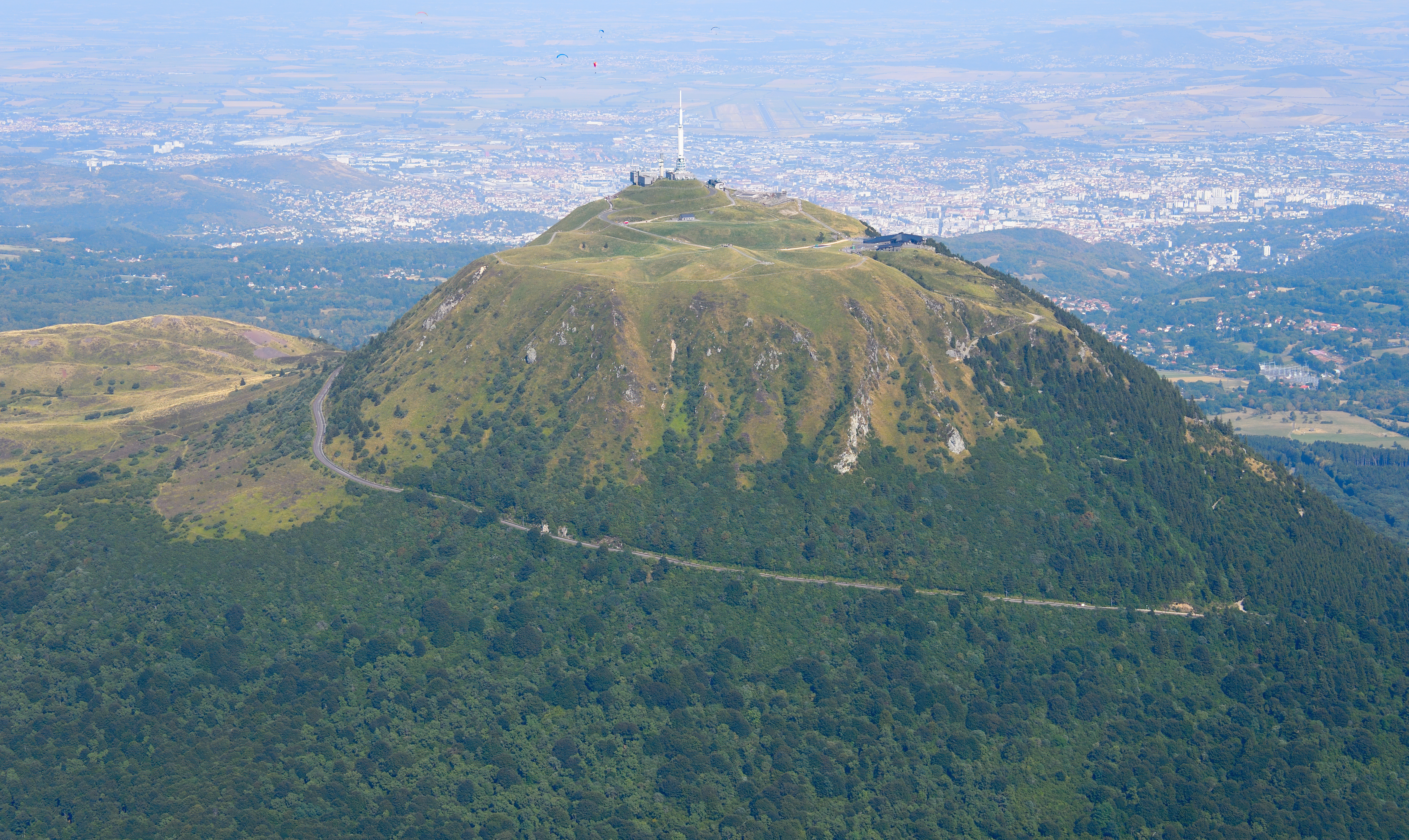
Michelin built its empire here. The tire company that would come to rate the world's restaurants and map its highways started in Clermont-Ferrand, the capital of the Puy-de-Dôme department, where volcanic rock meets industrial ambition in the heart of France's Massif Central. The department takes its name from the great dome-shaped volcano that rises 1,465 meters above sea level, a lava-capped summit that has served as a sacred site, a scientific observatory, and a symbol of Auvergne itself.
Forged in Fire and Steel
Two industries define the Puy-de-Dôme's identity, and both draw on the region's raw materials. Clermont-Ferrand gave the world Michelin, the tire manufacturer whose products roll on roads across every continent. But long before rubber vulcanization, there was steel. The town of Thiers has been the center of French cutlery since the 14th century, its workshops perched above the Durolle River gorge, where water once powered grinding wheels. The combination of metalworking tradition and volcanic geology created a department where industry grew naturally from the landscape rather than being imposed upon it.
A Volcano's Gift
The Puy de Dôme volcano itself, dormant for some 12,000 years, anchors a chain of roughly 80 volcanoes stretching across the Chaîne des Puys. From the summit, the view encompasses a sweeping panorama of cones, craters, and lava flows that earned UNESCO World Heritage status. The volcanic soil yields mineral-rich pastures and distinctive terroir. Lac de Guéry, the highest lake in the Massif Central, fills a valley between ancient volcanic peaks, its surface reflecting a landscape that looks more like Iceland than mainland France. Villages like Saint-Floret, recognized among the most beautiful in the country, nestle into valleys carved by lava and time.
Weekend Republic
The countryside draws Parisians and Lyonnais alike. As of 2019, more than ten percent of usable homes in the department were kept as second homes, a testament to the pull of these green volcanic highlands on urban France. The department is served by Clermont-Ferrand Auvergne Airport, though most domestic travelers arrive by road or the efficient train network. For international connections, Lyon-Saint-Exupéry Airport lies to the east. The Puy-de-Dôme also carries political weight: it was the electoral home of Valéry Giscard d'Estaing, who served as President of the Republic from 1974 to 1981, governing France from a constituency rooted in volcanic soil.
Dark Stone, Deep Roots
Clermont-Ferrand's cathedral, built entirely from black Volvic lava stone, rises above the rooftops like a gothic shadow, its dark silhouette unlike any other cathedral in France. The city itself layers Roman foundations beneath medieval streets beneath a modern university town. Beyond the capital, the department unfolds into a patchwork of spa towns, Romanesque churches, and cheese-producing farms where Saint-Nectaire and Fourme d'Ambert have been made for centuries. This is a landscape that rewards slow travel and patient observation, where every hilltop reveals another volcanic cone and every valley holds another village worth exploring.
From the Air
Located at 45.70°N, 3.22°E in central France. The Puy de Dôme volcano (1,465m) is a prominent landmark visible from altitude. Clermont-Ferrand Auvergne Airport (LFLC) serves the area. The Chaîne des Puys volcanic chain runs north-south and is clearly visible from above. Lyon-Saint-Exupéry Airport (LFLL) is the nearest international hub to the east. Recommend viewing at 5,000-8,000 ft AGL for best appreciation of the volcanic topography.