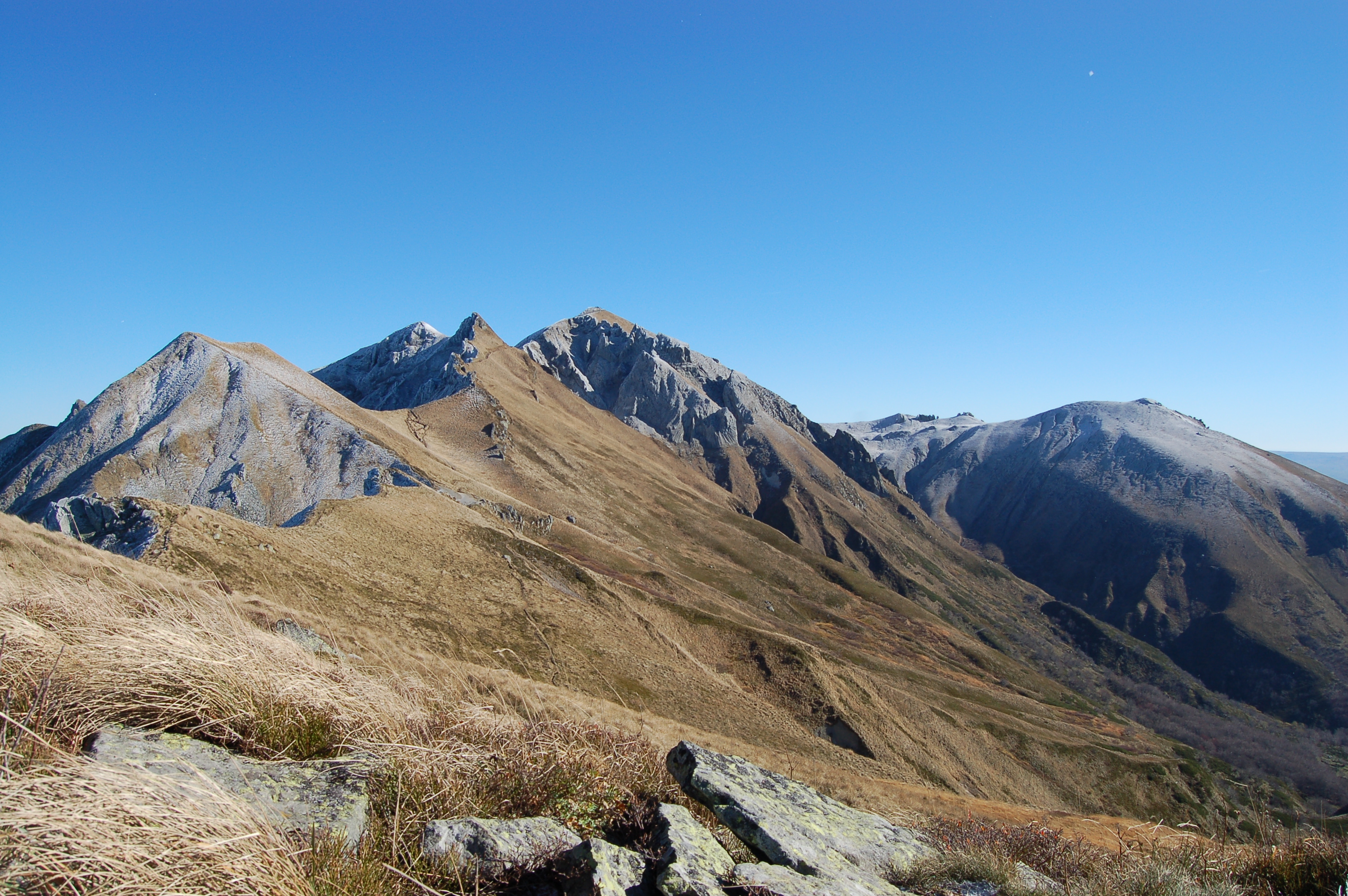
Puy de Sancy
Two streams called the Dore and the Dogne tumble down from opposite sides of a volcanic peak in south-central France, meet in a valley, and become the Dordogne -- a river that will travel 483 kilometers to the Gironde estuary and the Atlantic. The peak they descend from is Puy de Sancy, the highest point in the Massif Central, and it is not what most people picture when they think of volcanoes. There is no cone, no crater, no sulfurous venting. The stratovolcano that built this summit has been inactive for roughly 220,000 years, and what remains is a jagged ridgeline of eroded rock, alpine meadows, and slopes steep enough to have attracted skiers since two local priests strapped on their gear and traversed the mountain in 1905.
The Volcano That Time Forgot
The Massif Central is old volcanic country. The region's puys -- dome-shaped peaks -- are the remnants of eruptions that shaped central France over millions of years, building the highlands that stand between the Paris Basin and the Mediterranean lowlands. Puy de Sancy is the tallest of them all, the summit of an ancient stratovolcano whose eruptions ceased long before humans arrived in Europe. What erosion has left behind is dramatic: steep-sided valleys carved by glaciers, rocky needles that jut above the treeline, and cirques that hold snow well into spring. The peak stands in the Puy-de-Dome department, surrounded by the spa towns and pastoral landscapes that have drawn visitors to the Auvergne for centuries. From the summit, the view extends across the volcanic chain -- a landscape that looks serene from above but was built by forces of extraordinary violence.
Priests on Skis
Skiing came to Puy de Sancy early. In 1905, two local priests traversed the mountain on skis, an unlikely origin story for what would become one of central France's principal winter sports destinations. By 1936, a cable car connected the spa town of Mont-Dore at the mountain's base to one of the rocky needles just below the summit. On Christmas Day 1965, tragedy struck when a cable car on a newer line broke open, killing seven passengers and injuring ten. The accident cast a shadow over the resort but did not stop its growth. Today, the northern and southern slopes host separate ski areas, with Super-Besse on the southwestern face drawing its own crowds. The skiing is not alpine in scale -- the Massif Central lacks the vertical relief of the Alps -- but the terrain is varied and the setting is distinctive, volcanic ridges replacing the limestone walls that define most French resorts.
Where Two Rivers Are Born
The Dordogne's birth is quiet. The Dore flows down the northern face of Puy de Sancy while the Dogne descends from the south, and their confluence in the valley below produces a river that will become one of the most celebrated waterways in France, running through walnut orchards and medieval villages, past limestone cliffs and prehistoric caves, to merge with the Garonne at the Gironde. But at its source, the Dordogne is just a mountain stream, cold and clear, tumbling through the spa town of Mont-Dore before gaining the size and composure that define it downstream. Mont-Dore itself has drawn visitors to its thermal springs since at least the Roman period, the same volcanic geology that built Puy de Sancy heating the groundwater that surfaces in the valley below.
The Heart of the Massif
Puy de Sancy is less famous than Mont Blanc, less dramatic than the Pyrenees, and less visited than the volcanic domes of the Chaine des Puys to the north. But it is the geographic and geological heart of the Massif Central, the point from which France's central highlands fall away in every direction. The peak's isolation -- far from any major city, surrounded by pastureland and forest -- gives it a character quite different from the crowded resorts of the Alps. Hikers reach the summit in summer, skiers in winter, and in every season the wind sweeps across the ridgeline with a force that reminds visitors this was once a volcano, built by pressures that still shape the terrain. Cable cars climb the mountain from Mont-Dore, and the views from the top justify the ride: on clear days, the volcanic chain stretches to the horizon, peak after peak, a landscape that remembers its violent origins even as it presents a face of deep, windswept calm.
From the Air
Located at 45.528N, 2.814E, Puy de Sancy is the highest point in the Massif Central at 1,886 meters (6,188 feet). The peak and surrounding volcanic terrain present significant elevation and potential turbulence -- maintain safe altitude and be aware of rapidly changing mountain weather. The ski areas of Mont-Dore and Super-Besse are visible on the northern and southwestern slopes respectively. Nearest airports include Clermont-Ferrand Auvergne (LFLC) approximately 50 km to the northeast, and Brive-Souillac (LFSL) approximately 120 km to the southwest. The volcanic chain of the Massif Central provides dramatic terrain visible from cruise altitude. Expect orographic clouds and downdrafts near the ridgeline.