Pyle's Massacre
Colonel Henry Lee III was shaking John Pyle's hand when the killing started. It was the afternoon of February 24, 1781, in what is now Alamance County, North Carolina, and Lee's Patriot cavalry had ridden into Pyle's Loyalist camp in full salute, mistaken for Banastre Tarleton's British dragoons thanks to their similar short green jackets and plumed helmets. Lee had played along with the deception, exchanging courtesies with the Loyalist colonel. Then someone at the rear of the column recognized the strips of red cloth on the Loyalists' hats, asked a man which side he was on, heard the answer 'King George,' and brought a sabre down on his head. In ten minutes, 93 Loyalists lay dead and the rest had fled into the Carolina woods. The engagement known as Pyle's Massacre, Pyle's Defeat, or the Battle of Haw River would shatter Loyalist morale across the colony.
The Race to the Dan
The massacre grew from exhaustion. Lord Cornwallis had chased Nathanael Greene's Continental Army across North Carolina in what historians call the Race to the Dan, a grueling pursuit in which Cornwallis burned his own baggage train at Ramsour's Mill near Lincolnton to travel faster. It did not help. Greene used a screening column under Colonel Otho Williams to decoy the British toward Dix's Ferry while the main American force crossed the Dan River at Irwin's and Boyd's ferries. Henry Lee's cavalry crossed last, roughly two hours before the British arrived to find every boat gone. Stranded, Cornwallis marched his starving, freezing men south to Hillsborough, where he set up headquarters on February 21 and issued calls for Loyalist volunteers to rally to the Crown.
A Fatal Resemblance
Dr. John Pyle answered the call, gathering between 300 and 400 men from the countryside. He requested a British escort, and Cornwallis dispatched Tarleton with cavalry and infantry, about 450 men, to guide the Loyalists safely to camp. Meanwhile, Greene had sent Lee and Colonel Andrew Pickens back across the Dan to monitor British movements. On February 24, Lee's men captured two British staff officers and learned that Tarleton was only a few miles ahead. Then fate intervened. Two of Pyle's scouts encountered Lee's Legion and, seeing the green jackets, assumed they were Tarleton's dragoons. Lee seized the advantage. He instructed Pickens' riflemen to flank Pyle's position, then rode into the Loyalist camp as if arriving as the expected escort.
Ten Minutes of Chaos
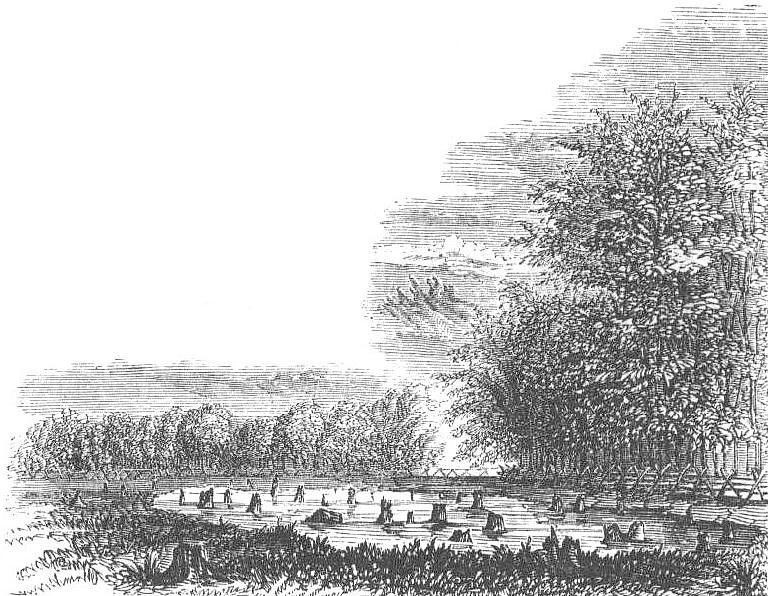
Accounts pieced together from Lee and Captain Joseph Graham suggest the deception was accidental. Lee's original target was Tarleton, the more important objective. The violence erupted at the rear of the column when Captain Eggleston, unfamiliar with local badges of allegiance, questioned a Loyalist and received the wrong answer. Pickens' riflemen joined the attack; the cavalry wheeled and charged. Pyle's men broke and ran, many cut down in the first exchange. Others, believing the assault was a mistake, kept insisting they served King George, to no avail. Local legend holds that Pyle himself was badly wounded and crawled into a nearby pond, hiding until friends could rescue him. After recovering, he surrendered to the local militia and was later pardoned for his care of wounded Patriots.
The Unraveling of Loyalist Hopes
Cornwallis ordered Tarleton to rejoin the main army that night, so Pickens and Lee never caught the British dragoons they had originally been hunting. But the massacre achieved something more lasting than a battlefield victory. Word of Pyle's destruction spread through the Carolina backcountry, and Loyalist recruitment collapsed. Cornwallis reported to Lord Sackville that Pyle's men had been 'inhumanly butchered, when begging for quarters, without making the least resistance.' Lee countered in his memoirs that he had let the survivors flee rather than pursuing them. Whatever the moral reckoning, the strategic effect was clear. Three weeks later, at the Battle of Guilford Courthouse on March 15, 1781, Cornwallis fought with diminished numbers and brittle morale. The site of the massacre, once marked with a stone placed in 1880, has since lost its marker. Only periwinkle and cedar trees still mark the ground where the dead were buried in mass graves.
From the Air
Located at 36.05N, 79.45W in present-day Alamance County, North Carolina, along the Haw River corridor. The battle site is in rolling Piedmont terrain between Hillsborough and the Haw River crossings. Best viewed at 2,000-3,000 feet AGL. Nearest airports: Piedmont Triad International (KGSO) approximately 20nm west, Burlington-Alamance Regional Airport (KBUY) approximately 8nm northeast. The rural landscape retains its agricultural character, with the Haw River visible as a winding tree-lined corridor through the farmland.