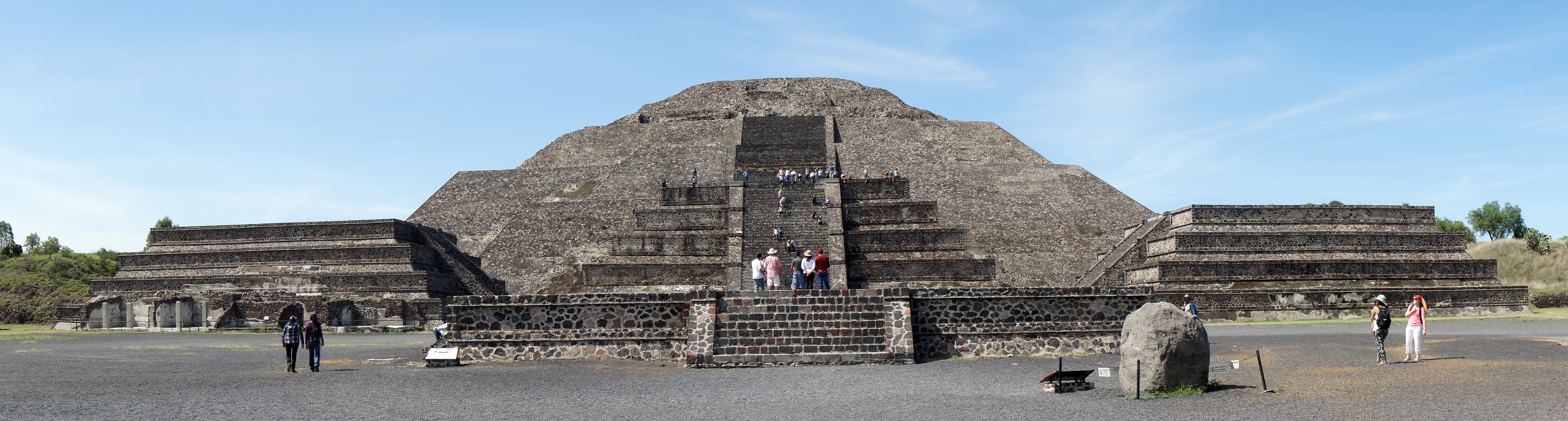
Pyramid of the Moon
Seven buildings lie stacked inside the Pyramid of the Moon, each one sealed over the last like a set of nested stone envelopes. The oldest dates to roughly 100 CE, making it the earliest known monument at Teotihuacan. The newest, completed around 400 CE, is the structure visitors see today -- 43 meters high, positioned at the northern end of the Avenue of the Dead so precisely that it mirrors the silhouette of Cerro Gordo, the mountain rising behind it. The Nahuatl name for that mountain may have been Tenan, meaning "mother or protective stone." The pyramid was built to echo its shape, as if the city's architects wanted their greatest ceremonial platform to appear as an extension of the earth itself.
Layers of Power
Between 100 and 450 CE, successive rulers expanded the Pyramid of the Moon at least six times. Each renovation was not merely architectural -- it was political. The first three buildings were relatively modest platforms built in the talud style, growing from 23.5 meters across to about 29 meters, with no associated burials. Then something changed. Building 4, completed around 250 CE, was a dramatic leap: its base exploded to nearly 89 meters on each side, and for the first time, ritualistic burials appeared within the structure. Archaeologist Saburo Sugiyama has argued that this shift marks a fundamental political and militaristic transformation within Teotihuacan. By Building 7, the final layer, the pyramid spanned 144 meters east to west and had adopted the talud-tablero style that would become Teotihuacan's architectural signature across Mesoamerica.
What the Dead Reveal
In 1998, archaeologists began tunneling beneath the pyramid, and the tombs they found read like dispatches from a civilization determined to consecrate its power in blood. A burial from Building 4 contained a man seated facing west, probably 40 to 50 years old, surrounded by ear flares, beads, obsidian blades, and greenstone figurines. Oxygen and strontium isotope analysis of his bones revealed he was likely not from Teotihuacan -- possibly a war captive, bound before being placed in the grave. Another tomb, from the fifth construction phase, held four human skeletons alongside the bones of wolves, jaguars, pumas, serpents, and birds, plus more than 400 relics including ceremonial knives and spear points. The figurines in one burial were arranged with obsidian blades pointing at their heads, a deliberate staging whose meaning scholars are still debating.
The Great Goddess and Her Plaza
A platform atop the pyramid once served as the stage for ceremonies honoring the Great Goddess of Teotihuacan -- the deity of water, fertility, earth, and creation itself. The Aztecs, arriving centuries after the city's collapse, reported that a massive stone figure related to the moon had once crowned the summit. When archaeologists uncovered it, the figure weighed 22 metric tons, raising an unanswered question: how did the builders lift it to the top? Opposite the pyramid lies the Plaza of the Moon, which contained a central altar and a geometric construction known as the "Teotihuacan Cross" -- four rectangular and diagonal bodies that formed a pattern central to the city's cosmological design. The plaza was far more than ceremonial space. It served as a center for astronomical observation, calendar-related activities, and political gatherings, functioning as the social and spiritual heart of a metropolis that may have held 125,000 people at its peak.
Obsidian, Eagles, and Storm Gods
The artifacts entombed in the pyramid paint a picture of a civilization whose trade networks and ritual vocabulary were vast. Greenstone and obsidian -- the latter Teotihuacan's most prized commodity -- were crafted into figurines, serpent-shaped knives, and ceremonial blades. Storm god vessels appeared at the corners of burial pits, suggesting weather deities were invoked alongside the Great Goddess. Animal sacrifices accompanied the human ones: pumas, eagles, falcons, owls, rattlesnakes, and even mollusks were placed in the tombs. One burial included a rare greenstone figure depicting a female, significant because most figurines from the site are male or gender-neutral. Scholars believe this figure may represent the goddess to whom the entire ritual complex was dedicated. Each layer of the pyramid, each tomb, each carefully positioned offering adds another sentence to a story written by people who left no written language -- only stone, bone, and obsidian.
From the Air
Located at 19.70N, 98.84W in the Teotihuacan archaeological zone, approximately 40 km northeast of Mexico City. The pyramid stands at the northern terminus of the Avenue of the Dead, with the larger Pyramid of the Sun visible to its southeast. The site sits in the Valley of Mexico at roughly 2,300 meters elevation. Nearest major airport is Mexico City International (ICAO: MMMX). The archaeological complex is clearly visible from altitude as geometric forms against the surrounding agricultural landscape.