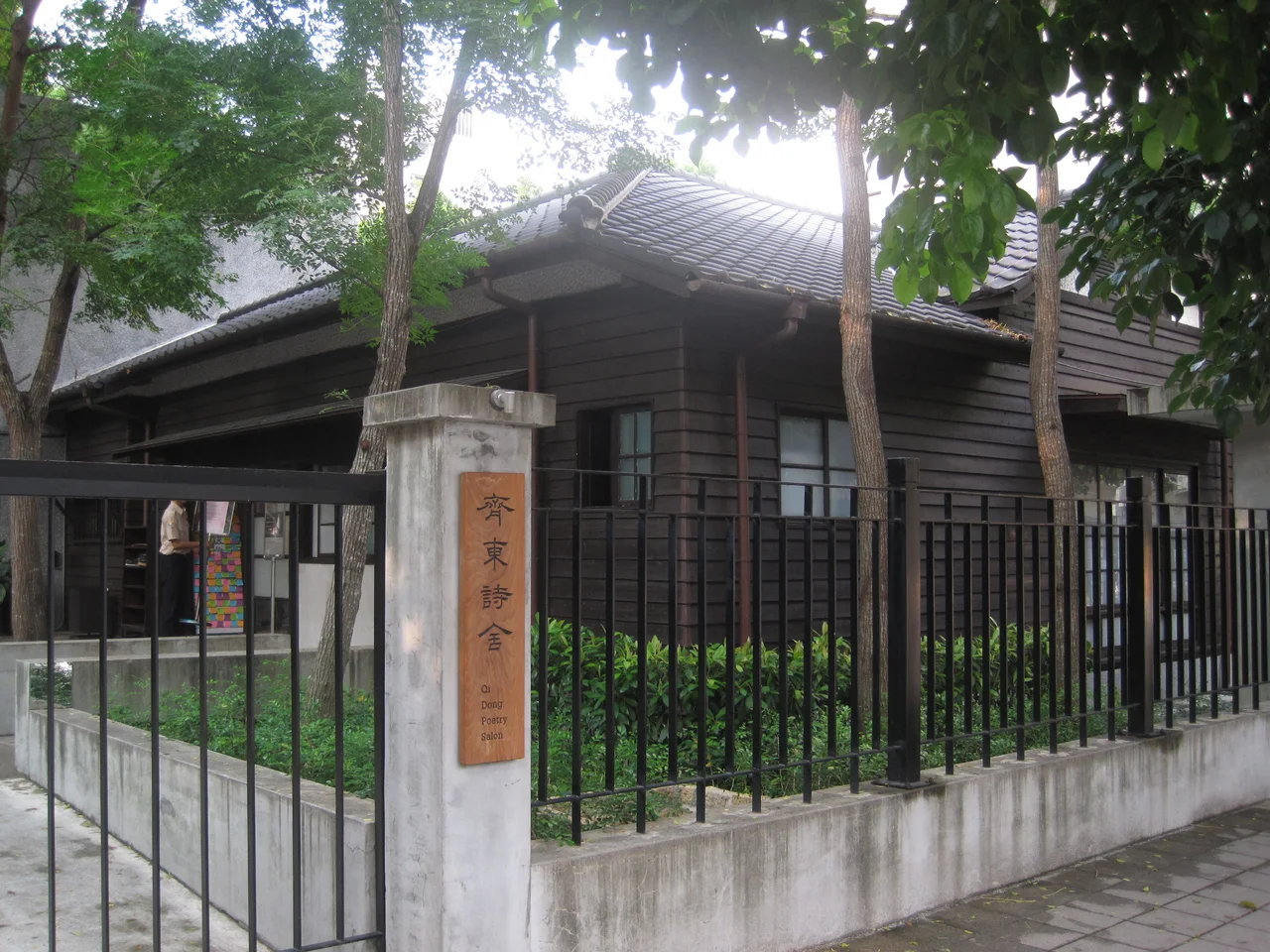

Qidong Street Japanese Houses
Long before it was a street of writers, Qidong Street was a road for rice. During the Qing Dynasty, it served as a primary lane carrying grain from the Taipei basin to river harbors, threading through what would become one of Taiwan's most densely layered neighborhoods. The construction of the Taipei City Walls in 1884 reorganized the urban geography around it, but the street itself persisted — connecting the old Bangkah district (today's Wanhua) eastward past the East Gate toward Songshan, Nangang, and eventually Keelung. When Japan took control of Taiwan in 1895 and began remaking Taihoku into an imperial city, Qidong Street was absorbed into a new order. The low wooden houses that replaced the old lane traffic are still there.
Wood and Tile: Architecture That Survived
The houses belong to what was known during Japanese rule as the Saiwaichō civil servant housing group — in Chinese characters, 幸町職務官舍群. Most date from the 1920s to the 1940s, and most are still standing in something close to their original configuration, which is genuinely unusual. Taiwan has lost the vast majority of its Japanese-era wooden structures to redevelopment; preservationists estimate that roughly 2,000 remain citywide, with some 4,000 trees still growing in their surrounding gardens.
The houses follow the conventions of Japanese residential architecture: low-pitched roofs, wooden verandas, interior spaces organized around the logic of tatami rooms, modest gardens pressed against the property line. The house at No. 11, Lane 53 — now operating as the Taipei Qin Hall — is the most intact of the cluster, retaining its original porch, doors, and interior layout, as well as a sculptured garden that has been tended since the colonial period. Walking through, you encounter the sensory grammar of a building that has aged on its own terms: uneven floors, wooden columns darkened by time, light filtered through paper screens.
Three Eras, One Street
The layering is what makes Qidong Street remarkable as a historical object. Under Qing administration, it was a working lane for agricultural trade. Under Japanese rule, it became residential — first for Japanese civil servants, then expanding into a broader housing complex. After Japan's surrender in 1945 and Taiwan's handover to the Republic of China, the dormitories changed hands again: the Bank of Taiwan took over the complex and converted the houses into residences for its senior executives.
For decades the buildings sat quietly in that role — not quite public, not quite preserved, gradually accumulating the patina of middle-class postwar Taipei. City officials eventually recognized the historical value of the cluster, and a campaign to save and rehabilitate the structures succeeded. The overall layout — the relationship between the buildings, the lanes between them, the gardens — remains largely complete, which preservationists note is rare. Most comparable complexes elsewhere in Taipei have been partly demolished or so heavily modified that their original character is difficult to read.
A Home for Taiwan's Writers
Since 2014, the complex has housed the Taiwan Literature Base, affiliated with the National Museum of Taiwan Literature. The pairing is apt. These were dormitories built for colonial administrators, but the literature they now shelter is distinctly Taiwanese — work produced in multiple languages, shaped by decades of political pressure, martial law, and the gradual emergence of a self-defined Taiwanese literary identity.
The centerpiece of the Literature Base's programming is its writers-in-residence program, launched in 2021, which invites authors from Taiwan and abroad to live and work on-site for residencies ranging from one to four weeks. The experience is deliberately immersive: residents inhabit actual Japanese-era dormitory rooms, work within the historic compound, and engage in public programming designed to bring readers inside the creative process. Writers who have participated include novelist Hung Shih-ting. The effect is to animate buildings that might otherwise exist only as artifacts — giving the old wood and tile a function it never had before.
What Endurance Looks Like
There is something instructive about the fact that these houses survived at all. Taipei has been remade repeatedly — by the Japanese, by postwar reconstruction, by the economic booms of the 1970s and 1980s that replaced old neighborhoods with towers. The Qidong cluster endured partly by being residential rather than commercial, partly by landing in the hands of the Bank of Taiwan, and partly by the efforts of advocates who recognized, before it was too late, that intact Japanese-era neighborhoods were becoming very rare.
Today, the compound sits within walking distance west of Zhongxiao Xinsheng Station — accessible, unhurried, easy to miss if you're not looking. The best approach is on foot, through the residential streets of Zhongzheng District, where the wooden eaves of the houses emerge between concrete buildings as a reminder that the city has not always looked the way it looks now.
From the Air
The Qidong Street Japanese Houses cluster is at approximately 25.041°N, 121.528°E in Zhongzheng District, central Taipei. At 2,000–3,000 feet, the area appears as a zone of lower-profile wooden-roofed structures set among mid-rise residential buildings, southeast of the Presidential Office and near the Zhongxiao Xinsheng intersection. Taipei Songshan Airport (RCSS) is roughly 6 kilometers to the northeast; Taiwan Taoyuan International (RCTP) lies about 35 kilometers west. The compound is near the Aihe (Love River canal) corridor and easily identified on low approaches by the distinctive garden-and-lane pattern of Japanese residential planning.
Nearby Stories
- Dapu Incident 9.3 km away
- Shuanglianpi Wetland 18 km away
- Toufen 41 km away
- North Jiangsu Main Irrigation Canal 980 km away
- General Cliff Rock Paintings 1050 km away
- Sinking of MV Sewol 1061 km away
- Yellow Sea 1111 km away
- Twin Forts of Romblon 1358 km away