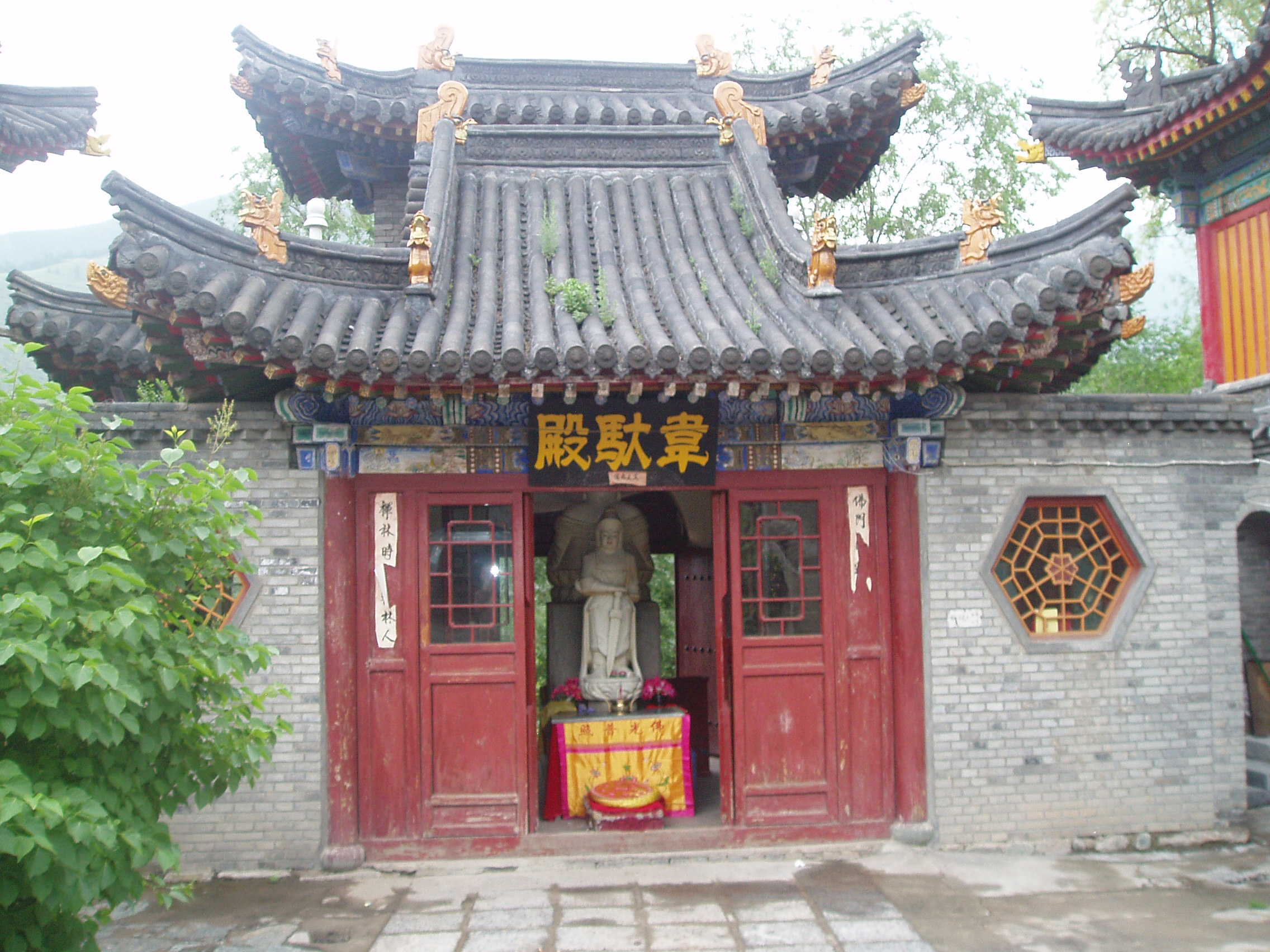
Qifo Temple
Seven jade statues of the Buddha glow faintly in the Qifo Hall, each one carved from stone brought from Myanmar. Seven is not a casual number here. Qifo means Seven Buddhas, and the temple is dedicated to all seven Buddhas recognized in Theravada tradition -- not just the historical Shakyamuni, but his six predecessors across cosmic ages stretching back beyond human reckoning. The concept collapses time: in this hall, the past and present Buddhas stand together as though the eons between them were nothing.
From Song Dynasty to Ruin
Qifo Temple was first constructed during the Northern Song dynasty (960-1127), making it one of the younger temples in the Mount Wutai complex by local standards. It was rebuilt in 1466 during the Chenghua period of the Ming dynasty, and again in 1734 during the Yongzheng period of the Qing dynasty. That 1734 renovation also marked a theological shift: the temple converted from Chinese to Tibetan Buddhism, joining a wave of conversions that the Qing emperors encouraged across Mount Wutai to cement political alliances with Mongolia and Tibet. But the Cultural Revolution (1966-1976) cared nothing for either tradition. Qifo Temple was completely destroyed, reduced to rubble and memory.
Resurrection by Two Monks
In 1991, two monks named Zhengti and Bentong began the work of rebuilding Qifo Temple from nothing. Over the following years, they oversaw the construction of a Mahavira Hall, a Hall of Four Heavenly Kings, the Qifo Hall itself, a Three Saints Hall, a Hall of the Guru, a Hall of Manjushri, and a Buddhist Texts Hall. The seven jade Buddha statues were brought from Myanmar, connecting this remote Shanxi temple to Southeast Asian Buddhist networks. The Three Saints Hall followed the traditional Huayan arrangement: Sakyamuni at the center, Manjushri to the left, Samantabhadra to the right -- the same configuration found in dozens of Mount Wutai's temples, a visual shorthand for the unity of wisdom, compassion, and practice.
The Mountain's Tallest Marble Tower
The Qifo Tower stands 22 meters high, built entirely of white marble, making it the tallest white marble structure on Mount Wutai. Hexagonal in plan with seven stories, the tower is composed of a pagoda base, a sumeru throne, and a dense-eaved body carved with lotuses, flowers, and grasses. But the carvings that matter most are the Buddha statues in the niches on each story. Reading from top to bottom, they depict the seven Buddhas of the past: Vipashyin, Shikhin, Vishvabhu, Krakucchanda, Kanakamuni, Kashyapa, and Shakyamuni. Each figure represents a different cosmic age, and their vertical arrangement -- ascending from the historical Buddha at the bottom to the most ancient at the top -- creates a timeline carved in stone, inviting the viewer to contemplate the vast expanse of Buddhist cosmological time.
From the Air
Located at 39.02N, 113.61E on Mount Wutai in Taihuai Town, Shanxi Province, China. The 22-meter white marble Qifo Tower is a distinguishing feature of this temple from the air. Elevation approximately 1,700 meters. Nearest airports: Wutai Mountain Airport (ZBWT) at roughly 50 km and Taiyuan Wusu International Airport (ZBYN) approximately 230 km southwest. Recommend 3,000-5,000 feet AGL for viewing the temple and its distinctive marble tower.