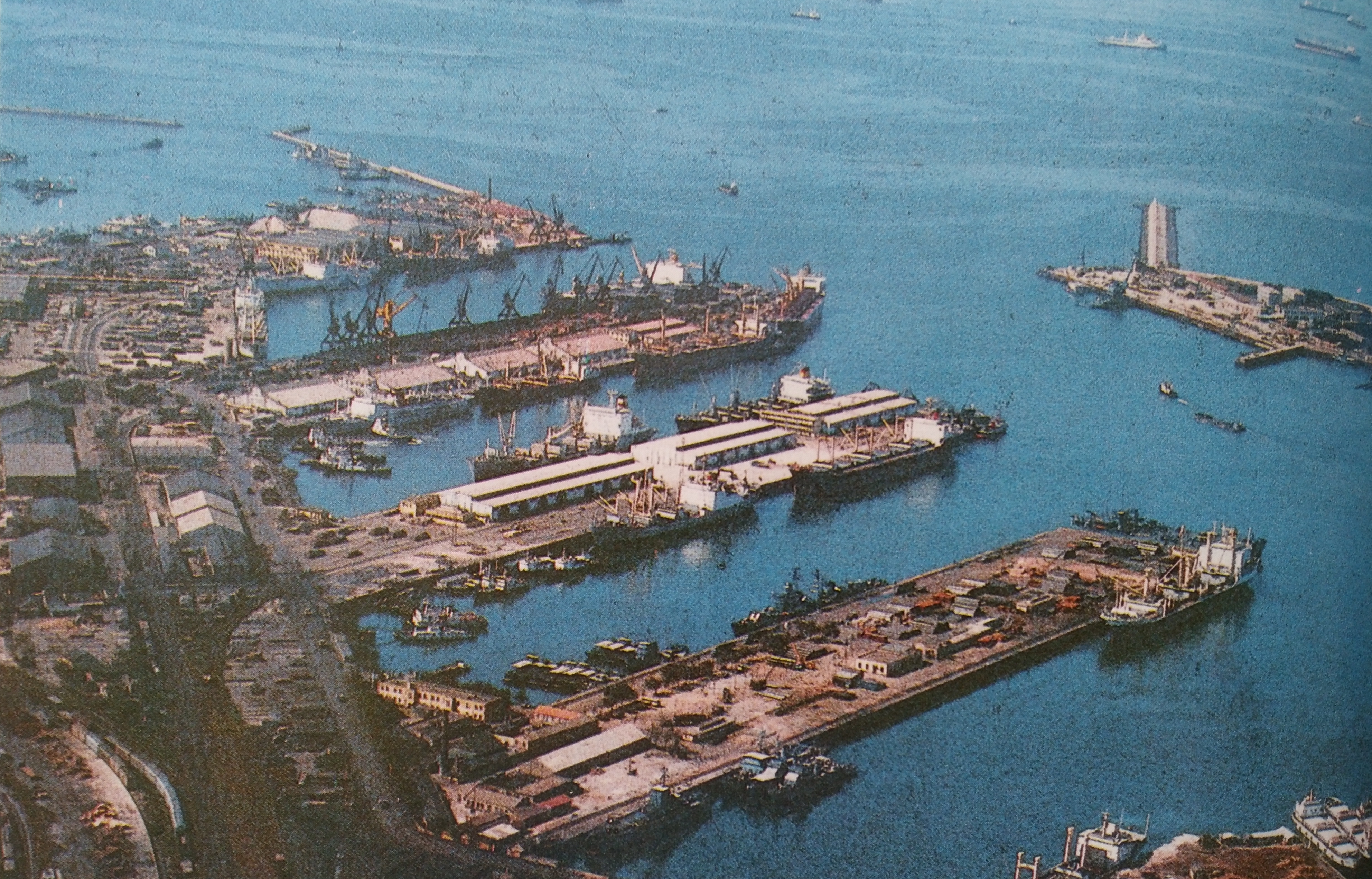
Qingdao Port
In 2019, the Port of Qingdao ranked seventh among the world's busiest container ports by total cargo volume. That single statistic, impressive as it is, only hints at the scale of the operation spread across the Yellow Sea coastline of Shandong Province. The port is not one facility but four: Dagang, the historic harbor in central Qingdao; Qianwan, the massive container terminal; Huangdong, dedicated to oil tankers; and Dongjiakou, a newer complex 40 kilometers to the south. Together they handle iron ore, crude oil, and containers in quantities that would have astonished the German naval officers who built Qingdao's first modern harbor in the 1890s to service a handful of warships.
From Colonial Harbor to Global Hub
Qingdao's port history began with Germany's lease of Jiaozhou Bay in 1898, when the Imperial Navy constructed a harbor to support its East Asia Squadron. What was once a colonial naval facility has become one of China's most important commercial gateways. The Qingdao Qianwan Container Terminal and the Qingdao Cosport International Container Terminal together form one of the largest container-handling operations on the Yellow Sea. In addition to containers, the port operates a large iron ore terminal that feeds China's steel industry. The transformation from military harbor to commercial megaport parallels Qingdao's own evolution from a fishing village seized by colonial powers into a city of ten million people.
The New Silk Road Crosses Here
Qingdao Port is a key node on the 21st Century Maritime Silk Road, China's ambitious trade corridor that traces a route from the Chinese coast to Singapore, around the southern tip of India to Mombasa, through the Red Sea and Suez Canal to the Mediterranean, and onward to the Adriatic port of Trieste, with connections to Central Europe and the North Sea. In 2011, the port formalized its regional ambitions by signing a strategic alliance with three other Shandong ports -- Yantai, Rizhao, and Weihai -- and South Korea's Port of Busan, aiming to create a shipping and logistics center for Northeast Asia. The port's position at the intersection of domestic rail networks and international shipping lanes makes it a natural hub for the kind of overland-to-maritime cargo transfer that the Silk Road concept envisions.
Containers in the Sky
In 2020, the Port of Qingdao began constructing something never before attempted: a suspended monorail capable of carrying fully loaded 20-foot and 40-foot shipping containers. The first phase went into operation in 2021, making it the world's first such system. The monorail moves containers above ground level, freeing port surface area for other operations and reducing the congestion that plagues conventional truck-based container transfer systems. It is the kind of engineering ambition that the port's German founders would have understood, if not imagined. They built Qingdao's first harbor to project naval power; their successors have built a port that projects economic power on a scale the German Empire could never have achieved. Qingdao Port International went public in Hong Kong in 2014, seeking to raise $377 million -- a figure that represents a fraction of the cargo value that passes through its terminals in any given year.
From the Air
Located at 36.083N, 120.317E on the Yellow Sea in Qingdao, Shandong Province. The port's four areas (Dagang, Qianwan, Huangdong, Dongjiakou) span a considerable stretch of coastline. Container cranes, ship traffic, and the Jiaozhou Bay Bridge are prominent landmarks from altitude. Nearest airport is Qingdao Jiaodong International Airport (ZSQD). Port operations are visible from 5,000-10,000 feet, with container yard patterns and vessel movements clearly distinguishable.