Qingzhou
The construction cranes outnumber the foreign tourists a hundredfold. That single detail tells you everything about Qingzhou, a city of nearly a million people in central Shandong Province that most of the outside world has never heard of. Yet four kilometers southwest of the city center, carved into the slopes of Yunmen Shan -- Cloud Gate Mountain -- an ancient collection of Buddhist grottoes sits under national protection, a reminder that this place was drawing pilgrims long before it started drawing developers.
Mountains That Look Like Paintings
Qingzhou is famous within China for being surrounded by mountains that look the way mountains are supposed to look in Chinese landscape paintings. Tuo Shan, Camel Mountain, humps against the skyline. Yunmen Shan rises through mist and cloud in a way that feels almost performed, its Buddhist grottoes tucked into the rock face like secrets kept in plain sight. Hiking the surrounding peaks is straightforward on most ridgelines, though Yunmen Shan itself is fenced in, requiring a bit of creative route-finding or a ticket. The views from the upper ridges reveal the scale of the plain below, the city's wide boulevards radiating outward in a grid that manages to avoid the congestion that plagues most Chinese cities of comparable size.
Song Dynasty Facades and Back-Alley Feasts
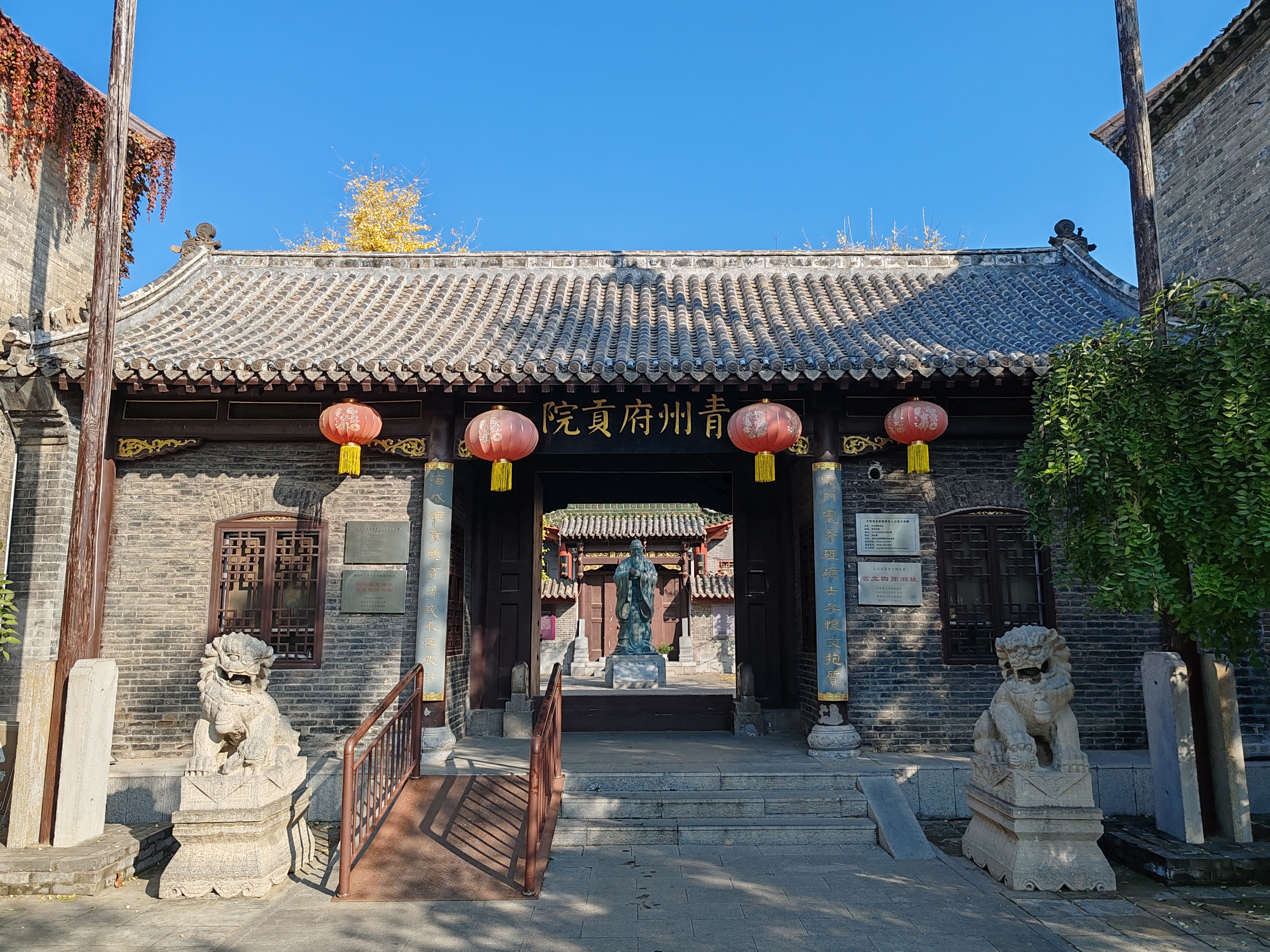
Just north of the river crossing in central Qingzhou, a newly built tourist district replicates traditional Chinese architecture. Locals call it Song Cheng Road, and it offers the kind of clean, curated experience that Chinese domestic tourism prizes: upscale restaurants, proper storefronts, a sense of order. The real eating, though, happens elsewhere. Walk west along Qianyinzi Road from the Days Hotel, duck into one of the alleys about 200 meters down -- the lights will guide you -- and you will find yourself in what looks like someone's living room. Sit on chairs smaller than a six-pack and order the surprisingly delicious goose feet. Qingzhou's local specialties include honey three-knives, a traditional pastry that is crispy on the outside and sweet through the middle, and Qingzhou peaches, round and juicy, available in early, medium, and late ripening varieties through the growing season.
A City Meant for Its Own People
Menus are not in English. Hotel staff do not speak it, though they try hard and are friendly about the attempt. The green-and-gold Hyundai Elantra taxis will take you anywhere in the city for less than twenty yuan, and bus K1 runs a circular loop along the two main roads. Qingzhou sits in the warm temperate monsoon climate zone of the central Shandong Peninsula, with an average annual temperature of 13.6 degrees Celsius and an average rainfall of 672 millimeters, concentrated in summer. The hot, humid summers and cold, dry winters give the city four genuinely distinct seasons. The Qingzhou Museum houses artifacts spanning the region's long history, and the People's Market area at the crossing of Yao Wang Shan West Road and Yunmen Shan North Road serves as the commercial heart, ringed by shopping malls and fast food joints.
Where the Kite Capital Meets Cloud Gate
Qingzhou occupies a peculiar position in Chinese geography. It is close enough to Weifang, the self-proclaimed World Capital of Kites, to share its Shandong Peninsula identity, yet distinct enough to feel like its own world. The city is developing fast, its infrastructure modern and well-built, its ambitions clear in every new boulevard and housing block. But the Buddhist grottoes on Yunmen Shan predate all of it by centuries. The tension between ancient stone and fresh concrete defines Qingzhou more than any single landmark could. This is a city that has not yet been discovered by the wider world, and it does not seem to mind.
From the Air
Located at 36.70N, 118.48E in central Shandong Province. The mountains surrounding the city, including Yunmen Shan (Cloud Gate Mountain), are visible from altitude as green peaks breaking the flat agricultural plain. Nearest major airport: Weifang Nanyuan Airport (ZSWY). Jinan Yaoqiang International (ZSJN) approximately 150 km northwest. Best viewed at 3,000-5,000 ft for mountain detail.