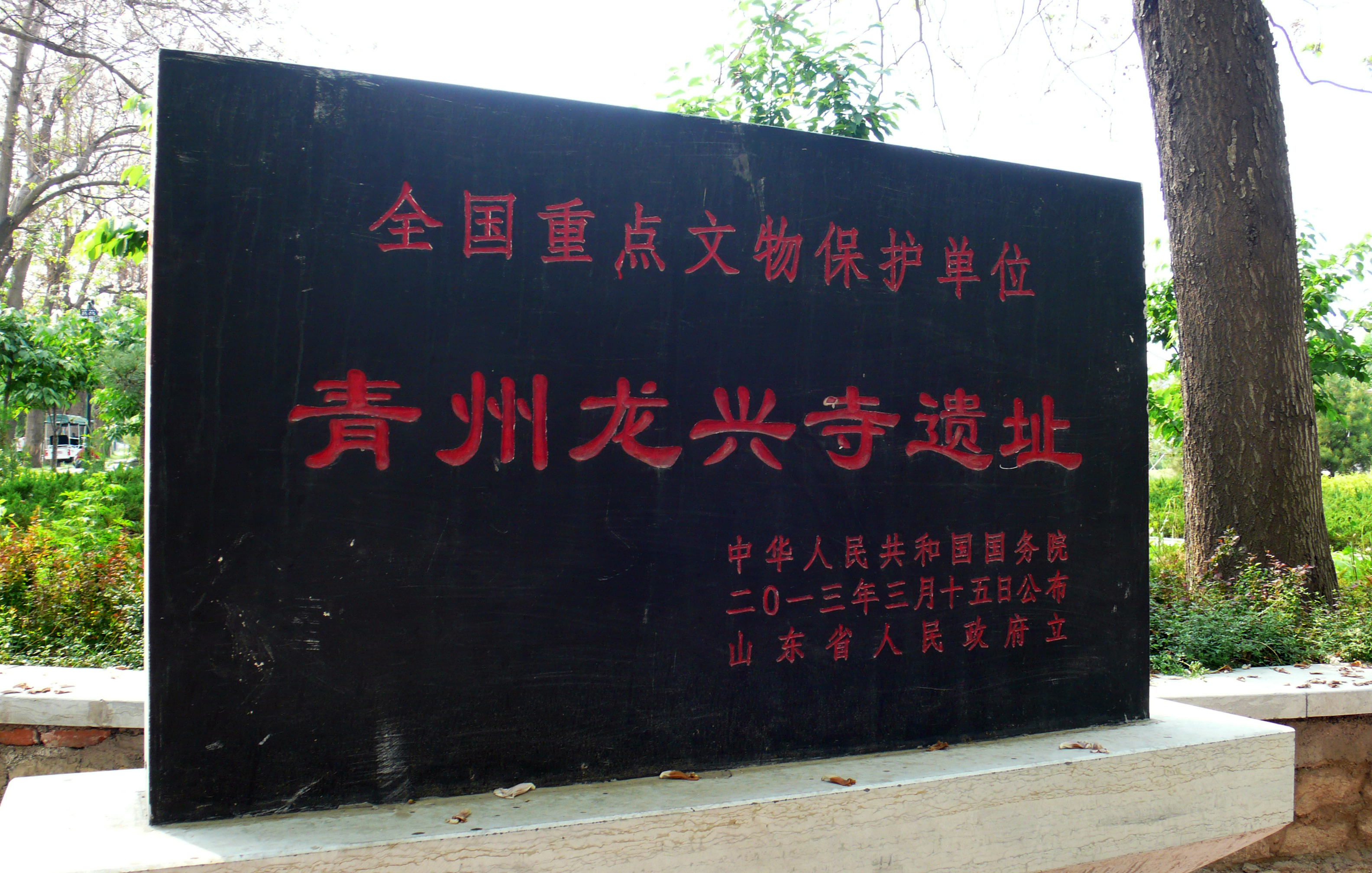
Qingzhou Longxing Temple
In 1996, workers refurbishing a school sports field in Qingzhou, Shandong Province, struck a stone oil lamp. What followed was one of the most remarkable archaeological discoveries in modern Chinese history: beneath the playing field lay the remains of the Longxing Temple, a Buddhist sanctuary built during the Northern and Southern dynasties -- a period spanning roughly the 5th and 6th centuries CE -- and destroyed some 800 years later. Excavation revealed more than 400 Buddhist statues, many retaining traces of their original paint and gilt. The find was subsequently named one of China's 100 major archaeological discoveries of the 20th century.
The Hoard Beneath the Field
The statues had been deliberately buried. Whether they were hidden to protect them from iconoclasm during one of China's periodic campaigns against Buddhism, or interred as part of a ritual practice, remains debated. What is clear is that whoever placed them underground did so with care. The figures represent a range of Buddhist iconography: standing bodhisattvas, seated Buddhas, celestial figures in high relief, many with elaborate painted surfaces showing pigments that survived centuries underground. Some statues bear traces of gold leaf applied over painted surfaces, a technique that required extraordinary skill and expense. The condition of the paint -- reds, blues, greens, and golds still visible after more than a millennium -- made the Qingzhou hoard internationally significant.
Between Dynasties
The Northern and Southern dynasties era, when the Longxing Temple was built, was one of the most artistically productive periods in Chinese Buddhist history. China was politically fragmented, divided between northern kingdoms ruled by non-Han peoples and southern courts that maintained the traditions of the fallen Jin dynasty. Buddhism flourished in both halves, but the sculptural styles diverged. Northern Buddhist art shows influences from Central Asian and Gandharan traditions -- the faces are rounder, the drapery more voluminous, the poses more frontal. The Qingzhou statues occupy a middle ground, blending northern monumental scale with southern elegance, their thin robes clinging to elongated bodies in a style that art historians recognize as distinctly Shandong.
From Qingzhou to Shenzhen
The statues were primarily placed in the collection of the Shenzhen Museum, more than 1,800 kilometers from where they were found. This decision reflected the realities of Chinese museum infrastructure in the 1990s -- Shenzhen, a special economic zone experiencing explosive growth, was building cultural institutions at a pace that older cities could not match. The relocation has been controversial among those who believe archaeological finds should remain near their sites of origin, but it has also given the Qingzhou statues a global audience. They have been exhibited internationally, drawing attention to a period of Chinese art that is less well known than the Tang dynasty masterpieces that followed. Beneath the school sports field in Qingzhou, the excavated pit remains marked by a sign -- an unlikely memorial to a temple that existed for eight centuries, was buried for another six, and was found because someone wanted to repave an athletic track.
From the Air
The Qingzhou Longxing Temple archaeological site is located at approximately 36.684N, 118.457E in Qingzhou, Shandong Province. The area is inland, about 200 km west of Qingdao. The nearest significant airport is ZSQD (Qingdao Jiaodong International Airport) or ZSJN (Jinan Yaoqiang International Airport). The site is within the modern urban area of Qingzhou and is not visually distinctive from altitude.