Qirqqiz Fortress
Nobody agrees on what Qirqqiz Fortress was built for. Archaeologists have called it a palace, a caravanserai, a Sufi khanqah, a military outpost, and -- most intriguingly -- the first Islamic academy for girls. The name itself offers the strongest clue: Qirqqiz, from the Uzbek for "forty girls." According to folk epics from the region, when the Samanid dynasty began to fracture and succession struggles intensified, a fortress was raised near the ancient city of Termez. Its first students, the stories say, were the forty most talented young women in the country.
A Building That Defies Classification
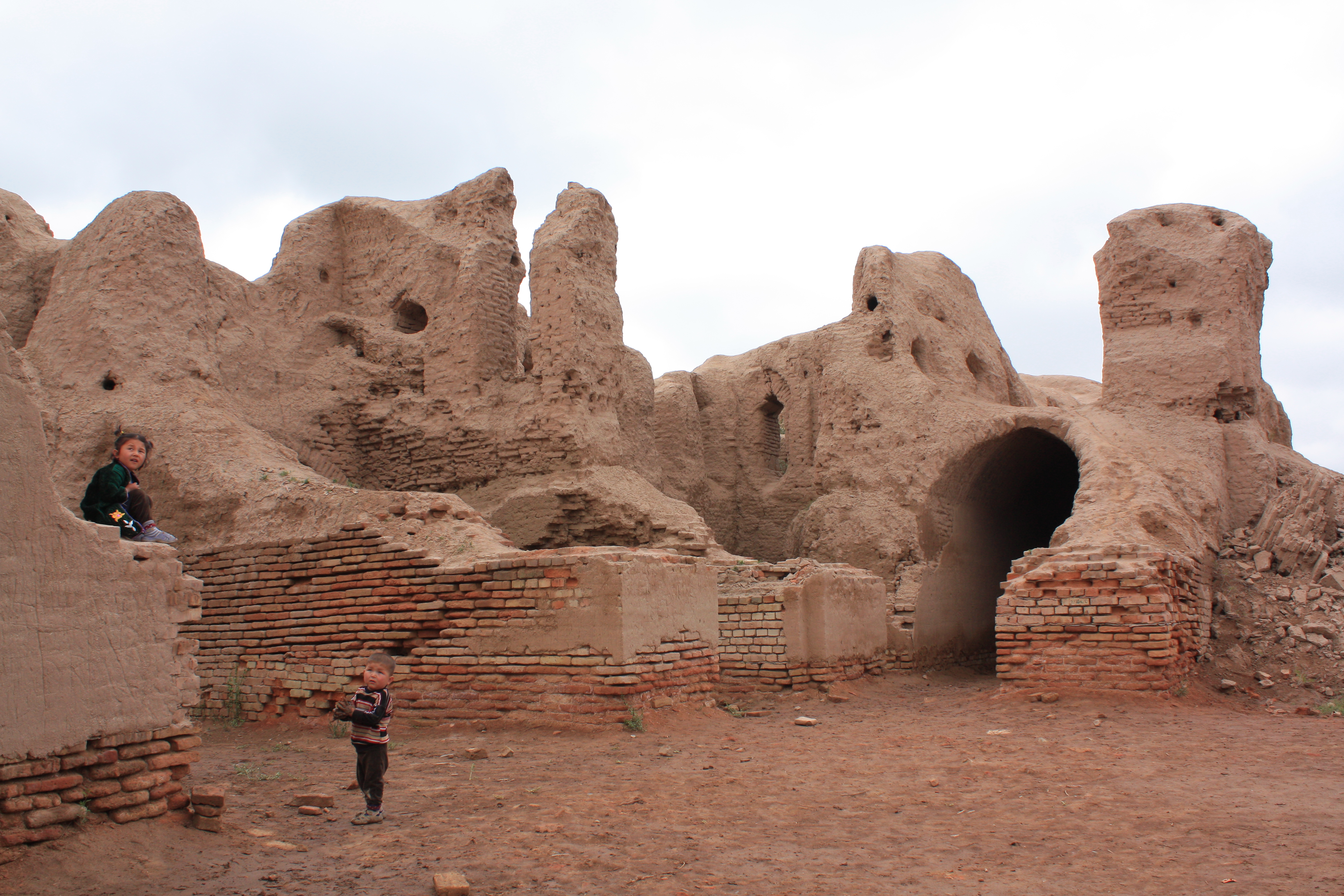
The fortress sits in the Surxondaryo region of southern Uzbekistan, preserved in a state of ruin in Termiz District. Built by the Samanids in the 9th century, its construction drew master craftsmen from Iran and India. The rectangular structure measures roughly 53 by 55 meters and originally contained 54 rooms arranged around a central courtyard of about 11.5 meters square. Thick mud-brick walls, 2 to 2.5 meters deep, surround the exterior, reinforced at the corners by massive towers. Domed porches stand between the towers, their niches decorated in repeating geometric patterns. Corridors connect every room to the central hall, which may itself have been capped by a dome. A second story once rose above it all, but the Mongol invasion of the 12th and 13th centuries brought it crashing down.
Forty Girls and a Lost Curriculum
The folk tradition is specific: the fortress was a school for science and art, and the forty girls who studied there were chosen for their intelligence and talent. Whether this oral history reflects actual practice is impossible to confirm, but the building's design supports an educational function. Classrooms, a bathhouse, and toilets have been identified within the ruins. Water entered through a canal system. The rooms are lit through wall niches rather than large windows, creating an introverted space focused on study rather than display. If the tradition holds any truth, Qirqqiz represents something remarkable -- a formal institution for women's education in the Islamic world more than a thousand years ago, centuries before such institutions became common anywhere.
A Century of Competing Theories
Archaeologists have been arguing about Qirqqiz since 1926, when an expedition from the Museum of Oriental Culture first studied the site. V. Zgura described it as a small palace or an outlying fortress, comparing it to a structure built by Harun al-Rashid near the Froth River. In 1927, B.N. Zasipkin excavated the central area and identified a destroyed dome, dating the monument to the pre-Mongol period and calling it a khanqah. By 1936, M.Y. Masson's expedition pushed the date back to the 6th or 7th century. G.A. Pugachenkova argued for a remote palace. In 1940, B.V. Veymarn called it a caravanserai. Excavations in 1983 by Z. Hakimov uncovered evidence of a major fire, with coins dating from the 12th to 15th centuries found in the ashes. Most recently, Termez archaeologist T.J. Annayev's 2016 research suggested the building was constructed in the 14th or 15th centuries -- contradicting earlier estimates by half a millennium.
Mud Brick and Memory
What survives today is a skeleton of mud brick and fired brick, its arches and vaults still showing the skill of craftsmen who traveled hundreds of miles to build it. The fortress was rebuilt several times between the 9th and 15th centuries, which partly explains the confusion over its dating. Each layer of construction represents a different era's needs -- defense, scholarship, trade, worship. The building sits outside the medieval boundaries of Termez, which suggests it served as either an outpost or a retreat, separated from the city's daily commerce. From the air, the rectangular footprint is clearly legible against the dry landscape of the Surxondaryo plain, a geometric assertion of human purpose in a terrain that otherwise belongs to dust and distance.
From the Air
Qirqqiz Fortress is located at 37.27N, 67.29E, near the modern city of Termez in southern Uzbekistan. The rectangular ruin is visible from moderate altitudes against the flat Surxondaryo plain. Nearest airport: Termez Airport (UTST), approximately 10 km northeast. The site is close to the Afghan border; be aware of restricted airspace in the area. Best viewed in morning light when shadows accentuate the remaining walls and tower foundations.