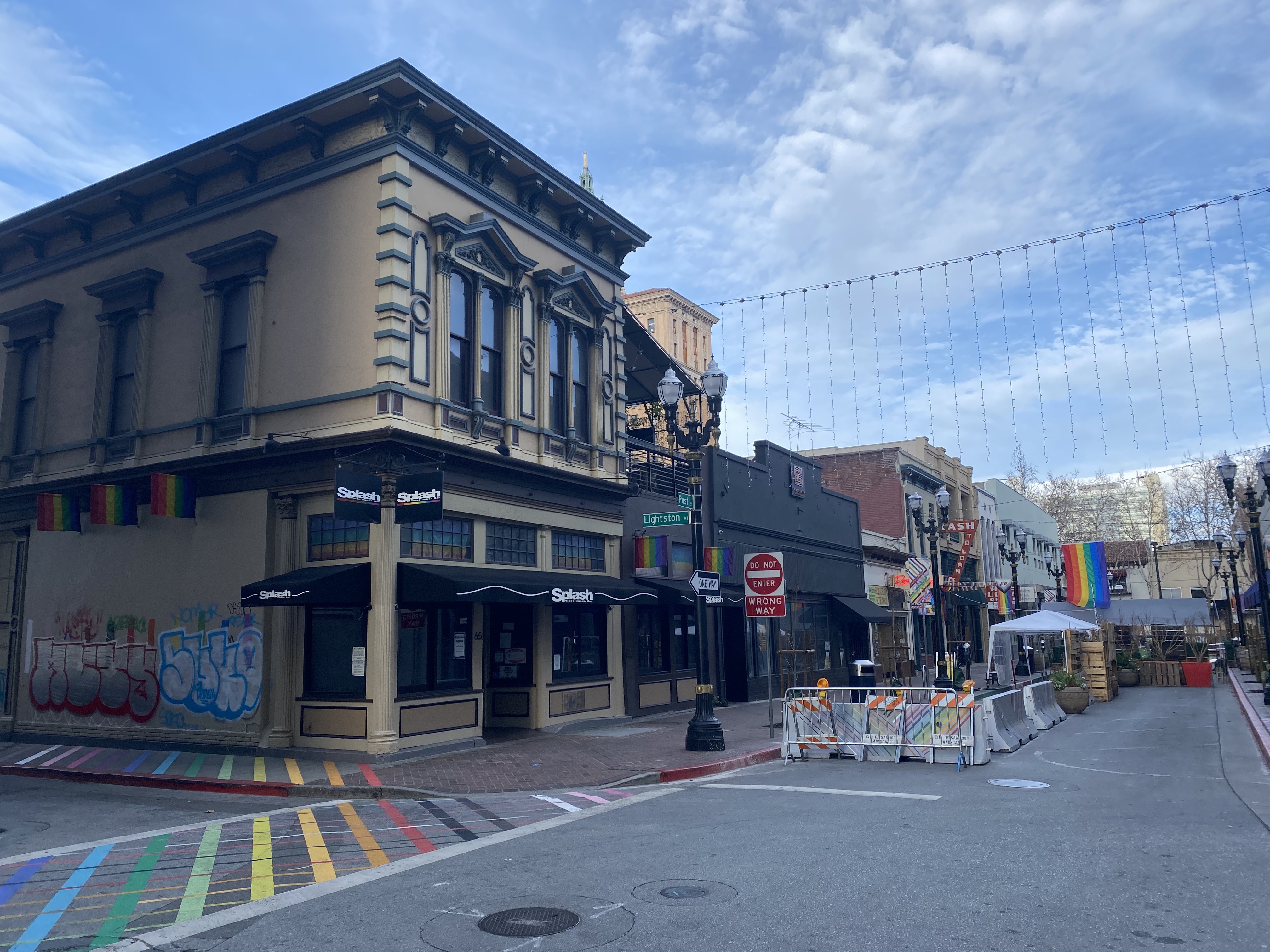
Qmunity District
Most people associate Silicon Valley with server farms and stock options, not nightlife. But on Post Street in Downtown San Jose, between 1st Street and Market Street, a two-block stretch tells a different story about the valley's culture. The Qmunity District became San Jose's first officially designated LGBTQ neighborhood in 2020, a formal recognition of what the regulars at places like the Splash Bar had known for years: this corner of downtown was already home.
A Name on the Map
City and downtown leaders formally designated the Qmunity District in 2020, choosing the location because it was already an important center of gay life within San Jose and the broader Silicon Valley community. The district runs along Post Street and is intersected by Lightston Alley, a narrow corridor that gives the neighborhood an intimate, tucked-away quality amid downtown's wider boulevards. The designation was not about creating something from nothing. It was about putting a name on a place that had been building its identity for years, one bar and one gathering at a time.
The Splash Bar and Its Neighbors
At the heart of the Qmunity District sits a cluster of gay bars, anchored by the Splash Bar, one of San Jose's oldest. In a city where tech campuses dominate the cultural conversation, these venues have served as gathering points for a community that does not always see itself reflected in Silicon Valley's public image. The bars along Post Street are not relics. They are working institutions where people meet, celebrate, organize, and simply exist without explanation. For a region that prides itself on innovation, the district represents a different kind of forward thinking: the idea that a city's identity is shaped as much by its nightlife and its gathering places as by its corporate headquarters.
Silicon Valley's Other Culture
San Jose is the largest city in Silicon Valley, home to more than a million people, yet its cultural identity often gets flattened into a narrative about technology. The Qmunity District pushes back against that reduction. It sits in Downtown San Jose, a neighborhood of older buildings and street-level storefronts that predates the office parks sprawling through the surrounding valley. The district's boundaries, compact enough to walk in five minutes, concentrate energy rather than diffuse it. Post Street between 1st and Market is not a sprawling entertainment zone. It is a neighborhood in the truest sense, small enough that the bartender knows your name and specific enough that its regulars feel ownership over the space.
What a District Means
Official designation matters in ways that go beyond signage. When San Jose recognized the Qmunity District, it acknowledged that LGBTQ spaces contribute to the city's character and deserve the same civic attention given to business improvement districts and historic preservation zones. The designation also made visible something that can be easy to overlook: that queer communities exist and thrive in suburban and tech-centric regions, not only in the traditionally recognized neighborhoods of San Francisco or West Hollywood. For Silicon Valley, a region that reinvents itself constantly, the Qmunity District is a reminder that some of the most meaningful innovations are social ones.
From the Air
Located at 37.33N, 121.89W in Downtown San Jose, California. The district occupies Post Street between 1st Street and Market Street, a compact two-block area in the downtown grid. From the air, it sits within the dense urban core south of the Guadalupe River. Nearest airports: San Jose International (KSJC, 3nm NW), Reid-Hillview (KRHV, 5nm E), Palo Alto (KPAO, 13nm NW). Best viewed at 2,000-3,000 feet AGL to appreciate its position within downtown San Jose's grid layout.