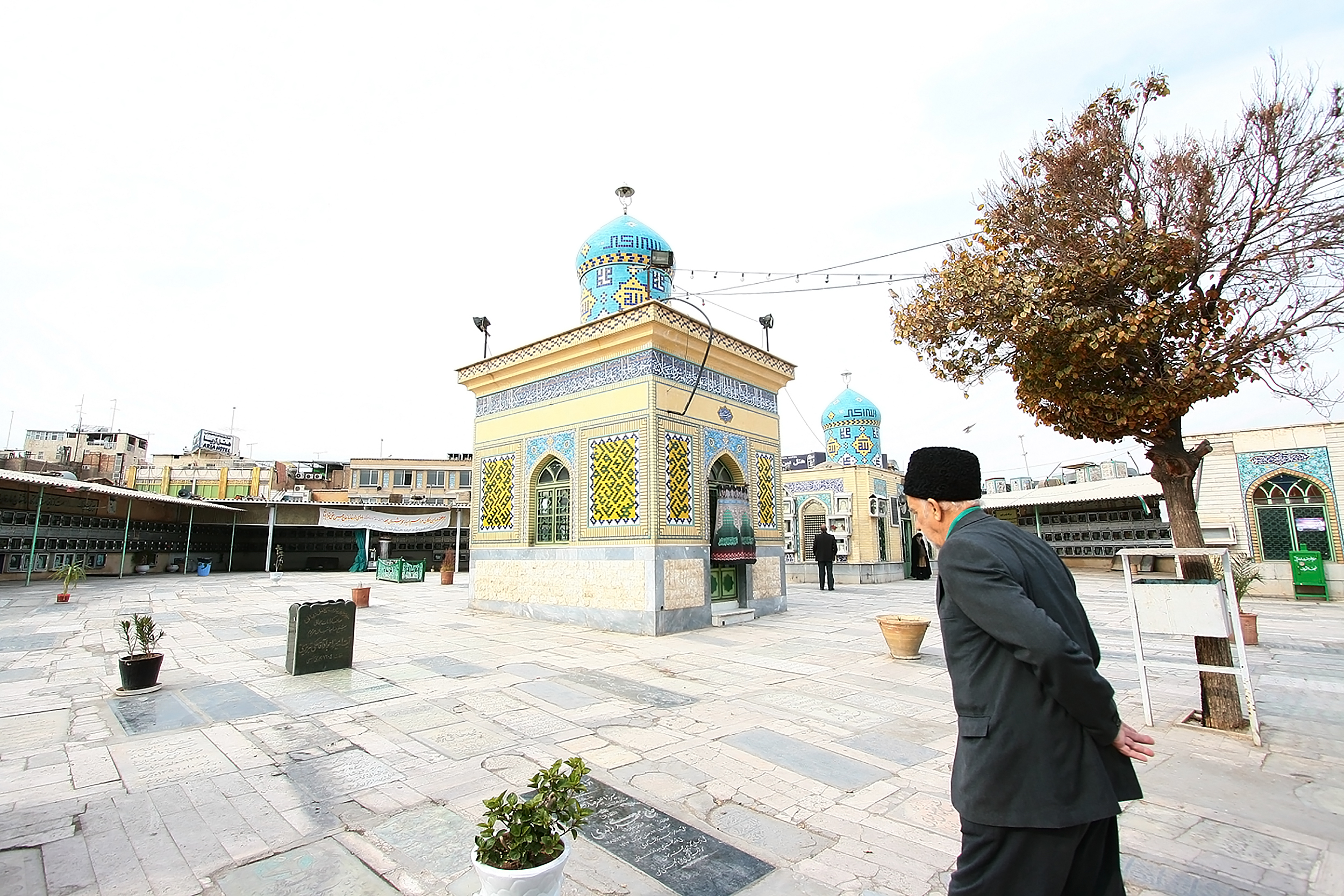
Qom Seminary
Ja'far al-Sadiq, the sixth Shia Imam, is reported to have made a prediction: "Soon Kufa will be empty of believers, and knowledge will be withdrawn like a serpent withdrawing into its lair, and it will reappear in a city called Qom." Whether prophecy or aspiration, the words proved accurate. When Grand Ayatollah Abdul-Karim Haeri Yazdi arrived in Qom in 1922 and formally established the modern seminary, he was not creating something from nothing. He was reviving a tradition of Shia scholarship that had taken root in the city more than a thousand years earlier, when the Ash'ari family -- a Shia clan from Kufa -- migrated east and began teaching hadith and the Quran in their new home. Today, the Qom Seminary is the largest hawza in the Shia world, with over forty thousand students from Iran and dozens of other countries.
The Nest of the Ahl al-Bayt
Qom fell to Muslim armies between 643 and 644 CE, but it was the arrival of the Ash'ari Arabs from Kufa, beginning around 670 CE, that set the city's intellectual trajectory. The Ash'aris brought more than their families. They brought the hadith -- the recorded sayings and traditions of the Prophet -- and a commitment to Shia learning that turned Qom into what became known as the "nest of the Ahl al-Bayt," the household of the Prophet. Ibrahim ibn Hashim Kufi became the first scholar to transmit Kufic hadiths to Qom, and over the following centuries, the city developed into one of the three earliest centers of hadith scholarship in Shia intellectual history, alongside Kufa and Baghdad. More than eighty percent of the sources in al-Kulayni's Al-Kafi -- one of the most important Shia hadith collections -- trace back to Qomi scholars.
Centuries of Eclipse and Revival
Scholarship does not survive in a vacuum. When the Seljuk dynasty rose to power and imposed Sunni orthodoxy, Qom's seminary influence waned. The Mongol invasion inflicted further damage. Revival came under the Safavid dynasty, which made Twelver Shiism the state religion and poured resources into Shia institutions. During this period, some of the greatest minds in Islamic philosophy passed through Qom's halls: Sheikh Baha'i, the polymath astronomer and architect; Mulla Sadra, whose transcendent theosophy reshaped Islamic metaphysics; Mulla Mohsen Fayz Kashani, the mystic and jurist. The Feyziyeh School, established during the Qajar period, further strengthened the seminary's standing. But it was Yazdi's 1922 refounding that transformed Qom from a respected provincial center into the beating heart of Shia education worldwide.
Fifty Thousand Students and a Global Reach
Under Seyyed Hossein Borujerdi's leadership in the mid-twentieth century, enrollment at the Qom Seminary swelled to fifty thousand students. The seminary sent representatives to Medina, Kuwait, Pakistan, the United States, and Europe. Borujerdi secured recognition of the Ja'fari school of jurisprudence as a legitimate Islamic legal tradition from al-Azhar University in Cairo -- a significant accomplishment given the historical tensions between Sunni and Shia institutions. He founded Dar al-Taqrib in Egypt to promote dialogue between the schools. For the first time, the Najaf Seminary in Iraq, historically the preeminent center of Shia learning, received financial support from Qom rather than the reverse. The student body grew from two thousand in 1947 to five thousand by 1954, and continued expanding after the 1979 Iranian Revolution brought seminaries into a new phase of political influence and state support.
Learning by Listening, Then by Debating
The method of instruction at Qom follows traditions centuries old. In the early years, a teacher would recite hadiths from memory or text while students memorized or transcribed them. When a student demonstrated sufficient understanding, the teacher granted permission to transmit the narrations independently -- a personal authorization that carried weight. Today the curriculum spans Arabic grammar, rhetoric, Quranic sciences, theology, jurisprudence, philosophy, ethics, and mysticism. The academic structure divides into four levels, each requiring years of study: the first covers Arabic literature and foundational texts; the second and third introduce jurisprudence and its principles through increasingly advanced treatises; the fourth, called dars-e kharij, involves original scholarly argumentation at the doctoral level. Examinations were once controversial -- some scholars feared the government would use them to identify talented students for state recruitment -- but are now standard. Students debate in the courtyards of the Feyziyeh School, testing arguments in real time, as their predecessors have done for generations.
From the Air
Located at 34.64N, 50.88E in the city of Qom, approximately 125 km south of Tehran in central Iran. The seminary complex is spread across multiple buildings in the city center, near the golden dome of the Shrine of Fatima Masumeh, which serves as a strong visual landmark from altitude. Qom sits in a flat, arid basin with the Kavir Desert to the east. Nearest airports: OIIQ (Qom Airport), a small local facility; OIIE (Imam Khomeini International Airport, Tehran), approximately 125 km north. Desert conditions generally provide clear visibility, though summer dust haze is common.