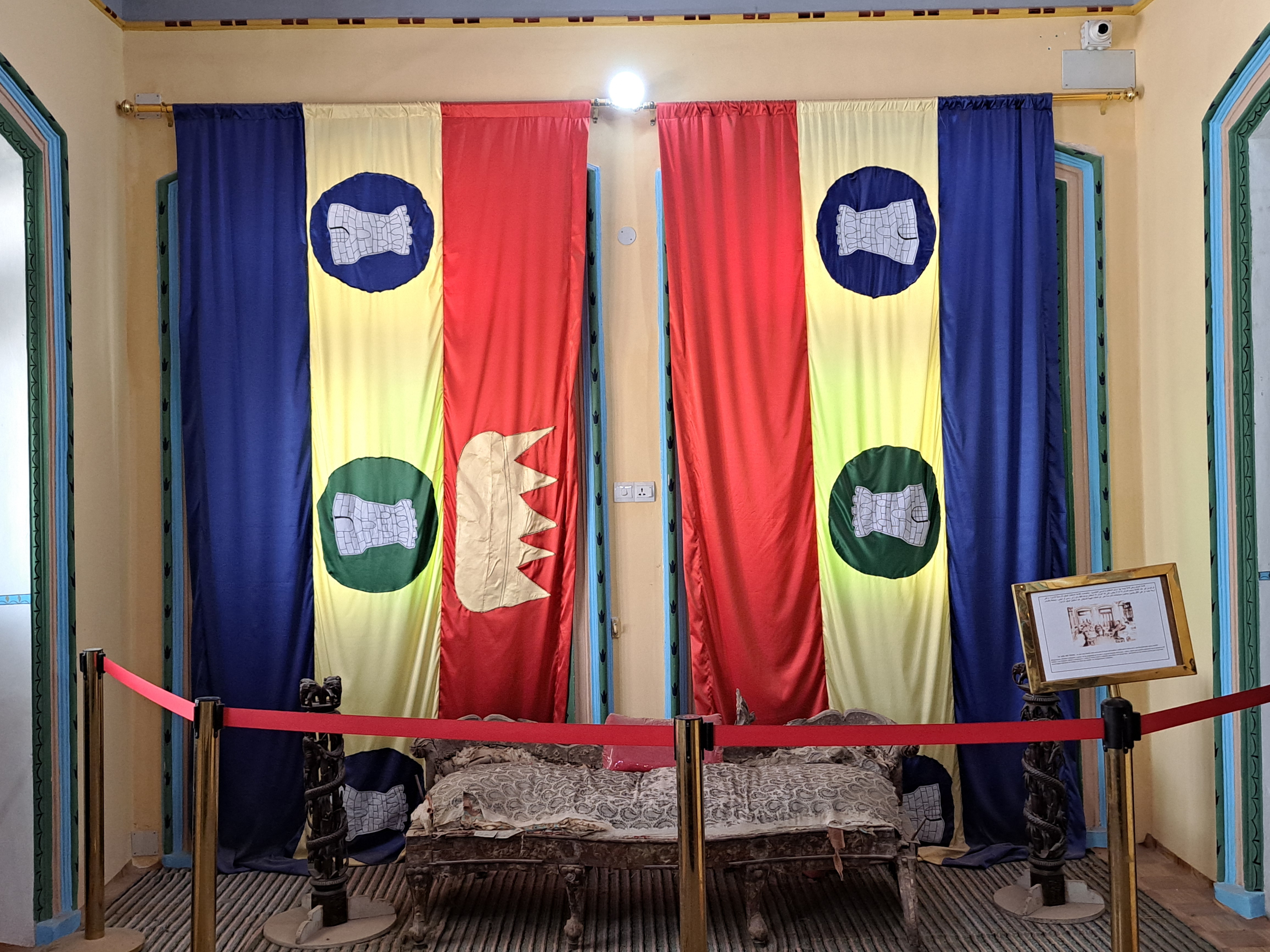
Qu'aiti Sultanate
The story of the Qu'aiti Sultanate begins not in Yemen but in India. In the mid-nineteenth century, sons of the al-Qu'aiti clan served as jemadars -- military officers -- in the armies of the Nizam of Hyderabad, one of the wealthiest rulers in the world. With the wealth and connections they accumulated across the Indian Ocean, they returned to Hadhramaut and built a state. From their capital at Mukalla on the Arabian Sea coast, the Qu'aiti sultans came to control a vast territory stretching from the Indian Ocean shore through the oasis settlements of Wadi Hadhramaut to the fringes of the Empty Quarter. It was a peculiar empire: financed by Indian wages, garrisoned by Bedouin soldiers, connected to the outside world through a diaspora that stretched from Java to East Africa, and ultimately dissolved by a revolution the sultans were attending UN negotiations too far away to prevent.
Soldiers of the Nizam
The dynasty's founder, Umar bin Awadh al-Qu'aiti, was a Yafa'i tribesman who rose to the rank of hereditary jemadar in the Nizam of Hyderabad's armed forces. His sons parlayed that military prestige and wealth into territorial ambitions back home. In 1858, they seized the town of Shibam from the rival Kathiri dynasty. When the Kathiri sheikh expelled a Qu'aiti ally from the port of Shihr in 1866, the family called on their brothers still serving in Hyderabad for help. In April 1867, Awadh bin Umar -- known by his Hyderabad title Sultan Nawaz Jang -- landed near Shihr, established a naval blockade, and routed the Kathiri forces. A counterattack in December failed. The Qu'aiti held Shihr, and with it access to the sea, from that point forward. The British, who declined to intervene on either side, eventually recognized Qu'aiti paramountcy in the region in 1882.
Fortress Houses and Camel Caravans
Life in the Qu'aiti domains was shaped by geography as much as politics. The Hadhramaut interior was arid, tribal, and violent. Blood feuds between clans were common, which is why residential buildings were constructed like fortresses -- thick-walled towers, sometimes surrounded by ditches, perched in difficult-to-reach locations. Bedouin Hamumi nomads organized the camel caravans that carried rice, dates, tea, fabrics, and wood from the coast to the hinterland, while exports were limited almost entirely to hides. Raiding was, for a long time, a legitimate source of income for the tribes. About a quarter of the population lived on the coast. Mukalla's population stood at roughly 16,000 in 1940, but swelled to 35,000 within a decade as famine drove people from the interior. Fishing and dam construction sustained the coastal economy until the Pan-American International Oil Company, a subsidiary of Standard Oil of Indiana, secured a concession in 1961.
A Diaspora from Java to Zanzibar
The harsh conditions of Hadhramaut pushed its people outward for centuries. Early emigrants served as mercenaries in the Mughal Empire, where Arab fighters were prized. After 1870, when British India stopped admitting armed men, the emigrant stream shifted from soldiers to merchants. By the 1930s, the Hadhrami diaspora numbered roughly 100,000 people, with 70,000 of them in Java alone. Others settled across island Southeast Asia and East Africa. These communities maintained deep ties to the homeland. The al-Kaff family, based in Singapore, single-handedly financed the construction of the only motor-worthy road in the sultanate -- a 250-kilometer route from the coast at Shihr through Kathiri territory to the interior city of Tarim. The sultanate's infrastructure depended almost entirely on emigrant wealth. Electricity reached Mukalla in 1938. A Western-style primary school system began on the coast in 1937, staffed by teachers recruited from Sudan and Jordan.
The End Came While the Sultans Were Away
In February 1937, British political officer Harold Ingrams and the wealthy Sayyid Abu Bakr al-Kaf brokered what became known as Ingrams Peace -- a truce between the Qu'aiti and Kathiri sultanates that was unprecedented in the region's history. For three decades, the peace held under a loose British protectorate. But by the 1960s, revolutionary sentiment was rising across South Arabia, fueled by Nasserism and anti-colonial movements. The National Liberation Front infiltrated the Hadhrami Bedouin Legion, the sultanate's security force. In September 1967, while the Qu'aiti and Kathiri sultans were attending UN negotiations in Geneva, NLF forces seized the administrative centers. When the sultans attempted to return via Mukalla on September 17, a combined NLF-Legion delegation blocked their entry. The dynasty that had been built by Indian wealth and sustained by a global diaspora ended with its rulers standing on a tarmac, unable to enter their own capital.
From the Air
Coordinates: 14.58N, 49.08E. Mukalla, the former Qu'aiti capital, sits along the Gulf of Aden coast in southern Yemen. Riyan Airport (OYRN) is nearby. From altitude, the narrow coastal plain backed by the steep Jowl escarpment rising to 1,370 meters is clearly visible. The walled city of Shibam, with its famous mud-brick towers, lies inland in Wadi Hadhramaut to the north.