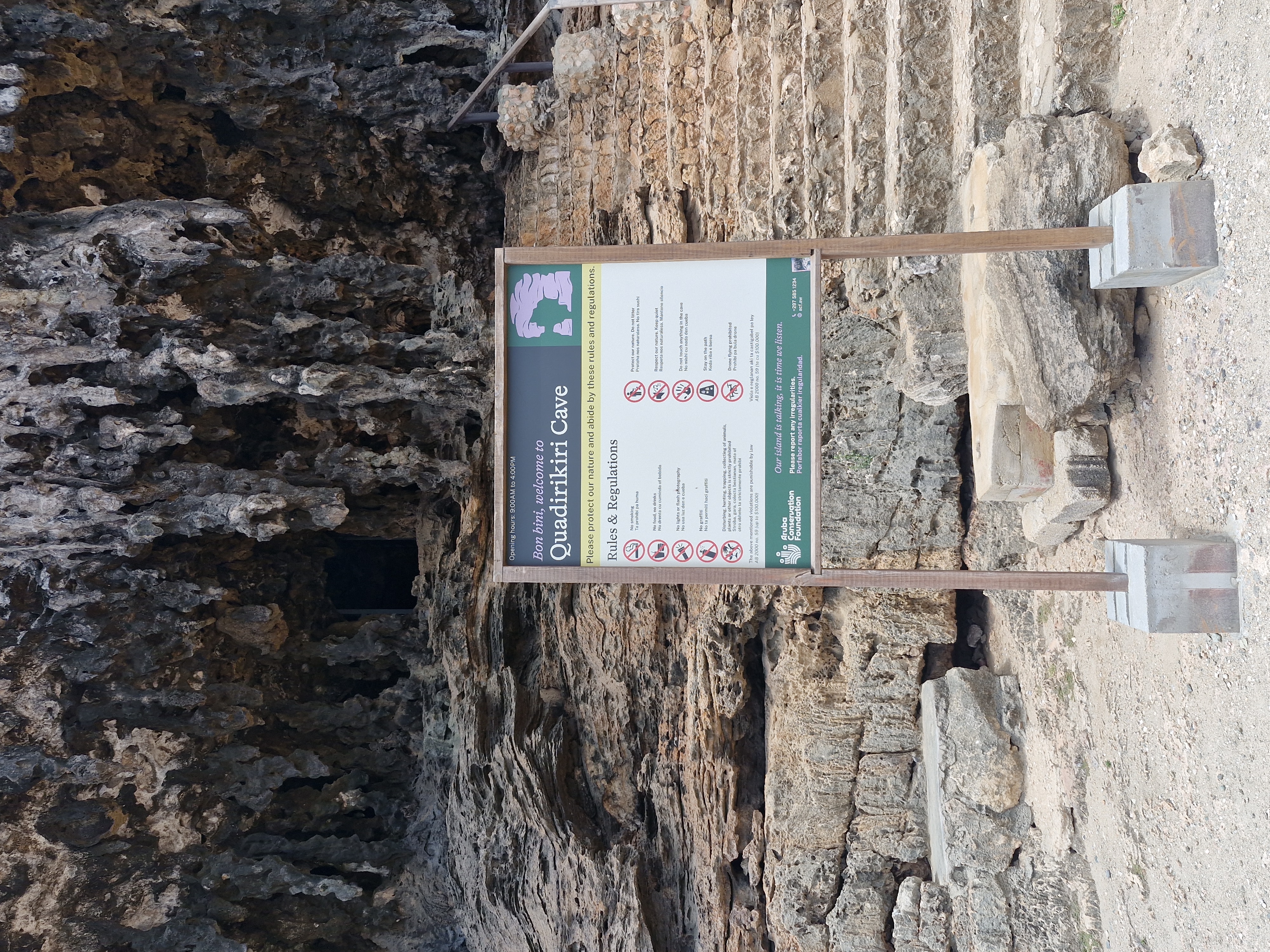
Quadiriki Caves
Step inside and the Caribbean disappears. The trade wind cuts out, the glare softens, and two shafts of sunlight drop through holes in the limestone ceiling like spotlights on an empty stage. The Quadiriki Caves -- also spelled Guadirikiri or Quadirikiri, depending on who transliterated the Arawak -- sit at the base of a limestone terrace in Arikok National Park, on Aruba's wild eastern coast. The largest chamber stretches roughly 150 meters into the rock. The first two rooms are the ones visitors remember: bright, cathedral-scaled, illuminated by natural skylights that send columns of light straight to the cave floor. The third chamber offers no such comfort. It is damp, dark, thick with the ammonia smell of bat guano, and utterly lightless. Between the sunlit rooms and the black one, the cave tells a story about the boundary between the world we see and the one we sense -- a boundary the Arawak people understood well enough to carve their thoughts into the walls.
Written in Stone
East of the main cave, a smaller chamber measures roughly 30 meters in length. What it lacks in scale, it compensates for in significance: its walls hold a remarkable concentration of Amerindian petroglyphs, believed to be over a thousand years old. The carvings depict animals, human figures, and abstract symbols -- a visual vocabulary left by the Arawak people who inhabited Aruba long before European sails appeared on the horizon. These caves were not simply shelters. The petroglyphs suggest ritual use, places where the boundary between the physical and spiritual worlds thinned. The Arawak name for the caves comes from their own language, though its precise meaning has been debated by linguists and locals alike. What survives unambiguously is the art itself -- shapes pressed into limestone by hands that understood this place as something more than geology. The petroglyphs remain legible after a millennium of humidity, bat activity, and foot traffic, a testament both to the hardness of the stone and the depth of the marks.
The Lovers Underground
Local folklore offers a story that even the tourism brochures cannot resist. An Arawak chief's daughter fell in love with a man her father found unacceptable. The chief's punishment was separation: he imprisoned his daughter in the Quadiriki Caves and confined her lover to the nearby Huliba Cave, known today as the Tunnel of Love for its heart-shaped entrance. The caves are close enough that underground passages connect them -- or so the legend insists. Despite their captivity, the lovers found each other in the darkness beneath the limestone. They met, they refused to let go, and they died together underground. Their spirits, the story goes, ascended to heaven through the natural openings in the cave's ceiling -- the same skylights that illuminate the first two chambers today. It is the kind of tale that accumulates meaning over generations: a story about defiance, about love that persists even when the world above forbids it, about light finding its way through stone.
Light and Dark
The two skylights that define the Quadiriki experience are geological accidents -- places where the limestone ceiling collapsed or eroded through, creating openings that funnel daylight into the cave below. The effect is dramatic. Depending on the time of day, the light shafts angle differently, painting the cave floor in shifting patterns of gold and shadow. Stalactites and stalagmites crowd the chambers, built over millennia by mineral-laden water dripping through limestone. In the illuminated rooms, these formations catch the light and gleam. In the third chamber, they exist only as textures felt in darkness, alongside the colony of bats whose guano carpets the floor. The contrast is deliberate in its teaching, even if no one designed it: the same cave contains revelation and obscurity, the same rock that lets light through also traps it. Visitors walk from brilliance into blackness in a matter of steps, a transition that the Arawak -- who chose to mark these walls with spiritual imagery -- clearly found meaningful.
The Limestone Coast
Aruba's eastern shore is a different island from the calm beaches of the west. Here, the trade winds arrive unimpeded across thousands of miles of open Atlantic, crashing waves against rocky coastline and scouring the limestone terraces that form the caves' foundation. Arikok National Park protects roughly 20% of Aruba's total land area -- 32 square kilometers of terrain that most tourists never see. The Quadiriki Caves sit within this protected zone, alongside Fontein Cave with its own petroglyphs and the now-closed Huliba Cave, sealed to protect its bat population. The limestone that forms these caves is the youngest of Aruba's three geological zones, a flat terrace that rings the older volcanic hills at the island's center. Water carved these chambers over hundreds of thousands of years, dissolving calcium carbonate grain by grain, creating spaces that the Arawak then made sacred and that visitors now enter with cameras and flashlights. The caves are open; the park charges admission; the petroglyphs endure. But something of the original silence remains in the third chamber, where the bats hang and the light does not reach.
From the Air
Located at 12.48N, 69.92W on Aruba's eastern coast within Arikok National Park. The caves sit at the base of a limestone terrace -- from the air, look for the pale limestone shelf along the northeast coast contrasting with the darker volcanic hills inland. The natural ceiling openings of the main cave may be visible as dark spots in the limestone at very low altitude. Nearby landmarks include Fontein Cave to the southeast and the Boca Prins sand dunes along the coast. Queen Beatrix International Airport (TNCA/AUA) lies approximately 9 km to the west. Best viewed at 1,500-3,000 ft to appreciate the geological transition from volcanic interior to limestone coast. Persistent easterly trade winds; generally excellent visibility.