Quan Am Temple
Three religions walk into a temple, and none of them leave. On Lao Tu Street in Cholon, Ho Chi Minh City's sprawling Chinatown, a pagoda built by Hokkien immigrants in the late 19th century refuses to choose between Buddhism, Taoism, and Chinese folk religion. Quan Am Temple dedicates its main altar not to the Buddha but to Mazu, the Fujianese sea goddess whom sailors once begged for safe passage across the South China Sea. The rear courtyard belongs to Guanyin, the goddess of mercy. The entry hallway seats the Jade Emperor, lord of the Taoist universe. And tucked into a corner of the outer courtyard, Sun Wukong -- the Monkey King from Journey to the West -- shields his eyes with one hand, scanning the distance for trouble.
A Garden of Immortals
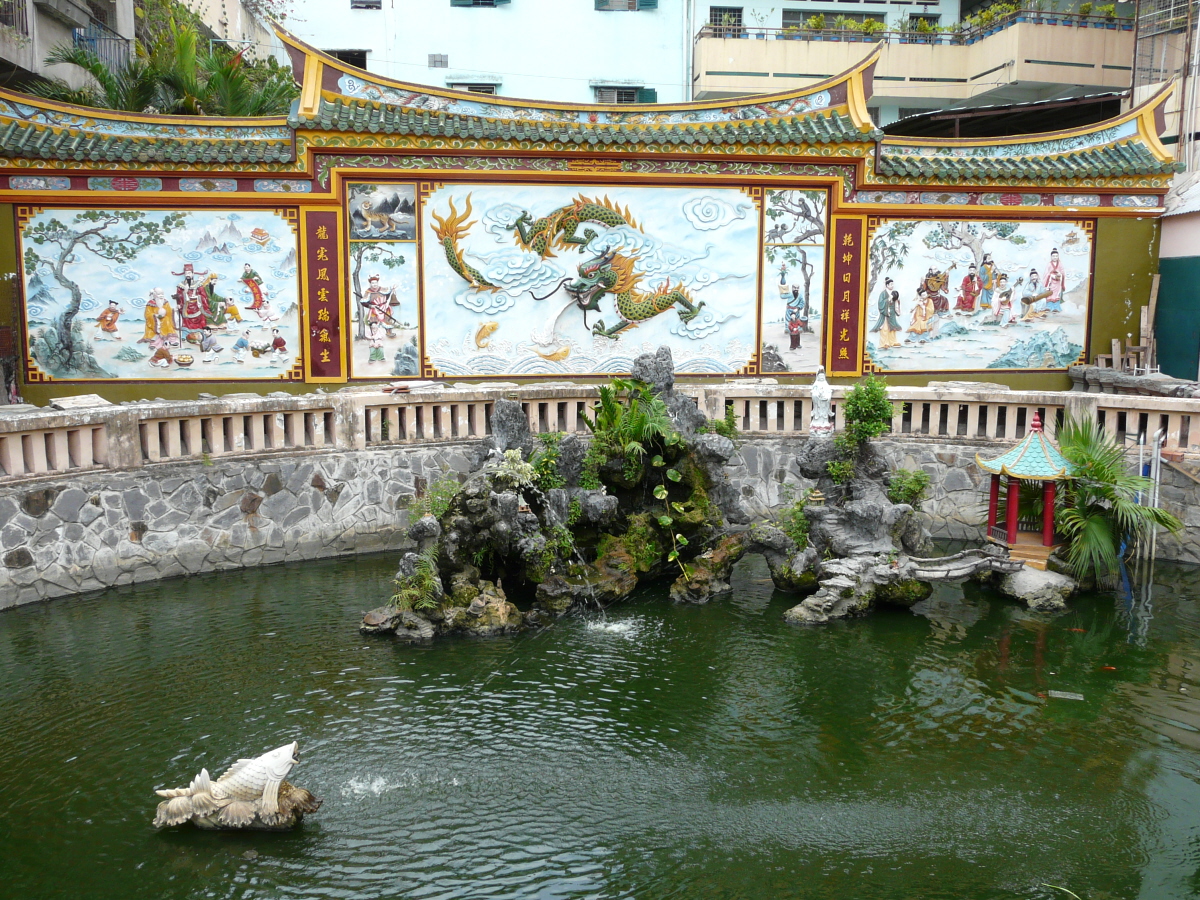
Before visitors even reach the pagoda, they encounter its garden across the street, separated from Lao Tu by a red metal gate. An artificial pond sits at the center, complete with a miniature rocky island crowned by a roofed pavilion. A white-robed statue of Guanyin stands at the pond's edge, balanced on a lotus flower, holding in one hand a golden pearl and in the other a small vial containing amrita -- the elixir of life. Relief panels surround the water on three sides. The center panel shows a green dragon hovering above ocean waves while golden fish break the surface. To the left, the Three Stars of Chinese folk religion -- Status, Prosperity, and Longevity -- stand together in heaven, while children gather the peaches of immortality into baskets and a small wagon. The Longevity Star, depicted as an old man in a yellow robe, carries one of those peaches in his right hand and a dragon-headed staff in his left. To the right, eight musicians play flutes, percussion, and strings in a natural landscape. The garden is Taoist through and through, a prelude that sets up the temple's syncretic character.
Where Pure Land Meets the Spirit of the Earth
Cross the street and pass through the small red gatehouse into a narrow front courtyard, and the religious vocabulary shifts from Taoism to Buddhism. Relief panels here depict the Pure Land of Amitabha Buddha -- a paradise available not through years of meditation but through sincere devotion. Amitabha sits cross-legged on a lotus throne in robes of red and orange, his head ringed by a halo of fire, flanked by the bodhisattvas Avalokitesvara and Mahasthamaprapta. But the panels contain stranger company too. On one relief, the spirit of the land itself -- white-bearded, dressed in black and red robes -- converses with a bodhisattva while a horned demon shades him with an umbrella made from a gigantic leaf. Above them, emerging from clouds, a dark-skinned four-armed archer with bulging eyes draws his bow. These figures are not standard Pure Land iconography. They belong to the specific ground on which this temple was built, a local spiritual negotiation between universal salvation and the particular spirits of Cholon's waterlogged earth.
The Jade Emperor's Antechamber
The partially covered entry hallway belongs to the Jade Emperor, Ngoc Hoang, lord of the Taoist cosmos. His dark statue stands at the center of the altar, clothed in yellow robes and a golden crown. In front of him sits the chubby Maitreya -- the Laughing Buddha, the Buddha of the future -- cross-legged on the ground with his robe open at the chest, mouth wide in friendly mirth. The walls flanking the altar carry their own declarations: a tigress nursing her cub on one side, symbol of fertility, and a golden dragon swirling through clouds on the other. Gilded panels of Amitabha Buddha and three female bodhisattvas mounted on mythical creatures complete the scene. Manjusri, bodhisattva of wisdom, rides a snarling lion that represents the wild mind subdued through meditation. Samantabhadra, bodhisattva of virtue, sits atop a white elephant symbolizing the purification of the senses. That a Taoist deity, a future Buddha, and Buddhist bodhisattvas share the same hallway without tension captures the temple's governing logic: these traditions are neighbors here, not competitors.
Mazu's Domain
The main chamber's altar belongs to Mazu, the Fujianese sea goddess whose worship the Hokkien immigrants carried with them across the water. Her Vietnamese name Thien Hau transcribes her Chinese title Tianhou -- Empress of Heaven. She is also called A Pho, from the Cantonese A-ma, meaning Beloved Mother. Both titles have caused her to be syncretized at various times with both the Virgin Mary and Guanyin, a theological fluidity that would alarm a systematic theologian but makes perfect sense in Cholon's devotional world. Mazu stands tall at the center of the altar in multicolored robes and crown, her golden face calm, flanked by shorter attendants while scowling demons guard her feet. Yellow dragons coil down the pillars before her altar, spiraling from heaven to the sea. On the surrounding walls, Taoist Immortals gather in a mountainous landscape -- two playing a board game, one making music -- while on the opposite wall, celestial women accompany a youth riding a cloud between mountain peaks.
The Monkey King in the Courtyard
Beyond Mazu's chamber lies the partially covered outer courtyard, the heart of the pagoda. Here Guanyin stands tall and smiling at the central altar, her right hand raised in a gesture of instruction, her left cradling the vial of the elixir of life. Dragons wind around pillars on either side. Smaller altars ring the periphery, dedicated to figures from Buddhism, Taoism, and Chinese literature alike. Dark wooden statues of Buddhist arhats -- holy men -- occupy one altar in various postures: one seated with a bowl, another mounted on an elephant, another offering his bowl skyward. But the most charming presence belongs to Sun Wukong, the Monkey King of Journey to the West, clothed in yellow robes with a gilded headpiece, his right hand raised to his forehead as he peers into the distance. Across the courtyard, a small diorama shows Monkey and his companions -- the monk Tang Sanzang, Pigsy, and Sandy -- traveling through a rocky landscape while Guanyin watches from a clifftop. It is a fitting image for the whole temple: a journey through overlapping worlds of faith, watched over by a goddess who sees no contradiction in any of it.
From the Air
Located at 10.7541N, 106.6596E in the Cholon district of Ho Chi Minh City (District 5). From the air, Cholon's dense urban grid is visible southwest of central Saigon. The temple sits on Lao Tu Street amid the tight blocks of the old Chinatown quarter. Nearest major airport is Tan Son Nhat International (ICAO: VVTS), approximately 6 km to the northwest. Best viewed at 1,500-2,000 ft AGL. The Saigon River curves to the east, providing a useful visual reference.