Quatsino
In 1893, at the Chicago World Exposition, a Norwegian farmer from Fargo, North Dakota named Christian Nordstrom met a man called Jobe Leeson from Winter Harbour, British Columbia. Leeson described a place at the head of Quatsino Sound on northern Vancouver Island where the Canadian government was offering thirty free lots of 80 acres each through Crown Grants. Nordstrom went home and organized a group of fellow Norwegian settlers. The following year, they boarded a steamship to Victoria, then chartered a vessel called the Mischief and sailed north into waters none of them had seen. They spent their first winter in the abandoned cabins of a failed coal mine at Coal Harbour. When spring came, they scouted the land, chose their lots, and began clearing forest. The village they built still exists -- population 91, no roads in or out, accessible only by boat or floatplane.
The Chapel in the Woods
Two years after the settlers arrived, they built a small wooden building that served first as a schoolhouse. In 1897, it was consecrated as St. Olaf's Anglican Church -- a woodland chapel that remains the oldest building on northern Vancouver Island. Painted white and tucked among the trees, St. Olaf's is still a popular site for weddings, drawing couples who make the boat trip for the chance to exchange vows in a church that has stood for well over a century. The one-room schoolhouse that replaced it was built in 1935 and is one of the few public one-room schools still operating in British Columbia, a two-story wooden structure where a handful of children receive their education in the same room. The post office, established in those early years of settlement, also remains in operation. Two cemeteries mark the passage of generations -- Norwegian names on the older stones, a broader mix on the newer ones.
Boom and Quiet
For its first half-century, Quatsino was far more than a hamlet. As resources in the surrounding area developed, the village grew into a thriving community with mines, canneries, general stores, rental cabins, a hotel, a saloon, a telegraph office, and an Imperial Oil fuel station. Freight service connected Quatsino to Victoria, and a customs office handled cross-border trade. The decline came gradually through the 1940s as industries shifted and larger towns like Port Hardy, an hour northeast by boat and road, absorbed the region's economic gravity. Today, Coal Harbour to the east is twenty minutes away by boat, Port Alice to the south about forty. The nearest paved road is at Coal Harbour, and from there it is a short drive to Port Hardy. Quatsino's isolation is total by road -- and entirely deliberate for the people who choose to stay.
Wilderness Stage
Quatsino's remoteness made it famous in an unexpected way. The History Channel's survival series Alone filmed three of its seasons -- the first, second, and fourth, shot between 2015 and 2017 -- in Quatsino Territory. The show drops contestants into wilderness with minimal supplies and films them trying to survive as long as possible. Quatsino Sound's combination of dense temperate rainforest, heavy rainfall averaging 3.3 meters per year, abundant bears and cougars, and sheer inaccessibility made it, in the producers' words, a perfect location. The Quatsino First Nation collaborated on the production, requiring archaeological surveys of filming sites to protect historical areas, and hosting a send-off ceremony for contestants. Emily St. John Mandel also drew on the area for her novel The Glass Hotel, basing the fictional coastal community of Caiette on Quatsino -- a place that feels, in her telling and in reality, like the edge of the known world.
Edge of the Map
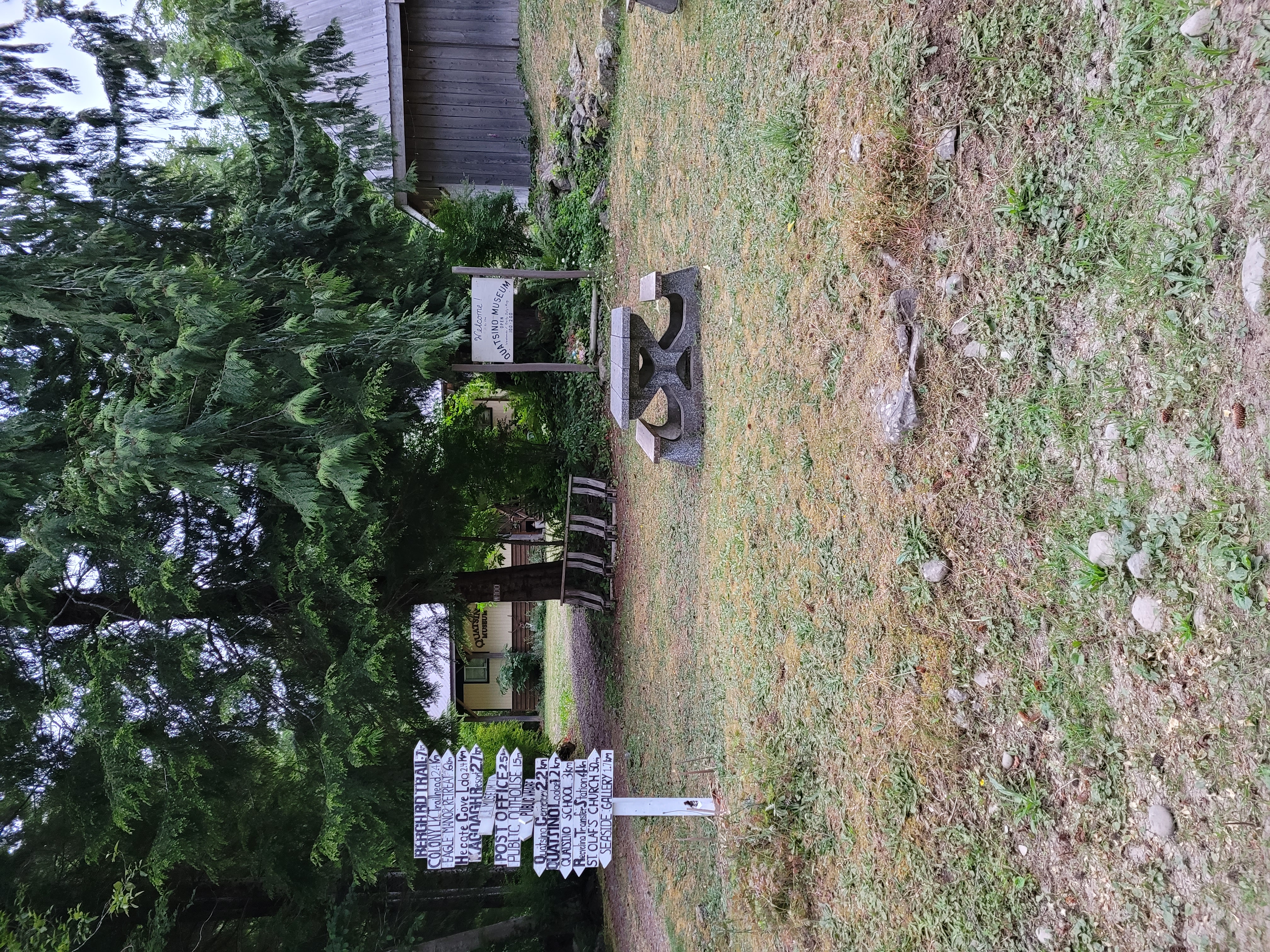
Colony Lake, a short distance north of the village, remains a favorite for swimming, canoeing, and lake trout fishing. Since 2003, the broader Quatsino Sound area has attracted increasing numbers of visitors for sports fishing, kayaking, bird watching, and whale watching, and several fishing lodges have opened in response. The Quatsino Museum, which opened in 2007, preserves the community's layered history -- Norwegian, First Nations, industrial. High-speed satellite internet arrived that same year, replacing dial-up. But connectivity has not erased the essential character of the place. Quatsino sits at the rainy, forested edge of an island that is itself at the edge of a continent. The oceanic climate keeps winters cool and soaking, summers mild and merely damp. The ninety-one people who call it home have chosen a life measured in boat rides and tides rather than highways and traffic lights.
From the Air
Quatsino is located at 50.53N, 127.61W on the north shore of Quatsino Sound, accessible only by water or air. From the air, look for a small cluster of buildings along the waterfront at the head of the sound, with St. Olaf's white church visible among the trees. Colony Lake is visible to the north. The hamlet has no airstrip -- access is by floatplane landing on the sound. Nearest airport: Port Hardy Airport (CYZT) approximately 18nm northeast. Coal Harbour Water Aerodrome (CAQ3) is about 20 minutes east by boat. Best viewed below 2,000 feet AGL to spot the settlement against the dense forest backdrop.