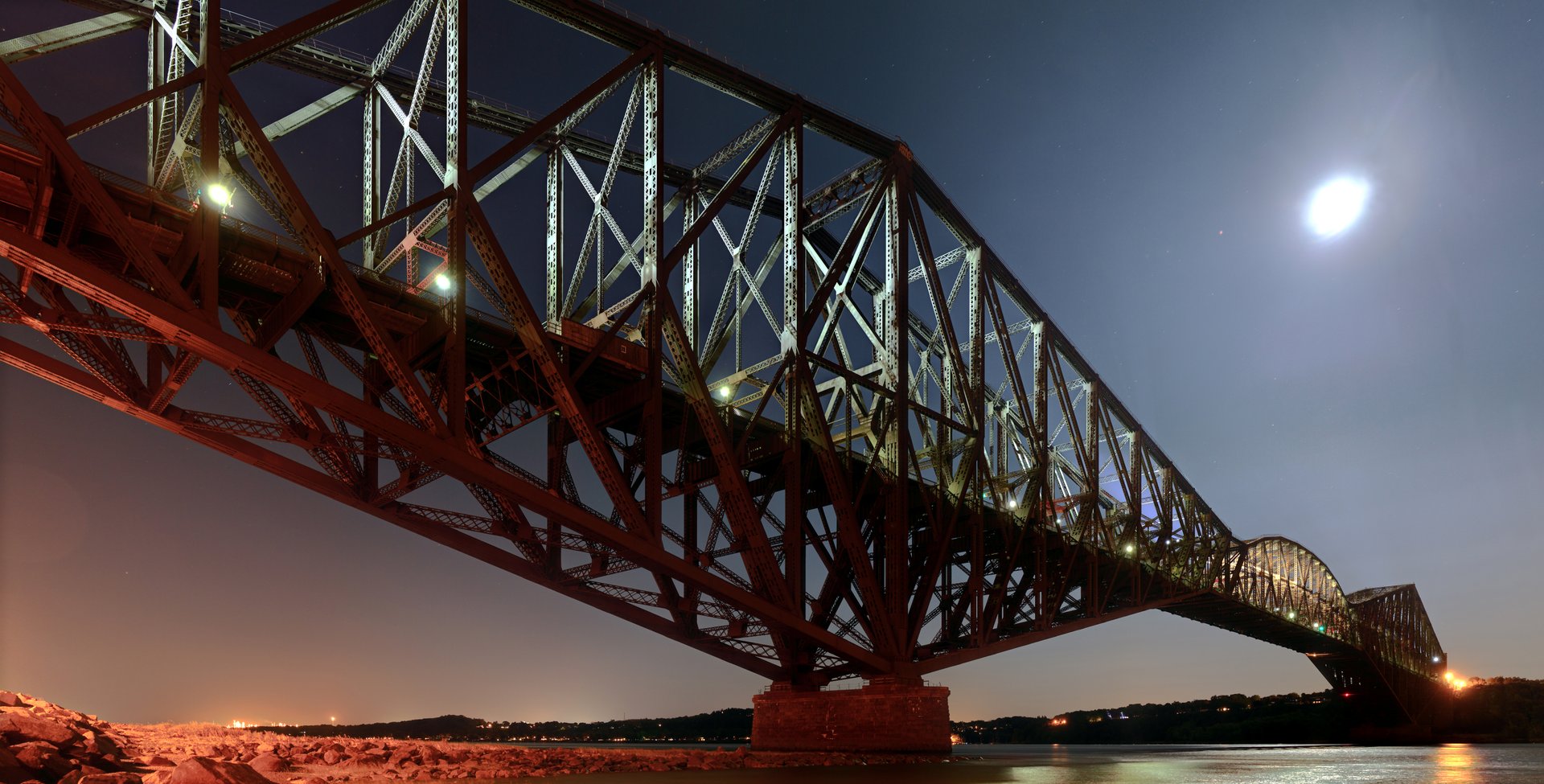
Quebec Bridge
The telegram arrived too late. On the afternoon of August 29, 1907, consulting engineer Theodore Cooper sent an urgent message to the Phoenix Bridge Company: "Add no more load to bridge till after due consideration of facts." But the message never reached the construction site at Quebec. Near quitting time that day, after four years of work, the south arm of the Quebec Bridge collapsed into the St. Lawrence River in fifteen seconds. Seventy-five of the eighty-six workers on the structure were killed, including thirty-three Mohawk steelworkers from the Kahnawake reserve near Montreal, who were buried at home under crosses made of steel beams. It was the worst bridge construction disaster in the world, and it was only the first catastrophe this bridge would endure.
The Dream of Spanning the St. Lawrence
Before the Quebec Bridge existed, the only way to cross the St. Lawrence between Levis on the south shore and Quebec City on the north was by ferry in summer or by walking across the ice bridge in winter. The idea of a permanent crossing had been discussed as early as 1852, debated again in 1867, 1882, and 1884, but it took Prime Minister Wilfrid Laurier's election in 1896 to turn talk into action. Laurier represented Quebec East and championed the project throughout his time in office. The Quebec Bridge and Railway Company was incorporated, bonds were issued, and in 1903, construction began on what was intended to be the longest cantilever bridge span in the world, part of the National Transcontinental Railway linking eastern Canada. The chief engineer assigned to the project, Edward A. Hoare, had never worked on a cantilever bridge structure of any significant length. It was a fatal oversight.
Fifteen Seconds of Ruin
The trouble began with arithmetic. Preliminary weight calculations made during the planning stage were never properly rechecked as the design evolved. By the summer of 1907, site engineer Norman McLure noticed that key structural members were distorting under loads far exceeding their capacity. The bridge was collapsing under its own weight. McLure wrote repeatedly to Cooper, the consulting engineer in New York, who initially dismissed the concerns. Phoenix Bridge Company officials insisted the steel beams must have been bent before installation. By August 27, McLure knew they were wrong, but instead of sending a telegram, the less experienced engineer wrote a letter and traveled to New York to meet Cooper in person. Cooper finally grasped the severity and sent his urgent telegram, but the message stalled in the Phoenix Bridge Company offices. The collapse that followed killed 75 workers and remains one of the deadliest engineering failures in history.
Lightning Strikes Twice
A Royal Commission laid blame squarely on Cooper and Phoenix Bridge Company designer Peter L. Szlapka for "errors in judgment." Construction restarted under a new engineering team that included Maurice FitzMaurice, a veteran of the Forth Bridge in Scotland, and Ralph Modjeski from Chicago. The redesign called for a more massive structure, but the St. Lawrence had not finished exacting its toll. On September 11, 1916, as the central span was being hoisted into position, a casting in the lifting equipment failed. The span plunged into the river, killing thirteen more workers. Initial fears of German sabotage during the Great War proved unfounded. Reconstruction resumed almost immediately, with the government granting special permission to acquire steel that was in high demand for the war effort. Armed soldiers and Dominion Police guarded the completed bridge and checked passes until the war ended.
A Record That Still Stands
The Quebec Bridge finally opened on December 3, 1917, after almost two decades of construction, at a cost of twenty-three million dollars and eighty-eight lives. Its centre span of 549 meters remains the longest cantilevered bridge span in the world, a record that has stood for over a century. The riveted steel truss structure carries three highway lanes, one rail line, and a pedestrian walkway, though its original configuration included two rail lines, two pedestrian paths, and a streetcar line. The bridge was designated a National Historic Site in 1995 and declared an International Historic Civil Engineering Landmark by the Canadian and American Societies of Civil Engineers in 1987. In May 2024, the Canadian government purchased the bridge from Canadian National Railway for the symbolic sum of one dollar, committing one billion dollars over twenty-five years for repairs and maintenance.
The Iron Ring's Legacy
The Quebec Bridge disaster transformed the engineering profession in Canada. Professor John Galbraith, one of the Royal Commission members who investigated the 1907 collapse, helped establish the organizations of Professional Engineers that now regulate the profession across the country. A popular tradition holds that the iron from the collapsed bridge was forged into the first Iron Rings worn by graduates of Canadian engineering schools beginning in 1925, a story that is likely myth but carries symbolic weight. The ring, worn on the working hand's little finger, serves as a reminder of the consequences of engineering failure. At the Kahnawake reserve, a year-long commemoration began on August 29, 2006, honoring the thirty-three Mohawk men killed in the first collapse. A memorial displaying the victims' names now stands on the Levis side of the bridge, and a steel replica of the bridge was unveiled at Kahnawake, honoring a community whose tradition of high-steel work traces directly to those lost on the St. Lawrence.
From the Air
Located at 46.746°N, 71.288°W spanning the St. Lawrence River between Quebec City and Levis. The cantilever truss structure is unmistakable from the air, sitting just downstream from the Pierre Laporte suspension bridge (opened 1970). Nearest airports: CYQB (Quebec City Jean Lesage International, 8 nm northeast) and CSP5 (Levis heliport). Best viewed at 2,000-4,000 ft AGL approaching from the south or east along the St. Lawrence. The bridge's distinctive diamond-shaped cantilever profile is visible from considerable distance.