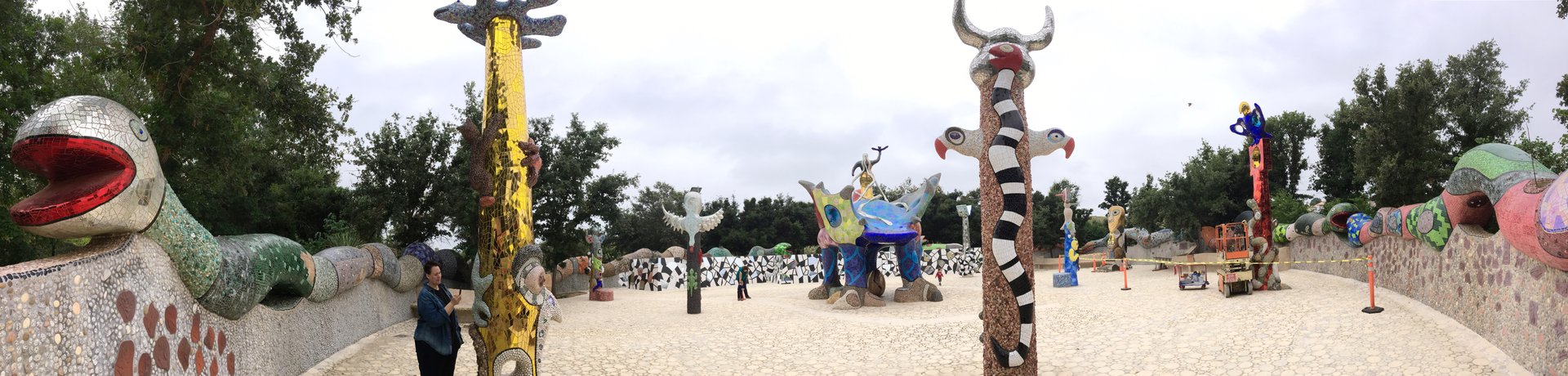
Queen Califia's Magical Circle
She never saw it finished. Niki de Saint Phalle died in May 2002 in her La Jolla home, and when the garden opened in Escondido on October 26, 2003, it was celebrated as both a gift and a farewell — the final creation of a Franco-American artist who had spent decades building enormous, joyous, mosaic-clad worlds wherever she could find a city willing to let her try.
A Queen Born in a Book
The spark came from John McPhee. In his book Assembling California, the Pulitzer Prize winner traced the geological history of the state, and somewhere in that account he described the legend of Califia — a fictional warrior queen who ruled the mythical Island of California, the place that gave the state its name. Saint Phalle read the legend and recognized something in it: a powerful, sovereign woman presiding over a land of impossible richness. She decided to make Califia real, or at least as real as steel armature and hand-cut mosaic tile can make anything.
Escondido agreed to host the project, drawn in part by the garden's setting in the semi-rural valley east of San Diego, where the surrounding hills would frame and contain the installation rather than compete with it. The city partnered with Saint Phalle to build and maintain the space, and construction proceeded with her direct involvement until her health declined in her final years.
The Maze, the Wall, the Queen
The garden is enclosed by a rippling snake wall that stretches 400 feet around the perimeter, ranging between four and six feet in height. Colorful mosaic serpents are stationed along its top. There is only one entrance, and it opens not into the courtyard directly but into a maze — its short walls and floor covered in black, white, and mirrored tiles — that visitors must navigate before reaching the space within.
What waits beyond the maze is Califia herself, seated on an eagle throne at the garden's center. Eight totem sculptures, each between eleven and fifteen feet tall, surround her. They draw on Native American, pre-Columbian, and Mexican visual traditions, their surfaces crowded with stylized animals and symbols. The eagle appears repeatedly — it figures prominently in both Native American and indigenous Mexican symbolism, and it was Saint Phalle's personal emblem throughout her career.
The queen is covered in hand-cut mirrored glass. The fountain at her feet uses gold leaf glass controlled by a solar-powered pump. The wall itself is faced mostly in Mexican pebble stones, but some sections hold ceramic plaques engraved with Native American rock art, and others bear the handprints and signatures of Saint Phalle's family and art team — a record of who built this thing and how much it mattered to them.
Materials as Method
Saint Phalle's distinctive surfaces — the voluptuous forms, the hybrid creatures, the symbols packed tightly together and shimmering with color — were not just aesthetic preferences. She had spoken at length about how creating vibrant, joyful work helped her process the traumas of her earlier life. The brightness was intentional. The mosaic tiles, thousands of them cut by hand from glass, ceramic, and stone, represented a kind of patient insistence that beauty was worth making.
The underlying structure is less romantic: polystyrene foam encased in a polyurethane skin, coated with fiberglass over a steel armature. The garden was built to survive California's sun and weather. It also accommodates California's temperament — it is open only a few days per week, dependent on docent availability, and closes during rain and for twenty-four to forty-eight hours afterward. The mosaic needs dry conditions to remain at its best.
What the Garden Asks
There is something unusual about encountering this garden in a mid-size California city, tucked into a park between residential neighborhoods. Most sculpture parks announce themselves on a grand civic scale. This one requires a docent schedule and a bit of planning. You cannot simply wander in.
That structure suits the work. The maze at the entrance is not just a design feature — it is a pause, a request to slow down before meeting the queen. By the time visitors emerge into the courtyard and see Califia on her throne surrounded by the eight totems, with the snake wall circling everything, the effect is of having entered a separate world. Saint Phalle built many such worlds over the course of her career. This was among the last, and among the most personal: a place where a mythical sovereign rules over a California that never existed, made by an artist who understood that the most enduring things are the ones someone imagined first.
From the Air
Queen Califia's Magical Circle sits in Kit Carson Park in Escondido at approximately 33.08°N, 117.063°W. The garden's colorful mosaic surfaces can catch light at lower altitudes; look for the park southeast of the intersection of Bear Valley Parkway and Mary Lane. Nearest airports: KSAN (San Diego International, ~27 nm SW), KMYF (Montgomery Field, ~17 nm SW), KSEE (Gillespie Field, ~18 nm S).