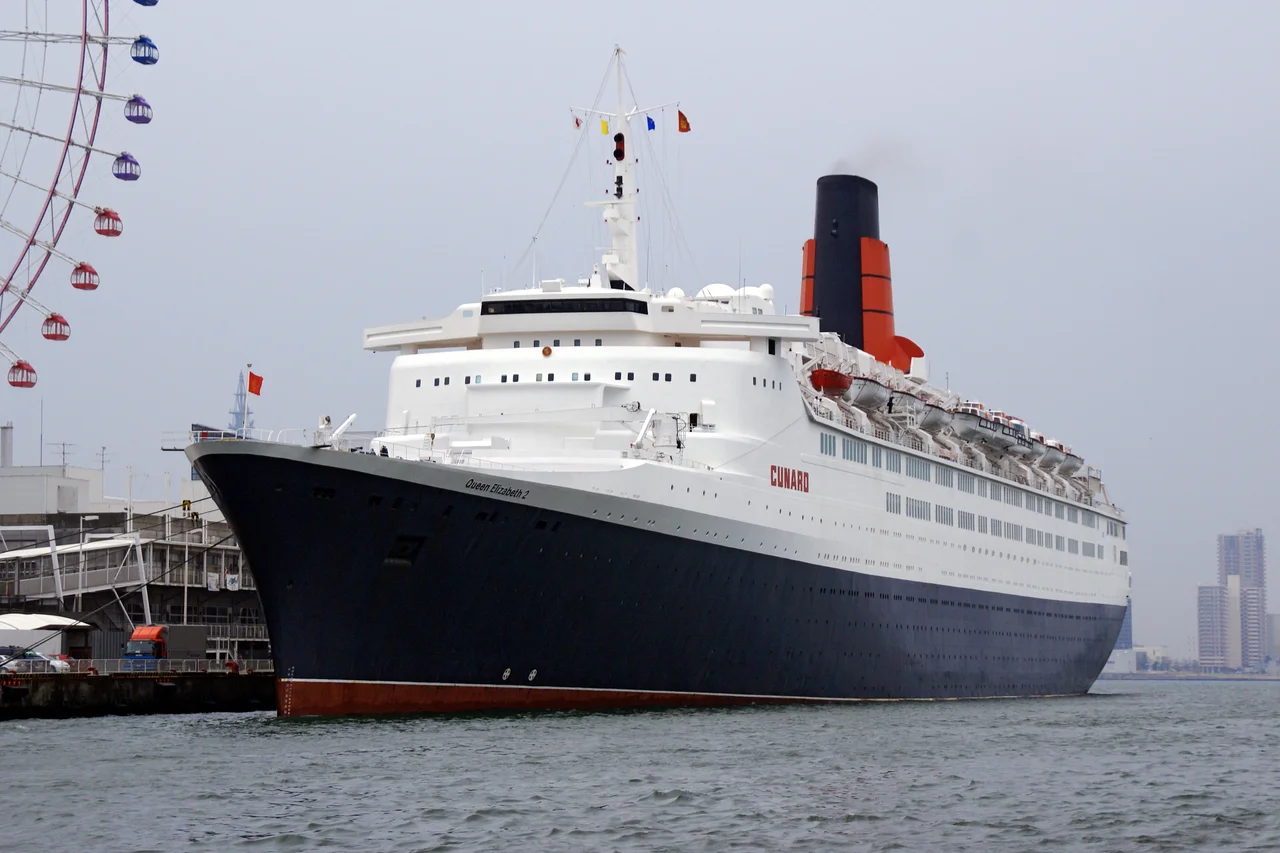

Queen Elizabeth 2
When the Queen launched her in September 1967 at John Brown's Clydebank yard, she paused and added two unscripted words: "the Second." Cunard had planned to call the ship simply Queen Elizabeth, in succession to the earlier Cunard liner RMS Queen Elizabeth of 1938. The monarch's improvisation rewrote the ship's name in real time. Cunard improvised back, using a modern Arabic 2 rather than Roman numerals to suit the 1960s. The result was QE2 - flagship, troop carrier, record-breaker, and, in her improbable final act, a hotel in the Persian Gulf.
Born for an Atlantic That Was Disappearing
By the late 1950s, the Boeing 707 had begun to take the transatlantic trade. Passenger numbers between liners and aircraft hit 50:50, and the curve was running only one way. Cunard's elderly Queen Mary and Queen Elizabeth, magnificent in their day, were burning coal and money. The line cancelled an ambitious replacement called Q3, then designed a smaller, more flexible Q4 that could cross the Atlantic in summer and cruise the warm seas in winter. With two propellers instead of four, automated systems, and welded steel construction instead of riveted plate, QE2 produced the same 28.5-knot service speed as her predecessors on half the fuel. She was built for a world where ocean liners had to earn their keep.
Style and Substance
QE2's interiors broke with the wood-panelled tradition of the old Cunarders. Designer Dennis Lennon, with Jon Bannenberg and Gaby Schreiber, used modular furniture, abstract art, and bold color. The Midships Lobby on Two Deck welcomed first-class passengers into a circular room with green leather banquettes around a chrome-railed sunken lounge. The Theatre Bar on Upper Deck went unapologetically red - red chairs, red drapes, even a red baby grand piano. The Queen's Room had flared white columns and indirect ceiling lighting. Three custom Helena Hernmarck tapestries depicting the launch hung in the D Stairway, threaded with gold. Later refits replaced most of this with art-deco nostalgia inspired by the old Cunarders, but by retirement only the ship's synagogue remained in its 1969 form.
Falklands
On 3 May 1982, one month into the Falklands War, the British government requisitioned QE2 as a troop carrier. Public lounges became dormitories. Fuel pipes were threaded through the ship to allow refuelling at sea. Two thousand sheets of hardboard covered the carpets. A quarter of her length was reinforced with steel plating, and an anti-magnetic coil was wrapped around the hull to defeat naval mines. More than 650 Cunard crew volunteered to make the voyage. She carried 3,000 soldiers of the Fifth Infantry Brigade to South Georgia, steaming blacked-out and with her radar off to avoid Argentine detection. On 11 June 1982 she returned to Southampton, where the Queen Mother came aboard to welcome her home. Captain Peter Jackson's reply was perfect Cunard: "Cunard's Queen Elizabeth 2 is proud to have been of service to Her Majesty's Forces."
Diesels and Records
Between October 1986 and April 1987 in Bremerhaven, QE2 was re-engined. Her steam turbines, which had carried her 2,622,858 miles in 18 years, came out. In their place went nine MAN diesel engines, each 120 tons, driving electric motors. The new system produced 130,000 horsepower, gave a 35 percent fuel saving, and her funnel grew wider to vent nine sets of exhaust. On 29 August 2002 she became the first merchant ship in history to log more than five million nautical miles at sea. By her 2008 retirement she had crossed the Atlantic 806 times, completed 26 world cruises, carried 2.5 million passengers, and sailed the equivalent of 270 times around the planet.
The Long Goodbye in Dubai
Cunard sold her to Dubai's Istithmar in June 2007 for 100 million dollars, in part because looming SOLAS regulations would have demanded ruinous structural changes. Her final voyage from Southampton to Dubai began on 11 November 2008. She arrived 26 November in a flotilla of 60 vessels led by the personal yacht of Sheikh Mohammed, greeted by a fly-past from an Emirates A380. Plans for a Palm Jumeirah berth collapsed in the global financial crisis. She sat at Mina Rashid for nearly a decade, maintained by a skeleton crew, generating her own power, sometimes breaking loose in dust storms. After repeated false starts, she finally reopened as a floating hotel on 18 April 2018. French hotel group Accor took over operations in 2024. The ship that crossed the Atlantic in three days now serves breakfast in the Gulf.
From the Air
If you are flying into Dubai, the QE2 lies at Mina Rashid (Port Rashid) at 25.27 N, 55.27 E, on the south bank of the Dubai Creek estuary. Look for the distinctive single fat funnel and the long white hull on approach to Dubai International (OMDB) from the north. For her Clyde origins, John Brown's yard at Clydebank lies just below the Erskine Bridge on the south bank of the River Clyde, west of Glasgow Airport (EGPF). Her home port of Southampton (EGHI) sees the Cunard tradition continued by Queen Mary 2 and Queen Elizabeth.
Nearby Stories
- Al Nasla 38 km away
- Dibba 40 km away
- Wadi Hayl 41 km away
- Abu Dhabi 73 km away
- Shinas 113 km away
- Telegraph Island 125 km away
- Shaybah 408 km away
- Ardashir-Khwarrah 430 km away