Quileute
Of the thousands of languages that have existed on Earth, only five are known to lack nasal sounds entirely -- no 'm,' no 'n,' no 'ng.' Quileute is one of them. The language belongs to the Chimakuan family, and its only relative, Chemakum, is extinct. This linguistic isolation mirrors a geographic one: the Quileute have occupied the western Olympic Peninsula for at least 9,000 years, fishing its rivers, hunting its sea mammals, and building cedar plank longhouses against winters that deliver some of the heaviest rainfall on the continent. Their name, from the word kwoliyot, originally referred to the village site at what is now La Push. The people became the place, and the place became the people.
Transformation, Not Migration
Quileute cosmology does not begin with a journey. It begins with transformation. The Creator-Transformer Qwaeti reshaped the world and its inhabitants, turning existing beings into the people and animals of the present age. Raven, the trickster and culture hero, plays a role in Quileute stories, though a more modest one than in the traditions of peoples further north. Thunderbird -- t'ist'ilal -- holds great significance, as does the kelp-haired child-snatcher dask'iya, one of several monsters whose stories encode warnings and lessons about the natural world. The Quileute's only kin, the Chimakum, were separated from them by a great flood that swept the Chimakum to the Quimper Peninsula near present-day Port Townsend. According to tradition, the Chimakum were later destroyed in the 1860s by Chief Seattle and the Suquamish. The Quileute remained.
Canoe Builders and Whale Hunters
Before European contact, the Quileute built their world from cedar. Plank longhouses sheltered extended families through the wet winters west of the Cascade Range. Canoes ranged from small two-person craft to ocean-going vessels capable of carrying three tons of freight. The Quileute ranked second only to the Makah as whalers and first among all coastal tribes as seal hunters. They bred a distinctive variety of woolly-haired dogs -- a lineage now lost -- and spun the hair into blankets traded up and down the coast. Society was organized into three classes: hereditary chiefs and family heads, commoners, and enslaved people obtained through raids or trade. Five ceremonial societies functioned as occupational fraternities: the Black Face Society for warriors, plus societies for fishermen, hunters, whalers, and weather specialists. Status was maintained through potlatches that could last four to six days.
Shipwrecks, Flour, and a French Name
European contact arrived through wreckage. According to Quileute elder Harry Hobucket, Spanish sailors who shipwrecked north of the Quillayute River were likely the first Europeans the Quileute encountered. The Quileute welcomed them, and the sailors lived with the tribe for years before eventually departing south in search of their countrymen. A second wreck, probably a French ship, occurred near the same village sometime later. These survivors also lived with the Quileute, teaching them to bake flour salvaged from the ship and marrying into Quileute families. The name 'La Push' may derive from the French La Bouche, meaning 'the mouth' -- a reference to the river's outlet. In 1792, the American captain Robert Gray traded with the Quileute at their main settlement. Contact was sporadic until 1855, when the Quinault Treaty began the long, contested process of ceding 800,000 acres of Quileute homeland.
Renaming and Reclaiming
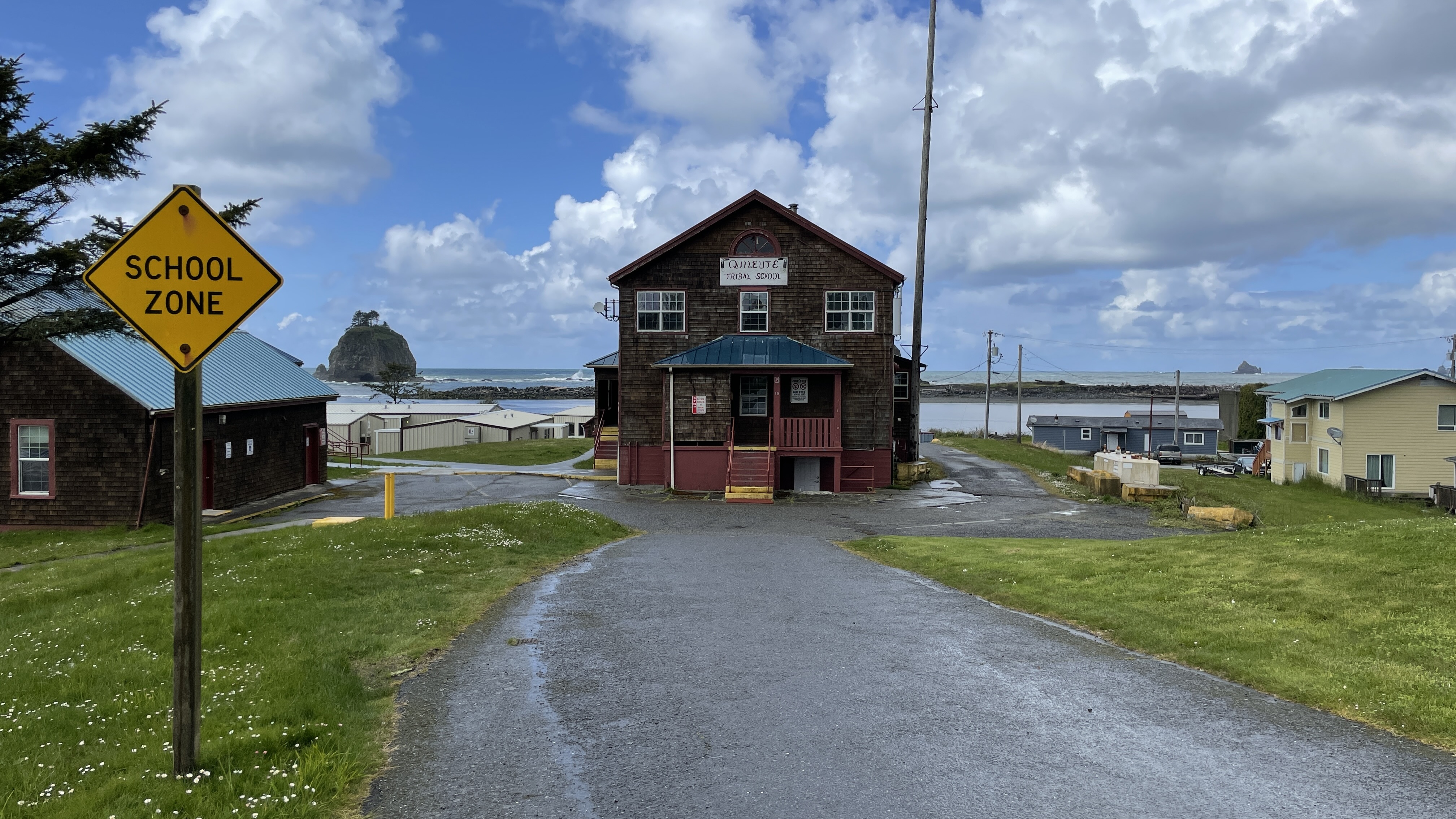
In 1882, a man named A.W. Smith arrived at La Push to 'civilize' the Quileute. A school followed in 1883, where Smith anglicized Quileute names and renamed others after biblical characters and figures from American history. It was a common practice of the era -- an attempt to erase identity through the simple mechanism of changing what people were called. The Quileute language, already isolated and fragile, declined through the twentieth century until it was spoken only by elders. Today the Quileute Tribe teaches the language in the Quileute Tribal School, using books written by elders for students. The school itself, once threatened by its location in a tsunami zone, moved to a new campus on higher ground in 2022. The tribe received no compensation from Stephenie Meyer's Twilight series, which appropriated Quileute names and culture for its fictional werewolf characters. The Burke Museum collaborated with the tribe on a project called Truth versus Twilight to correct the record.
From the Air
The Quileute homeland centers on La Push at 47.91°N, 124.63°W, at the mouth of the Quillayute River on Washington's Olympic Peninsula. The village and river are visible from moderate altitude, with James Island offshore and Rialto Beach to the north. Nearest airport is Quillayute (KUIL) approximately 2 nm east. The ancestral territory extended from the Quillayute River north to Makah lands and east to the headwaters of the Sol Duc and Hoh rivers. Frequent rain, fog, and low cloud. Best viewed at 3,000-5,000 ft.