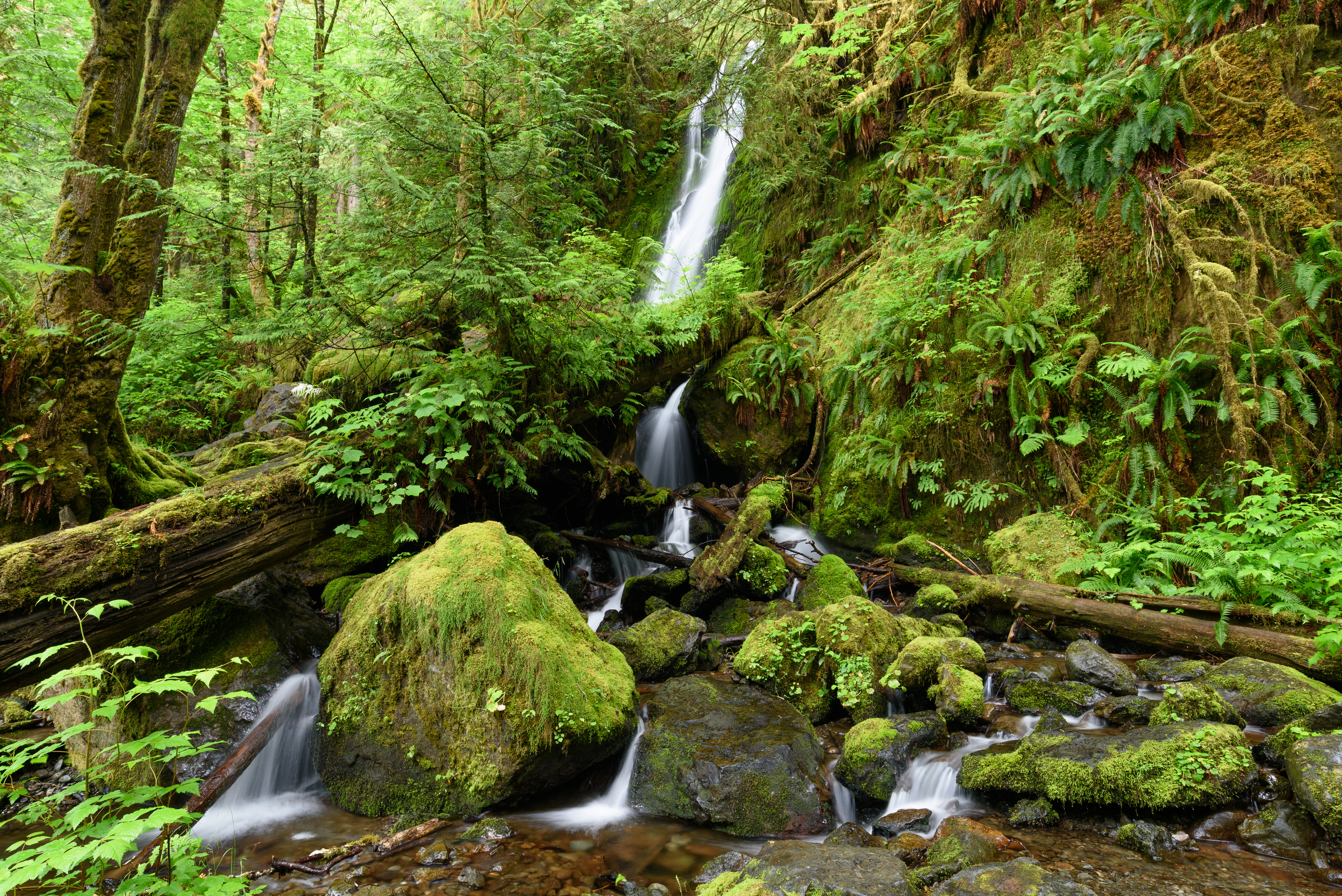
Quinault Rain Forest
Five of the ten largest Douglas-firs on the planet grow within walking distance of each other in this valley. So does the world's largest western red cedar, the largest Sitka spruce, the largest western hemlock, the largest Alaskan cedar, and the largest mountain hemlock. No other place on Earth concentrates this many record-holding tree species in such a small area -- a fact that earned the Quinault Valley its nickname: the Valley of the Rain Forest Giants. The explanation is simple and ancient: relentless rain, deep glacial soil, and thousands of years of uninterrupted growth.
How a Valley Grows Giants
The Quinault Rain Forest occupies the valley formed by the Quinault River and Lake Quinault, on the western side of the Olympic Mountains in Washington's Grays Harbor and Jefferson Counties. Glaciers carved this valley wide and deep, depositing rich alluvial soil as they retreated. The valley's east-west orientation acts as a funnel for Pacific moisture -- storms roll in from the ocean, hit the Olympic range, and dump their cargo before they can climb over. The result is a temperate rainforest that receives staggering quantities of rain per year. That combination of deep soil, abundant water, and mild maritime temperatures creates growing conditions that trees elsewhere can only dream of. The forest here is not merely old; it is enormous in a way that photographs fail to capture. You have to stand at the base of one of these cedars, neck craned backward, to understand that a living thing can be this large.
A Census of Champions
The record books read like a roll call of the Quinault Valley. The largest western red cedar. The largest Sitka spruce. The largest western hemlock, Alaskan cedar, and mountain hemlock. Five of the ten largest Douglas-firs. Outside of California's sequoia and redwood groves and New Zealand's kauri forests, no other place on Earth grows trees this large. What distinguishes the Quinault from those famous forests is the variety -- the sequoias have their one colossal species, but the Quinault produces champions across half a dozen. Each species has found its own niche in the valley's layered canopy. The spruces claim the river bottoms where groundwater stays high. The cedars anchor themselves on slopes where drainage keeps their roots from rotting. The hemlocks fill the gaps, tolerant of shade, patient enough to wait centuries for a gap in the canopy overhead.
The Architecture of Rain
Temperate rainforests exist in only a few places on Earth -- the Pacific Northwest, southern Chile, New Zealand's South Island, a sliver of Norway. What they share is a maritime climate where temperatures rarely freeze, rainfall is measured in feet rather than inches, and the forest canopy becomes so dense that it creates its own weather. In the Quinault, moisture that reaches the forest floor has already passed through several layers: the upper canopy of spruce and fir, the sub-canopy of hemlock and maple, the shrub layer of salal and huckleberry, the fern layer, and finally the moss layer that carpets every horizontal surface. Each layer strips some water from the air and adds some back. Walk through the Quinault on a day when the rain has stopped and you will still get wet -- the canopy continues to drip for hours, recycling the morning's storm through its own internal plumbing.
Walking Among Giants
The Quinault Rain Forest straddles two jurisdictions: its northern reaches fall within Olympic National Park, while the southern portion belongs to Olympic National Forest. Resorts and lodges cluster on both sides of Lake Quinault, making this one of the most accessible old-growth temperate rainforests on the continent. Trails wind through groves where the trees predate European contact with the Pacific Northwest by centuries. The scale is disorienting -- trunks wider than cars, root systems that form buttresses taller than a person, fallen logs so massive that they become nurseries for the next generation of trees, seedlings rooting in the decaying wood of their predecessors. Merriman Falls cascades into Merriman Creek, which feeds Lake Quinault, completing a water cycle that has run uninterrupted since the glaciers withdrew. Standing in the Quinault, surrounded by trees that were already ancient when Columbus sailed, the human timescale feels like a brief footnote in a very long story.
From the Air
Located at 47.51°N, 123.82°W in the Quinault Valley on the western slope of the Olympic Mountains. From the air, the rain forest appears as an unbroken expanse of deep green canopy filling the valley between ridgelines, with Lake Quinault visible as a dark water feature at the valley's western end. The Quinault River threads through the valley floor. Merriman Falls may be visible as a white thread on the southern valley wall. The forest spans parts of both Olympic National Park (north) and Olympic National Forest (south). Nearest airports: Bowerman Airport (KHQM) in Hoquiam, approximately 35nm southwest; Olympia Regional Airport (KOLM) roughly 65nm southeast. Persistent low cloud and rain are the norm -- the valley is frequently socked in below 2,000 feet. Best viewed from above the cloud layer when breaks permit.