Quincy Mine
Fifty-three consecutive years of profit. From 1868 through 1920, the Quincy Mining Company paid a dividend to its investors every single year, earning the operation its famous nickname: Old Reliable. In the volatile world of nineteenth-century mining, where fortunes evaporated with a single missed lode, that streak was almost supernaturally consistent. The secret lay a mile and three-quarters underground, following a copper-bearing vein down a 55-degree slope beneath the hills above Hancock, Michigan. By the time the Quincy Mine finally ceased production in 1945, its Number 2 shaft had reached 9,260 feet along the dip of the deposit -- the longest mine shaft in the world.
Born from a Bureaucratic Blunder
The Quincy Mine owes its existence to a clerical error. In the early 1840s, the copper rush drew speculators to Michigan's Keweenaw Peninsula, and two companies -- the Northwest Mining Company and the Portage Mining Company -- each purchased the same tracts of land, thanks to poor communication between government offices. Rather than litigate, the directors met and decided to merge. Significant investment flowed from Massachusetts, and the new operation took its name from the town of Quincy, Massachusetts. While dozens of copper mines launched during the same period, most failed within a few years. The Quincy Mine became the most successful of the 1840s-era operations and led the country in copper production from 1863, when it surpassed the Minesota Mine, through 1867, when the Calumet and Hecla overtook it.
The Pewabic Lode and the Art of Amygdaloid Mining
The Quincy's longevity hinged on a geological discovery and a willingness to change methods. In 1856, the recently discovered Pewabic amygdaloid lode was found to cross Quincy property, and the mine became the first in Michigan to switch from fissure mining to amygdaloid mining. The difference was transformative. Fissure mining targeted large, pure masses of copper trapped in rock veins -- dramatic finds, but ones that could take days or months to extract at enormous cost. Amygdaloid mining went after the upper portions of ancient basalt lava flows, where small pockets of copper filled the vesicles in the rock. This lower-grade ore could be blasted out quickly and processed elsewhere at a fraction of the cost. The Pewabic lode proved both rich and extensive, and the Quincy company expanded laterally along it, acquiring the Pewabic mine in 1891, the Mesnard and Pontiac in 1897, and the Franklin mine in 1908. This strategy of patient expansion helped the Quincy outlast nearly every other Keweenaw mining operation except the Calumet and Hecla Mining Company and the Copper Range Company.
The Hoist House That Dazzled Investors
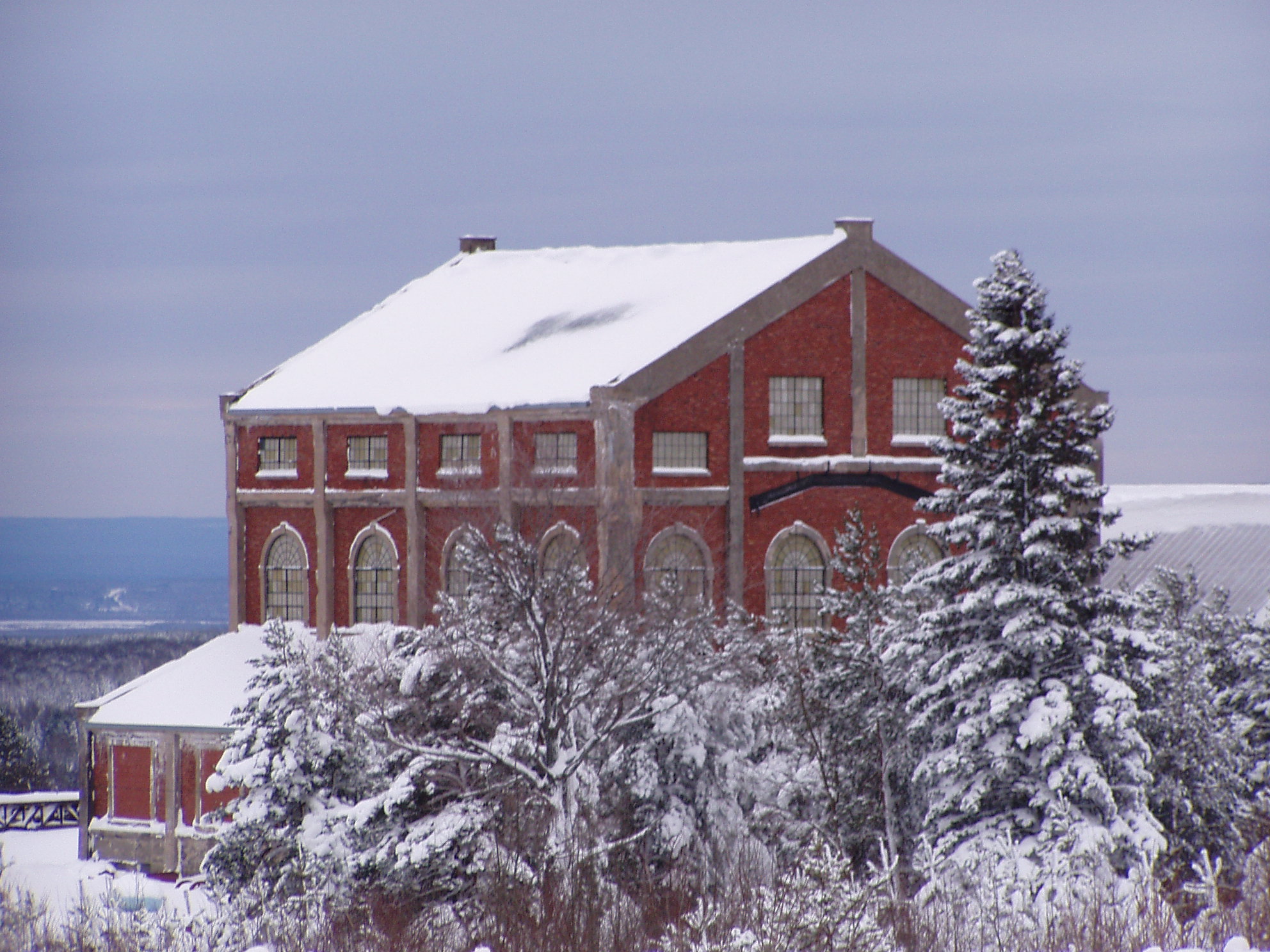
As the mine drove deeper, the engineering grew more ambitious. In 1918, the company built the world's largest steam-driven mine hoist to service the Number 2 shaft, housing it in a building that doubled as a showpiece for visiting investors. The Nordberg Steam Hoist weighed more than 880 tons and could lift 10 tons of ore at 36.4 miles per hour, saving $16,080 in fuel costs in its first year of operation alone. The hoist sat on the largest concrete slab ever poured at the time, containing 3,200 cubic yards of concrete and over 8 tons of reinforcement material. The building itself was no less impressive: a reinforced concrete structure built in the Georgian architectural style with brick veneer and Italian-tiled walls, costing over $370,000 -- a sum that reflected the company's confidence in the mine's future. That confidence proved short-lived. The great hoist operated for only eleven years before ceasing use in 1929, and the mine closed entirely in 1931 as copper prices collapsed.
Wartime Revival and Final Silence
The Quincy Mining Company did not dissolve when it shut down operations. It waited. When World War II drove copper demand skyward, the mines reopened to feed the war effort. But the reprieve was temporary. Once the government stopped supporting copper prices after the war, the Quincy closed for good in 1945. Meanwhile, above ground, the company had been shaping the community in subtler ways. To attract and retain workers, the Quincy Mining Company built and maintained housing that evolved from simple tents in the earliest days to complete three-story houses with electricity and running water. East Coast executives pushed for more elaborate dwellings over the objections of on-site managers who thought such amenities unnecessary for miners. The executives understood what the managers did not: comfortable homes meant stable families, and stable families meant workers who stayed.
Into the Seventh Level
Today the Quincy Mine is a centerpiece of the Keweenaw National Historical Park and one of the peninsula's most popular tourist attractions. The Quincy Mine Hoist Association maintains the buildings and grounds, offering guided tours of the Number 2 Hoist House and the seventh level of the mine during summer months. Visitors ride the Quincy and Torch Lake Cog Railway down to the entrance, an adit originally five feet high and three feet wide when it was constructed in 1892, later enlarged by Michigan Tech in the 1970s for a mining study. Below the seventh level, the mine tells its own story: the shafts and stopes have slowly filled with groundwater since closure, making the lower levels permanently inaccessible. Two locomotives of the Quincy and Torch Lake Railroad still sit on site -- including Locomotive Number 1, the Thomas F. Mason, a 32-ton Mogul built by Brooks Locomotive Works of Dunkirk, New York. Above it all, the decorative Hoist House still stands on the hill, its Georgian facade gazing out over the waterway toward Houghton, a monument to the era when copper was king and reliability was worth more than spectacle.
From the Air
Quincy Mine at 47.138N, 88.570W sits on the hillside above Hancock, Michigan, on the north side of the Keweenaw Waterway. The mine's surface structures are visible from the air, particularly the Number 2 Hoist House on the ridgeline overlooking Portage Lake. Look for the cluster of historic buildings on Quincy Hill, directly above the Portage Lake Lift Bridge crossing. Nearest airport: Houghton County Memorial Airport (KCMX) approximately 5nm northeast. Best viewed at 2,000-3,000 ft to see the mine buildings and their relationship to the hillside, the waterway, and the towns of Hancock and Houghton below.