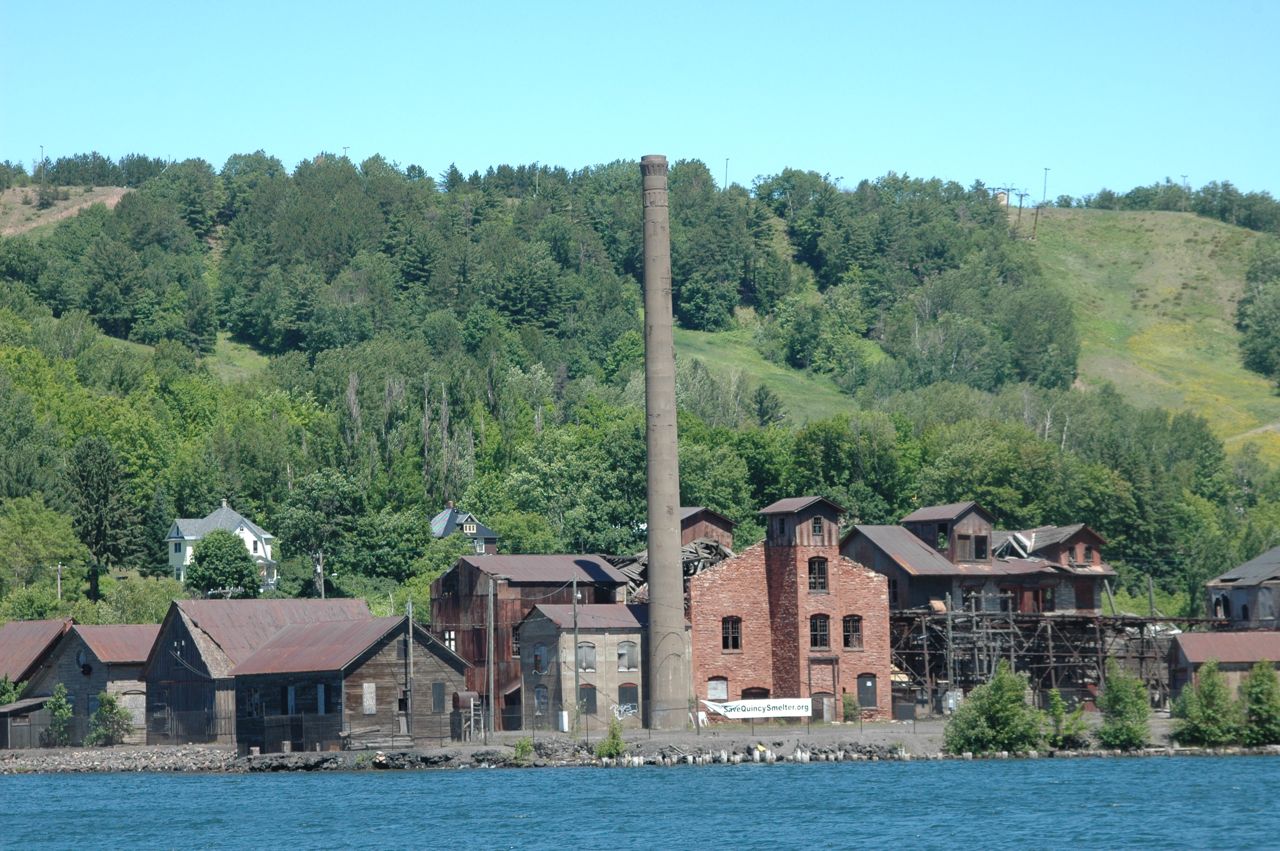
Quincy Smelter: The Last Copper Furnace Standing
A township once received a smelter as payment for a water tank. That transaction, in 1999, was just the latest improbable chapter for the Quincy Smelter, a complex that had already survived the Great Depression, a Superfund designation, and decades of abandonment on the shores of the Keweenaw Waterway. Built in 1898 on stamp sands left behind by the old Pewabic mill, the smelter was designed to save the Quincy Mining Company roughly $100,000 a year by processing copper on-site instead of shipping raw ore to Boston or Detroit. It did exactly that for over three decades, turning the Keweenaw Peninsula's native copper into refined metal while the industrial age demanded every ounce the Upper Peninsula could produce.
Built on Sand and Ambition
The Quincy Mining Company incorporated in 1848, during the earliest years of the Michigan copper rush. For decades, Quincy relied on stamp mills to crush copper-bearing rock and shipped the semi-processed mineral to distant smelters. But by the late 1890s, output justified building their own. In May 1898, construction began on the stamp sands where the Pewabic mill had dumped its waste. Workers dredged the shoreline and drove pilings for a loading dock, then laid foundations for the two critical buildings: the reverberatory furnace building and the cupola furnace building. By year's end, more than a dozen structures stood on the site. The smelter served not only Quincy's own mine but also processed copper from the Franklin, Adventure, Allouez, and Centennial mines, becoming a regional hub for the Keweenaw's copper industry.
Depression, War, and Decline
Low copper prices and the Great Depression forced the Quincy Mining Company to cease operations on September 22, 1931. The company boarded up everything, including the smelter. When copper prices recovered in 1937, the mine reopened, but instead of firing the smelter back up, Quincy sent its ore to Calumet and Hecla for processing. The smelter sat idle while World War II drove copper demand to new heights. In 1942, Quincy built a reclamation plant on Torch Lake to recover copper from the enormous volume of tailings that had accumulated in the lake over decades of mining. That reclamation operation ran from 1943 until 1971, interrupted only by a dredge lost in a 1956 storm and a ten-month pause in 1958. When Michigan's new environmental regulations arrived in 1971, Quincy finally abandoned the smelter for good, transferring ownership to the Quincy Development Corporation.
From Superfund to Sanctuary
The EPA placed the smelter within the Torch Lake Superfund site in 1986, adding it to the National Priorities List. When the Quincy Development Corporation's condominium plans fell through in 1999, Franklin Township acquired the smelter in lieu of payment for a water tank it had already built for the failed project. The EPA cleaned up the site starting in 2004, removing laboratory chemicals, testing for asbestos, building a chain-link fence, and stabilizing the shoreline with geotextile fabric and riprap. By 2008, asbestos had been removed from all twelve affected buildings. Public tours began as early as 2009, though visitors initially could not enter the buildings due to contamination and structural instability. A fire destroyed the carpentry shop in September 2010, and an ice house was demolished in 2015 because it was affecting surrounding groundwater pH.
The Only One Left
The Quincy Smelter holds a distinction no other industrial site in America can claim: it is the only remaining copper smelter from the early 20th century in the United States. The EPA has called it the best-preserved copper smelter in the country, and the Keweenaw National Historical Park Advisory Commission has gone further, suggesting it may be the only surviving copper smelter of its era anywhere in the world. The site contained 25 contributing buildings and 15 non-contributing buildings at the time of its historic designation. It sits within the boundaries of the Keweenaw National Historical Park, and in 2016, ASM International designated it as an ASM Historical Landmark. The National Park Service considered moving the mainland headquarters of Isle Royale National Park to the smelter site, but decided against it in 2017.
From the Air
Located at 47.13N, 88.56W on the north shore of the Keweenaw Waterway in Ripley, Michigan. From altitude, the smelter complex is visible as a cluster of industrial buildings jutting out from the waterway shoreline, built on the distinctive light-colored stamp sands of the former Pewabic mill. The Keweenaw Waterway cuts across the peninsula below, connecting Portage Lake to Lake Superior. Nearest airport is Houghton County Memorial Airport (KCMX), approximately 3 miles south. The Quincy Mine complex sits on the hill above to the north. Best viewed at 2,000-3,000 feet AGL for the relationship between the smelter, waterway, and surrounding mining infrastructure.