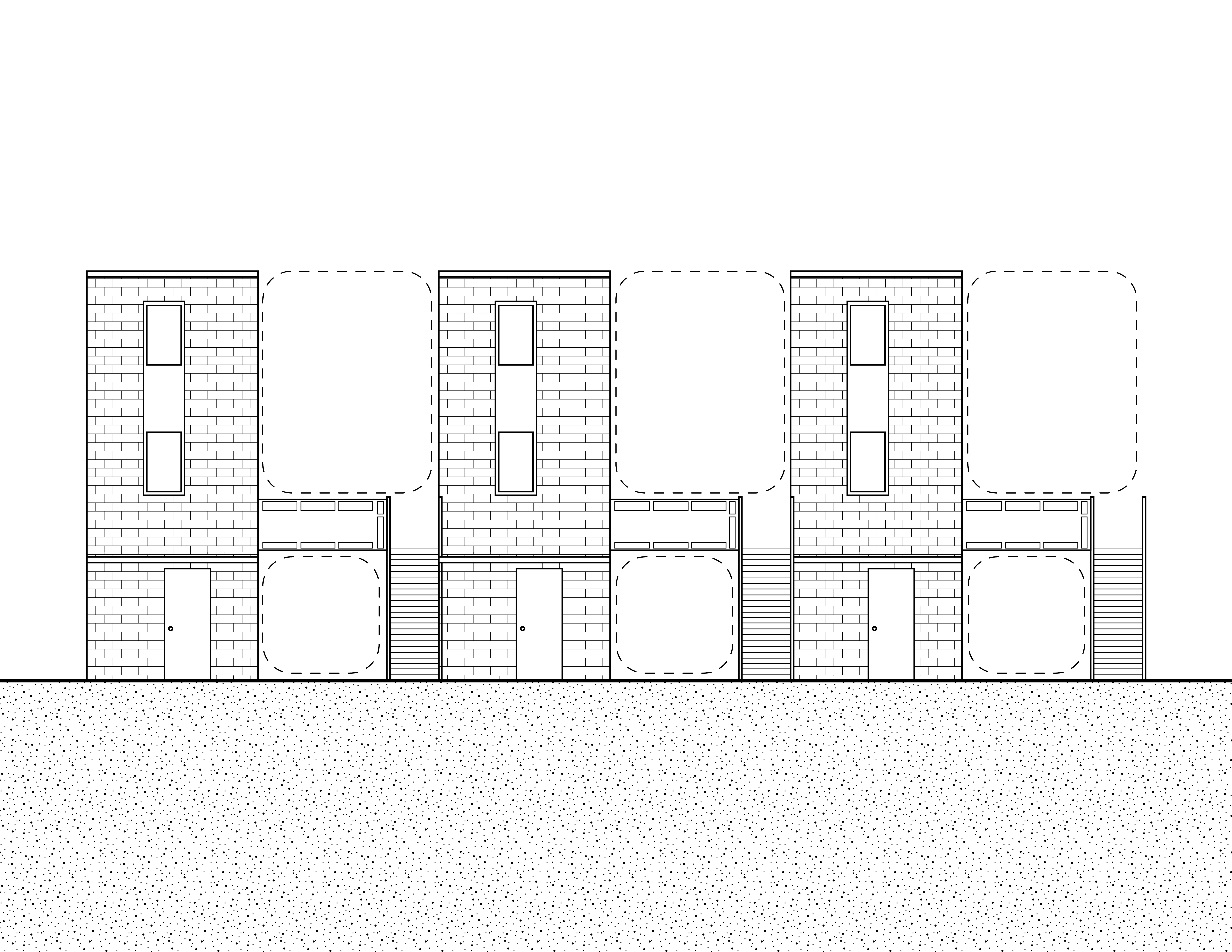
Quinta Monroy
What do you build when the budget covers half a house? Alejandro Aravena's answer, in a sun-blasted lot in central Iquique, was: exactly half a house. In 2003, the Chilean architect delivered 93 two-story units to families who had occupied the Quinta Monroy site informally since the 1960s. Each unit came with a kitchen, a bathroom, partition walls, timber stairs, and the essential plumbing and electrical infrastructure. The other half -- an open patio with the same footprint as the built portion -- was left deliberately empty, a framework for residents to fill according to their own needs, tastes, and budgets. Within a year, every home had doubled in value.
Squatters Who Refused to Leave
The Quinta Monroy site sits in a desirable part of central Iquique, a port city 1,700 kilometers north of Santiago with a population of roughly 200,000. For decades, 93 families lived there as informal occupants. When the former landlord died in 2000, land values had tripled, and the new owners threatened eviction. The residents appealed to the Chilean government, which turned to ELEMENTAL, the architecture firm Aravena had co-founded. The question was not abstract: these families needed homes they could afford, on land they refused to abandon. Relocation to cheaper parcels on the city's periphery would have solved the budget problem but destroyed the social networks, school access, and job proximity the families depended on. Aravena chose the harder path -- keeping them in place.
Ten Thousand Dollars and a Radical Idea
Through Chile's Vivienda Social Dinamica sin Deuda program, each family received the equivalent of $10,000. Of that, $2,500 went to land costs -- a steep price for social housing, since the central location consumed 70 percent of the project budget. That left roughly $7,500 per unit for construction. No conventional design could deliver a finished home at that price. Aravena flipped the constraint into a strategy: build the structural shell, the load-bearing walls, the complex parts that families could not easily do themselves -- the kitchen, the bathroom, the staircase, the roof. Leave everything else as an invitation. The result was 13 apartment blocks arranged around four communal courtyards, each unit a concrete-masonry box with a long vertical window at the front and an open framework beside it, waiting to be claimed.
What the Residents Built
Modifications began the day families moved in. Walls went up. Windows appeared. Rooms multiplied. Colors spread across facades -- blues, greens, pinks, yellows -- a spontaneous mural of individual taste painted over the architect's austere gray concrete. The project became a textbook example of what urbanists call "open urbanism," where professional design provides the skeleton and residents supply the flesh. Aravena's gamble paid off in measurable terms: property values doubled within twelve months. The project earned international acclaim and helped win Aravena the 2016 Pritzker Architecture Prize, the highest honor in the profession. The Pritzker jury cited his commitment to creating architecture that improves living conditions for the disadvantaged.
The Half That Complicates the Story
Not everyone celebrated. Critics Camillo Boano and Francisco Vergara Perucich argued that the half-a-house model shifts the burden of housing completion onto the people least able to bear it. "Why should the poor receive a half-house instead of a proper one?" they asked. The critique cuts to a genuine tension: many of the resident-built additions use low-durability materials that echo the informal conditions the project was meant to replace. The four communal courtyards, designed as shared social space, have been incrementally privatized as residents extend their homes into uncontested areas. What looks like empowerment from one angle looks like underfunded social policy from another. Quinta Monroy remains both a landmark of participatory design and an open question about what society owes its poorest members -- a half-finished argument, much like the houses themselves.
From the Air
Located at 20.23S, 70.14W in Iquique, Chile, along the northern Chilean coast. The site is a small urban block best identified from low altitude (1,000-2,000 feet AGL) by its distinctive layout of uniform apartment blocks surrounding courtyards, with colorful resident-added extensions visible against the original gray concrete. Nearest airport: Diego Aracena International Airport (SCDA), approximately 40 km south of Iquique. The Atacama Desert stretches east of the city, and the Pacific coastline runs immediately west.