Quintinshill Rail Disaster
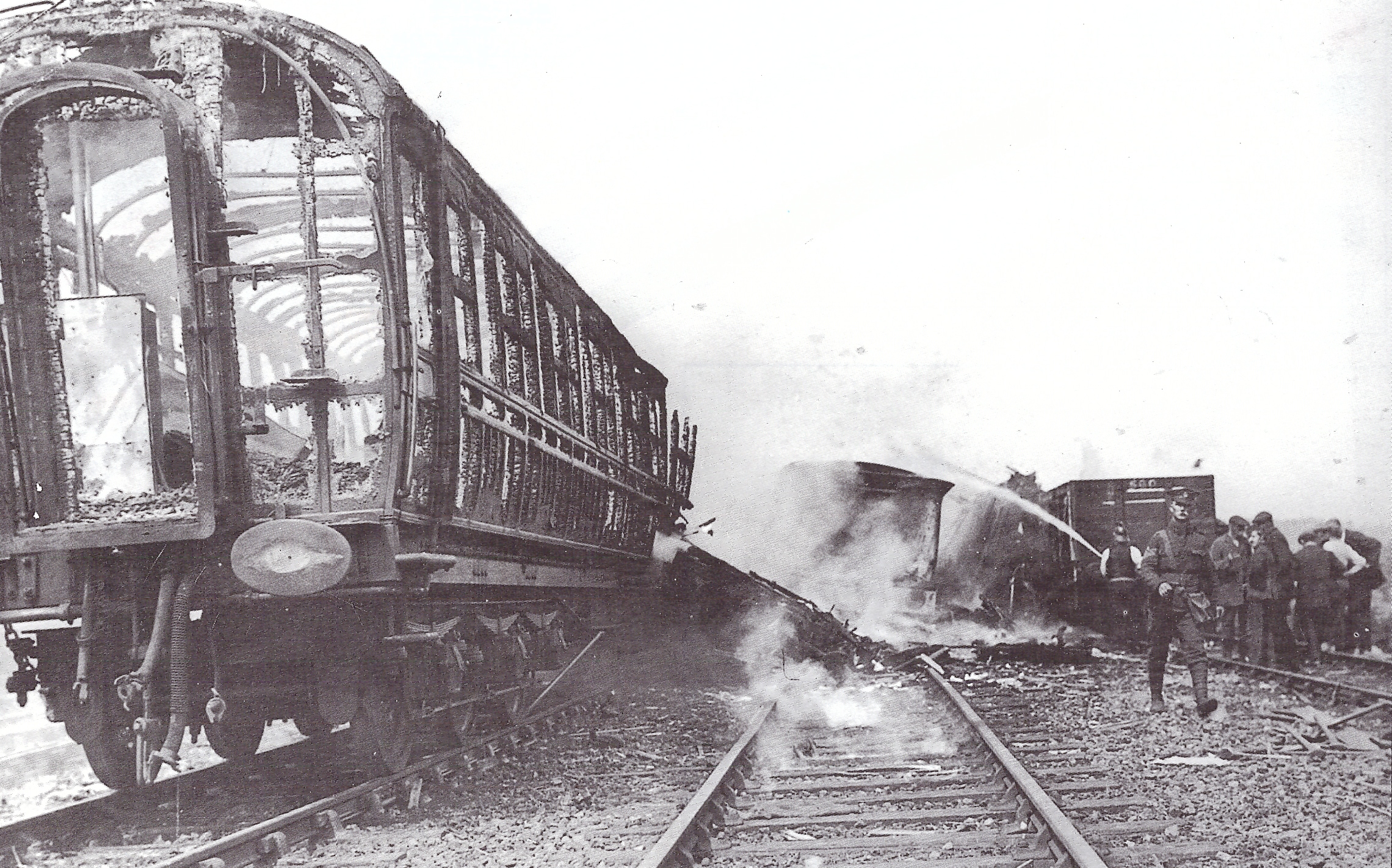
The soldiers of the 1/7th Leith Battalion, Royal Scots were heading for Gallipoli. They never arrived. On the morning of 22 May 1915, their troop train was hurtling south through Dumfriesshire toward Liverpool when it slammed into a stationary local passenger train at Quintinshill, a small signal box just north of Gretna Green. A minute later, an express from London ploughed into the wreckage. Fire broke out almost immediately. The old wooden carriages of the troop train, lit by Pintsch gas, burned so fiercely that many of the dead were never recovered. Britain's worst rail disaster had begun, and it was over in minutes.
A Tangle of Tracks and Mistakes
Quintinshill was an unremarkable point on the Caledonian Main Line between Glasgow and Carlisle, notable only for its two passing loops where slower trains could step aside for expresses. On that May morning, both loops were occupied by goods trains, and a northbound local had been shunted onto the southbound main line to clear the path for a late-running express. Into this crowded arrangement came the troop train at speed. The signalman who had just come on duty had failed to record the local train's presence, forgot the rules that should have prevented precisely this situation, and cleared the troop train to proceed. The collision was head-on. Within sixty seconds, the northbound London-to-Glasgow express struck the tangled wreckage from the opposite direction, compounding the destruction.
Fire and the Lost Roll
What turned a terrible collision into a catastrophe beyond reckoning was the fire. The troop train's carriages were old stock, gas-lit and built largely of wood. The Pintsch gas ignited on impact, and the flames spread through the wreckage of all five trains. The fire burned so hot and so long that some bodies were entirely consumed. The precise death toll was never established with certainty because the Royal Scots' regimental roll was also destroyed in the blaze. The official count settled at 226 dead, though some estimates run higher. Of the soldiers on the troop train, only half survived. Most of the dead were young Territorial soldiers from Leith, men who had volunteered to serve in the First World War and were being transported south toward the Dardanelles campaign. They died within sight of the Scottish border, on home soil.
Questions Without Clean Answers
The inquiry that followed focused on the signalmen, George Meakin and James Tinsley. Tinsley, who had just relieved Meakin, had arrived at the signal box by riding on the very local train that was then moved to the southbound line. He had sat directly on the train he would then forget existed. Both men were found guilty of gross neglect and sentenced to prison. But the disaster also exposed systemic failures: the use of outdated rolling stock for troop transport, the reliance on gas lighting when safer alternatives were available, and the absence of automatic train protection systems that could have overridden human error. Wartime pressures had crowded the railways with military traffic, stretching equipment and personnel thin at precisely the moment when the consequences of failure were highest.
The Memorial They Earned
Quintinshill left its deepest mark on Leith, the port district of Edinburgh where the 1/7th Battalion had been recruited. The community lost an entire generation's worth of young men in a single morning, not to enemy action but to a signalling error on a stretch of track in southern Scotland. The Rosebank Cemetery in Edinburgh holds the remains of many of those recovered. A memorial stone at Quintinshill, near the site where the signal box once stood, marks the place where so many journeys ended. The disaster also drove railway safety improvements, though the reforms came slowly. Today, the site is a quiet stretch of the West Coast Main Line, its passing loops long since removed. Trains still run through at speed, carrying passengers who have no reason to know what happened here. The ground remembers, even when the tracks do not.
From the Air
Located at 55.00N, 3.07W near Gretna Green in Dumfriesshire, just north of the Scotland-England border. The site is along the West Coast Main Line, visible as a straight stretch of railway in flat farmland near the Solway Firth. Nearest airports: Carlisle Lake District (EGNC) approximately 8 nm south; Glasgow (EGPF) approximately 60 nm north. Best viewed at 2,000-3,000 ft AGL.