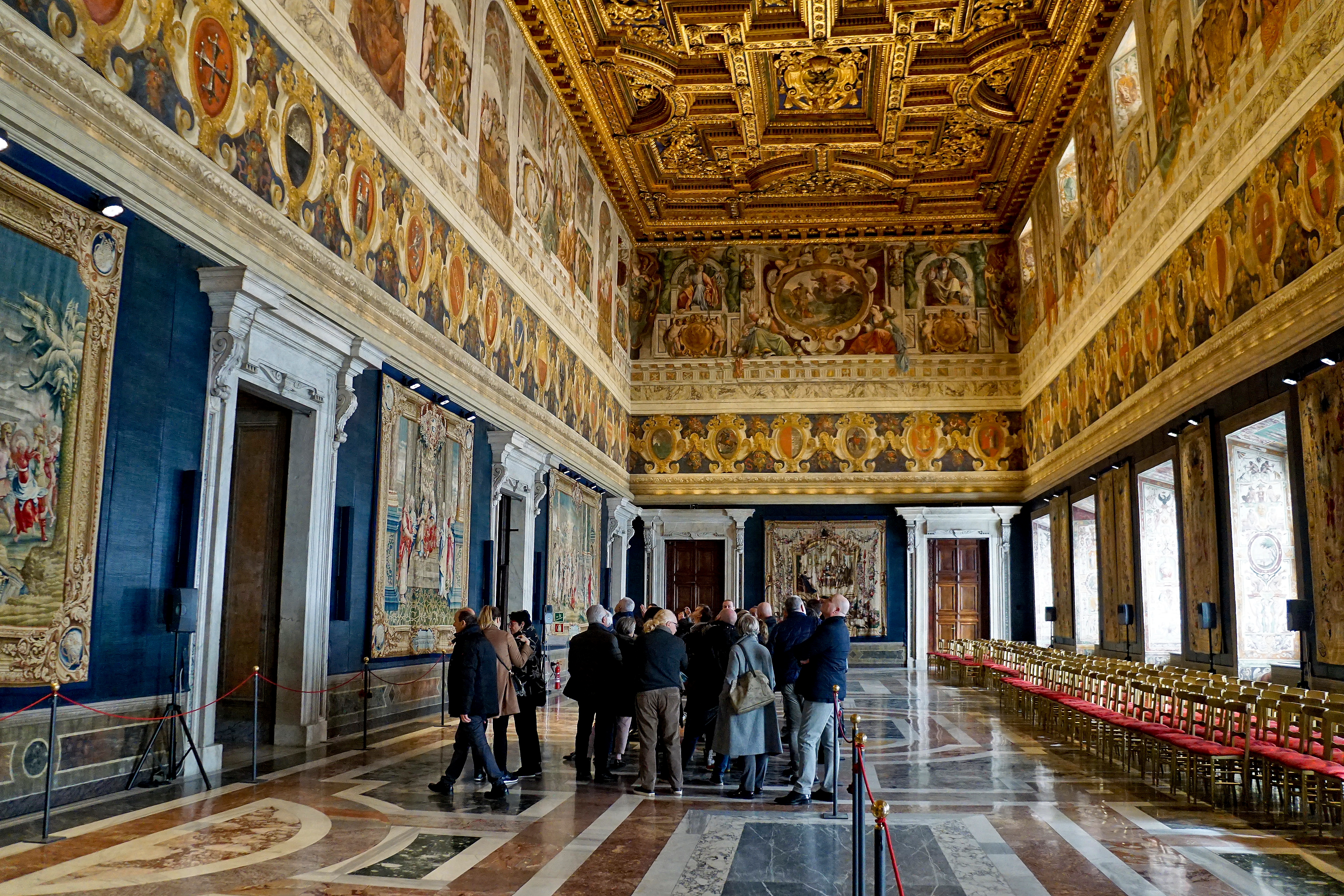
Quirinal Palace
Napoleon chose it as his imperial residence in Rome. He never spent a single night there. That failed claim is perhaps the most telling detail about the Quirinal Palace: for over four centuries, the building atop Rome's highest hill has attracted power the way gravity attracts mass, drawing popes, monarchs, and presidents into its 1,200 rooms regardless of how the political winds shift. Built in 1583 because a pope wanted to escape the stench of the Tiber, the palace has since served as the seat of the papacy, the throne of the Kingdom of Italy, and -- since 1946 -- the official residence of the Italian Republic's president. At 110,500 square meters, it is the eleventh-largest palace in the world, and arguably the one with the most turbulent political history.
Escaping the Tiber's Stench
The Quirinal Hill had attracted the powerful long before any palace stood here. In ancient times, Roman patricians built luxurious villas on its slopes -- the highest point in the city made it cooler in summer and offered commanding views. Temples to Flora and Quirinus rose among the estates, and during the reign of Constantine the Great, the last great complex of Roman baths was constructed nearby. The statues of Castor and Pollux taming horses that still decorate the piazza's fountain are survivors from that era. When Pope Gregory XIII commissioned architect Ottaviano Mascherino to build a summer residence here in 1583, the motivation was bluntly practical: the Lateran Palace was unhealthy, and the humidity and stench rising from the Tiber made the Vatican unpleasant during warm months. Mascherino incorporated a small villa already on the site, owned by the Carafa family, creating porticoed wings around an internal courtyard topped by the panoramic Torre dei Venti.
Four Popes Elected Here
Gregory XIII died in 1585 before the palace was complete, but his successors kept building. Pope Paul V commissioned the completion of the main structure between 1605 and 1621. The Pauline Chapel was constructed to match the dimensions of the Sistine Chapel exactly, so that papal ceremonies could be replicated in either location. Four popes were elected within its walls, during conclaves held in 1823, 1829, 1831, and 1846. The palace's facade, designed by Domenico Fontana, became one of Rome's defining architectural statements, while inside, Guido Reni painted frescoes and Melozzo da Forli contributed the Blessing Christ above the grand staircase. Carlo Maderno designed the Great Chapel; Francesco Borromini added the bell tower. The Quirinal was not merely a residence but a working center of papal government, housing the central offices of the Papal States until the very end.
From Tiara to Crown
That end came in September 1870, when Italian troops occupied what remained of the Papal States and annexed them to the new Kingdom of Italy. Five months later, Rome became the national capital, and the Quirinal Palace became the royal residence. The transition was less dramatic inside the walls than it might seem -- power simply changed hands, and the rooms adapted. The old throne room became the Great Hall of the Cuirassiers. The consistory room where cardinals had met became the Great Hall of Banquets, hosting state dinners. Not every king actually lived there: Victor Emmanuel III, who reigned from 1900 to 1946, preferred his private Villa Savoia and used the Quirinal mainly for official functions. Napoleon had designated the palace as his Roman residence par excellence, but the French defeat in 1814 ensured he never occupied it.
Rooms That Remember Everything
The palace is a palimpsest of power. The Yellow Room was once part of a seventy-meter gallery built by Pope Alexander VII; Napoleon ordered it divided to create private apartments for his empress. Under the republic, the Napoleonic decorations were stripped away, revealing the original papal ornaments underneath. The Hercules Room was carved out of private papal apartments during the Savoy era, its walls hung with tapestries depicting the twelve labors. The Chapel of the Annunciation, the palace's smaller chapel, was deconsecrated by the Savoy dynasty and used by servants to wash dishes. The Mascarino Staircase, an extraordinary spiraling ramp designed by Ottaviano Mascarino for the original Gregorian building, was nearly demolished by Savoy princes who wanted a large ballroom -- only the excessive cost of destruction saved it. Each room bears the fingerprints of every regime that has passed through.
The Republic's Hill
Since the monarchy's abolition in 1946, the Quirinal has served as the official residence of the Italian president, though not every occupant has embraced it. President Sandro Pertini famously preferred his own flat near the Trevi Fountain to the formality of the hill. The four-hectare gardens, an elevated green island above the city, preserve a 17th-century formal layout alongside an 18th-century romantic garden and the elegant Coffee House built by Ferdinando Fuga for Pope Benedict XIV. A trap door in the gardens leads to archaeological excavations revealing the remains of the original temple to Quirinus and Roman insulae from the imperial age. Since 1997, a water organ fed by an 18-meter waterfall has played in the gardens -- a modern addition that somehow fits a place where ancient temples, papal chapels, royal ballrooms, and republican offices have all occupied the same ground. The Quirinal endures not because any single ruler perfected it, but because every era found it indispensable.
From the Air
Located at 41.90°N, 12.49°E on Rome's Quirinal Hill. The palace compound is visible from the air as a large rectangular complex with distinctive gardens. At 2,000-3,000 ft AGL, look for the long Manica Lunga wing extending southeast. Palazzo Barberini lies one block northeast; Bernini's Sant'Andrea al Quirinale and Borromini's San Carlo alle Quattro Fontane are nearby. The Trevi Fountain sits to the west. The nearest major airport is Rome Fiumicino (LIRF/FCO), approximately 30 km southwest. Rome Ciampino (LIRA/CIA) lies about 15 km southeast.