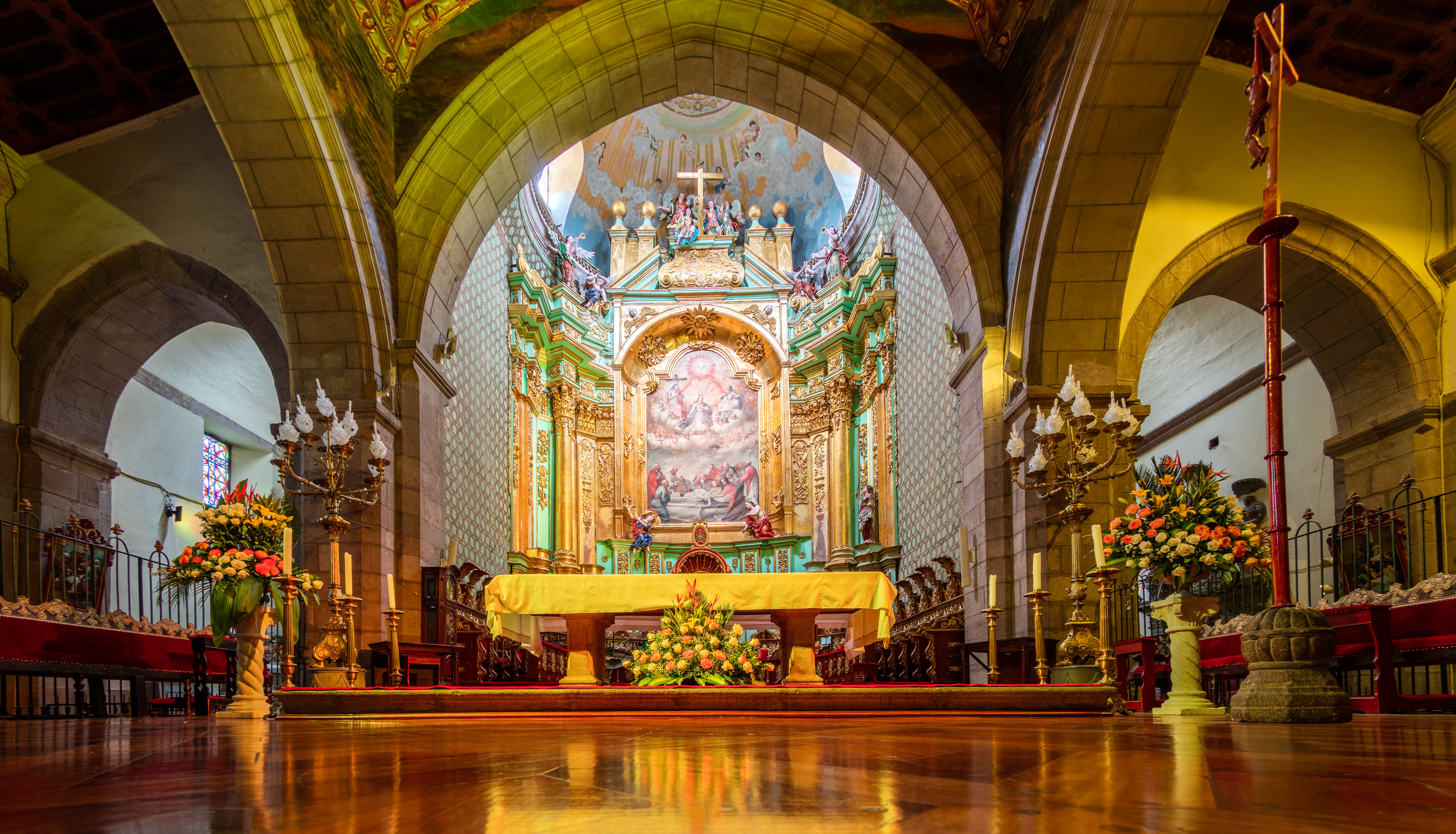
Quito Metropolitan Cathedral
On Good Friday morning, 30 March 1877, the Bishop of Quito lifted the chalice and drank. The wine had been laced with strychnine. Jose Ignacio Checa y Barba died before the mass concluded, murdered at his own altar. Two years earlier, President Gabriel Garcia Moreno had been hacked with a machete and shot on the steps of the adjacent presidential palace, then carried dying into the cathedral's side chapel of Nuestra Senora de los Dolores. A small plaque still marks the spot. The Quito Metropolitan Cathedral has absorbed more Ecuadorian history than any other building on the continent, and it wears the weight plainly.
Built on a Ravine
Construction began in 1535, barely a year after the Spanish founded San Francisco de Quito on the ruins of an Inca city. The entire southern edge of the future Plaza Grande had already been reserved for the Church, and Father Juan Rodriguez threw up a shelter of adobe, wood, and thatch to serve as Quito's first parish. The permanent building came next, raised by the architect Antonio Garcia using the minga system, an indigenous Andean tradition of communal labor in which neighbors hauled stone, carved beams, and mortared walls together. But there was a problem. A deep gorge called the quebrada de Sangunia cut across the rear of the property, blocking extension to the southwest. The cathedral was forced to turn its flank to the plaza instead of its face, an anomaly it carries to this day.
Earthquakes and Ceilings
Quito sits on a seismic spine. The cathedral has been shaken, cracked, and patched across four centuries. A modest tremor in 1755 required minor repairs. The catastrophic 1797 earthquake, the same one that leveled Riobamba to the south, forced a major reconstruction of the interior. The artist Manuel Chili, known by the mestizo nickname Caspicara, is said to have joined the work, installing a new choir and replacing a 17th-century canvas with his teacher Manuel de Samaniego's El Transito de la Virgen. The original 16th-century Mudejar coffered ceiling was replaced with a copy. That copy was itself replaced in the mid-20th century, destroying in the process a mysterious mural that may have dated to the 1600s. After the 1987 earthquake, engineers drove micropiles deep into the old foundations to keep the whole structure standing.
The Carondelet Arch
Between 1797 and 1799, the twentieth president of the Real Audiencia of Quito, the Flemish-born Baron Hector de Carondelet, commissioned an elaborate side entrance with a curving staircase sweeping down to the plaza. Engineered by another Antonio Garcia, a Spanish military man, the Carondelet Arch solved the cathedral's awkward orientation by giving the building a proper face toward the square. A long stone parapet runs the length of the plaza-side wall, decorated with spheres and pyramids and masking the steep drop between cathedral floor and plaza level. Three domes glazed in green ceramic rise above the roof, and atop the transept dome sits an iron rooster weather vane that has generated its own local legends, its silhouette familiar to anyone who has ever looked up while crossing the square.
The Catacombs
Below the cathedral lie some of the most consequential figures in Ecuadorian history. Antonio Jose de Sucre, the Venezuelan general who defeated the Spanish at the Battle of Pichincha in 1822 and liberated what would become Ecuador, rests in his own Mausoleum Chapel. Assassinated in a Colombian forest in 1830 at age thirty-five, Sucre's remains were eventually brought home to Quito. Several Ecuadorian presidents and dozens of bishops share the crypt. The catacombs make the cathedral something more than a place of worship. They make it a national reliquary, the closest thing Ecuador has to a pantheon, holding the bones of nearly everyone who shaped the republic's first century.
Quito School
Inside, the three naves rise on pointed arches supported by square pillars, a Gothic-Mudejar hybrid that experts still debate how to classify. Cedar paneling lines the central nave in a distinctly Moorish register. Along the right wall, five chapels open one after another, each topped by a small dome with a skylight. The reredos glow with gold leaf applied by early masters of the Quito School, the colonial art movement centered at the nearby Church of St. Francis that fused European iconography with indigenous craft traditions. Caspicara himself was one of its luminaries. Niches hold saints and martyrs carved in wood, polychromed, their glass eyes catching the filtered light. The Assumption of the Virgin from 1793 hangs above, part of a living collection that has accumulated for nearly five centuries.
From the Air
Located at 0.22 S, 78.51 W in central Quito on the Plaza de la Independencia. Altitude 2,850 m. Recommended viewing altitude 4,000 to 5,000 m above the surrounding valley. The nearest major airport is Mariscal Sucre International (SEQM), about 18 km east of the historic center. The cathedral's green glazed domes and white facade stand out against Quito's terracotta roofscape, with Panecillo hill to the south and Pichincha volcano looming to the west.