Qumran
In 1947, a Bedouin shepherd named Muhammed edh-Dhib threw a stone into a cave above the Dead Sea and heard something shatter. What broke was a clay jar containing leather scrolls that had been sealed in darkness for two thousand years. That accident -- a boy looking for a lost goat, a stone tossed into shadow -- triggered one of the twentieth century's most significant archaeological discoveries: the Dead Sea Scrolls. The caves that yielded them riddle the cliffs above Qumran, a ruined settlement on a dry marl plateau 1.5 kilometers from the northwestern shore of the Dead Sea. Between 1947 and 1956, eleven caves produced roughly 900 manuscripts, including the oldest known copies of books from the Hebrew Bible. The ruins below the caves, once dismissed as a minor Roman fort, turned out to be far more interesting.
A Community at the Edge of the World
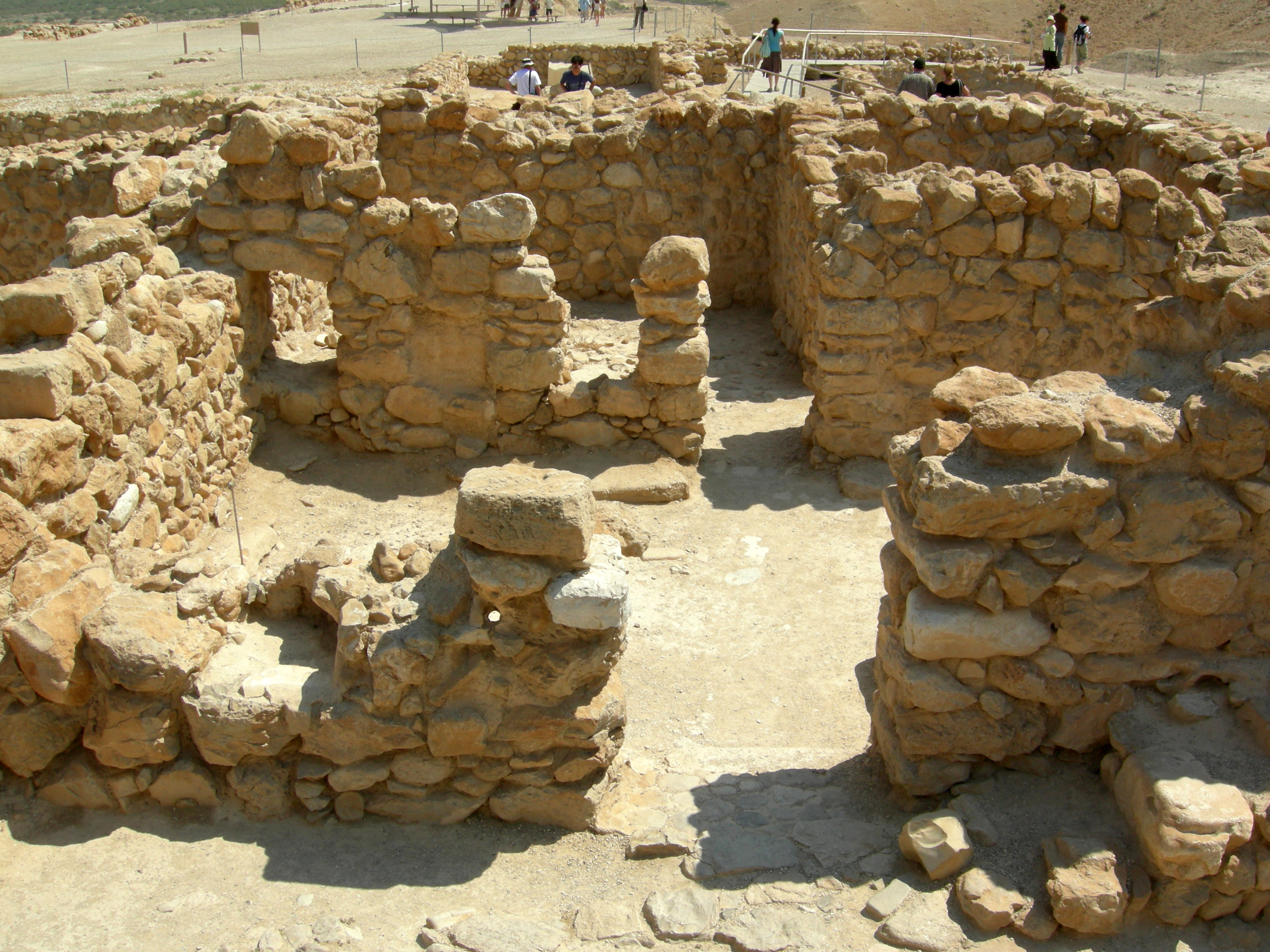
The settlement was established during the Hasmonean period, most likely during or shortly after the reign of John Hyrcanus in the late second century BCE. Most scholars identify its inhabitants as Essenes -- a Jewish ascetic sect described by the ancient historians Josephus, Philo, and Pliny the Elder. Pliny placed the Essenes on the western shore of the Dead Sea, north of Ein Gedi, which aligns precisely with Qumran's location. The community that lived here practiced ritual purity with an intensity that shaped the very architecture of the site: at least ten stepped cisterns and ritual immersion pools, called miqva'ot, were carved into the plateau, fed by an elaborate system of channels and aqueducts that captured rare flash-flood water from Wadi Qumran. In a landscape where rain almost never falls, engineering water for purification was itself an act of devotion.
The Scriptorium Debate
Among the ruins, Father Roland de Vaux, the Dominican archaeologist who led the major excavations from 1951 to 1956, identified a long room furnished with plaster benches and inkwells as a scriptorium -- a writing room where the scrolls may have been copied. The identification remains debated. Some scholars argue the inkwells could have been used for record-keeping at what was essentially a commercial estate; others note that the quantity and variety of manuscripts found in the caves suggest a library assembled from multiple sources rather than a single workshop's output. What is not debated is the scale of the textual treasure: the scrolls include every book of the Hebrew Bible except Esther, along with previously unknown sectarian texts like the Community Rule, the War Scroll, and the Temple Scroll. These documents revolutionized understanding of early Judaism, revealing a religious landscape far more diverse and fractious than later tradition preserved.
Destruction and Silence
The settlement shows evidence of a violent end. Roman forces destroyed Qumran during the First Jewish-Roman War, likely in 68 CE, as Vespasian's legions moved through the Jordan Valley toward Jerusalem. Arrowheads found in the ruins and a layer of ash confirm the assault. Before the Romans arrived, the community apparently hid their library in the surrounding caves -- a desperate act of preservation that succeeded beyond anything they could have imagined. The scrolls survived because the Dead Sea region's extreme aridity -- hot, dry air and low humidity at 400 meters below sea level -- created a natural preservation environment. Parchment that would have disintegrated in centuries elsewhere endured for two millennia in sealed jars within limestone caves. After the destruction, the site was briefly occupied by a Roman garrison, then abandoned to the desert.
Excavating the Arguments
Not everyone agrees Qumran was a religious community. Alternative theories have proposed that the site was a commercial entrepot, a pottery factory, a fortified manor house, or a winter estate connected to Jericho. Yizhar Hirschfeld suggested it was a fortified manor of the type found throughout the Judean Desert; Yizhak Magen and Yuval Peleg, who conducted excavations between 1993 and 2004, argued it was a pottery production center with no direct connection to the scrolls. The debate matters because it determines how we read the manuscripts themselves: as the products of a specific community living in isolation, or as a broader sample of Second Temple Judaism that was stored here for safekeeping. The cemetery to the east of the site, containing over a thousand graves oriented north-south, adds complexity -- most burials are male, but some female skeletons have been found, and some burials may date to medieval times.
The Plateau Today
Qumran sits within a national park managed by the Israel Nature and Parks Authority, in territory the international community considers occupied. Visitors walk through the excavated ruins -- the communal dining hall with its stacked pottery, the channels that once carried rainwater to the ritual baths, the tower that may have served as a defensive lookout or simply a storehouse. The caves are visible in the cliff face above, dark mouths in the pale limestone. The Dead Sea shimmers below, its surface 430 meters below sea level, retreating year by year as its tributaries are diverted. The scrolls themselves are 50 kilometers away in the Shrine of the Book at the Israel Museum in Jerusalem, housed under a white dome shaped like the jar lids that protected them for twenty centuries. At Qumran, what remains is the landscape: the barren plateau, the bone-dry wadis, and the caves where a shepherd's thrown stone changed what we know about the origins of Western religion.
From the Air
Located at 31.742N, 35.460E on a marl plateau near the northwestern shore of the Dead Sea, at approximately -370m below sea level (the plateau itself sits about 30-50m above the Dead Sea shore). The site is visible from the air as excavated ruins on a pale, barren terrace with cliff caves above. The Dead Sea stretches to the east and south. Nearest airports: Ben Gurion International (LLBG) approximately 75 km west-northwest, and Ein Yahav Airfield (LLEY) to the south. The descent from Jerusalem (750m) to the Dead Sea (-430m) is one of the most dramatic elevation changes visible from the air anywhere on Earth.