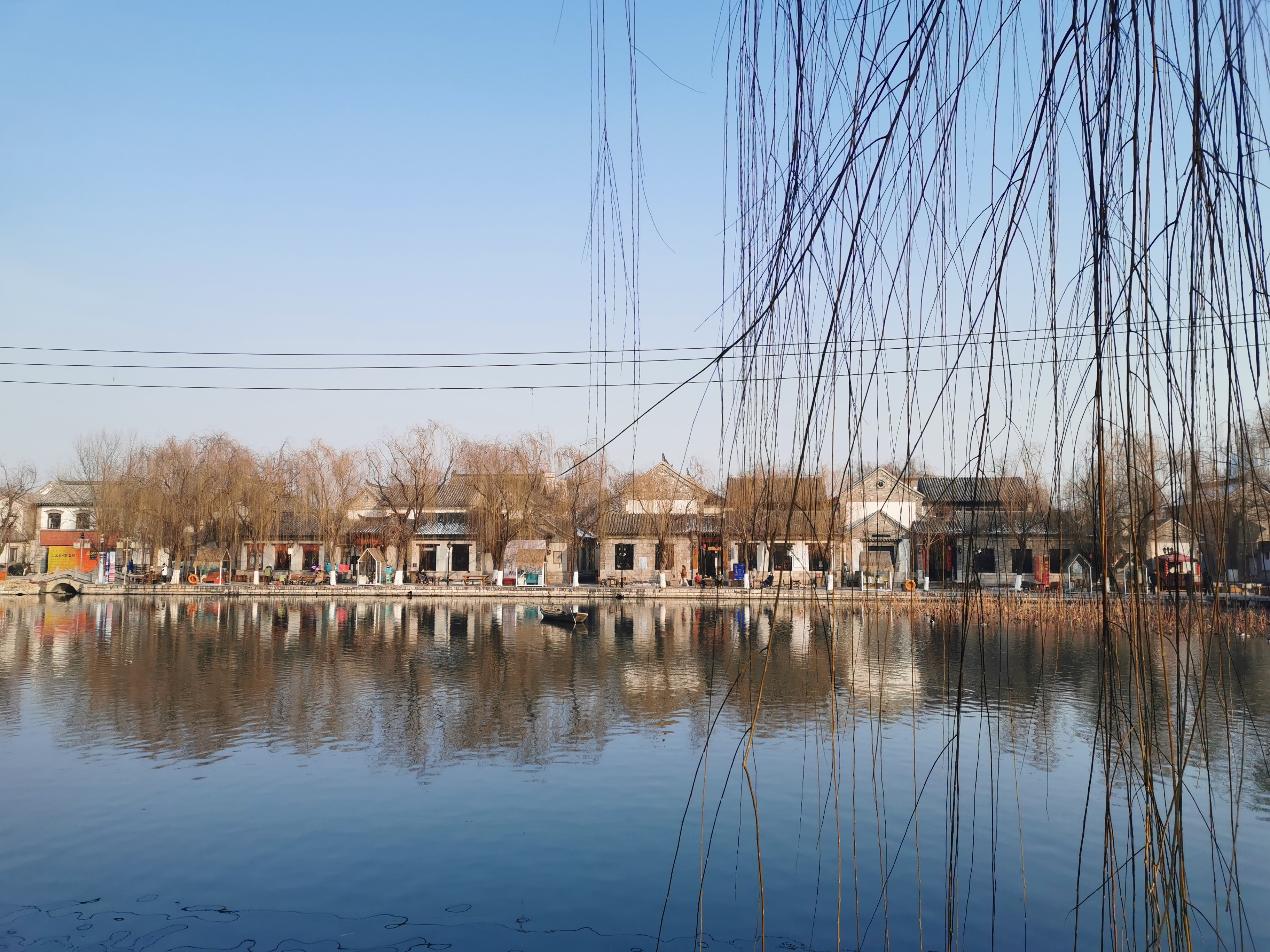
Qushuiting Street
On the third day of the third month, by the old calendar, the scholars of Jinan gathered at the Palace Pool to wash themselves clean. Then they sat along Qushui Creek and floated cups of wine downstream on small wooden trays. When a cup stopped in front of you, you composed a poem. If the poem displeased the crowd, you drank. This ritual played out annually along what is now Qushuiting Street, a willow-lined alley barely three meters wide that threads through the historic center of Jinan. The tradition dates to the Northern Wei dynasty, around the fifth century, and continued for over a thousand years until the Qing dynasty brought it to an end.
A Creek Runs Through It
Qushuiting Street follows the course of Qushui Creek -- the Winding Water Creek -- for roughly 520 meters through Jinan's Lixia District. The creek flows northward from the Palace Pool, which is itself the spring pool of the Zhuoying Spring, one of Jinan's 72 famous springs. Along its course, the street passes the Fuxue Confucian Temple and the Hundred Flower Pond before ending on Daming Lake Road, just south of the great lake itself. Willow trees line nearly the entire length of both creek and street, their branches trailing into the water. At an average width of just 2.86 meters, the alley feels more like a garden path than a city street -- an intimate corridor of moving water and green shade winding through a modern metropolis.
Wine Cups and Verse
The poetry-and-drinking festival that defined this street for centuries was no casual gathering. Scholar-bureaucrats -- the educated officials who ran the imperial administration -- would first ritually cleanse themselves at the Palace Pool. The banquet that followed was structured around the creek itself, which served as both stage and judge. Cups of alcohol drifted on the current, and wherever they paused, a participant was expected to produce verse on the spot. Bad poetry carried a penalty: more drinking. The format rewarded quick wit and literary grace, turning the narrow waterway into a competitive literary salon. It was, in essence, a drinking game designed by Confucian intellectuals -- rigorous and convivial in equal measure.
Every Family Has Spring Water
Qushuiting Street is more than a historical curiosity. It stands as a living emblem of Jinan's identity as the City of Springs. The late-Qing novelist Liu E captured this perfectly in his 1907 novel The Travels of Lao Can, writing of a neighborhood that matches this street: "Every family has spring water, every household has a willow tree." That image -- artesian water flowing openly through a residential neighborhood, private homes built right to the water's edge, willows drooping overhead -- still describes what you see walking Qushuiting Street today. In a city that has grown into a sprawling capital of nine million people, this narrow alley preserves the texture of a Jinan that once defined the entire urban landscape.
The Spring City's Living Thread
Jinan sits atop one of the most prolific karst aquifer systems in China, and its springs have shaped the city's culture, architecture, and daily life for millennia. Qushuiting Street is the most concentrated expression of that relationship. Where other cities channeled their water underground or walled it behind infrastructure, Jinan let it run through the streets and into people's lives. The creek that gives Qushuiting its name is not decorative -- it is geology made visible, groundwater rising through limestone and flowing through a neighborhood as naturally as it flows through the bedrock beneath. Walking the street today, with the willows overhead and the water audible at your feet, you understand why the scholars kept coming back.
From the Air
Located at 36.67°N, 117.02°E in the historic center of Jinan, Shandong Province. The street runs between the Zhuoying Spring and Daming Lake. Nearest airport is Jinan Yaoqiang International Airport (ZSJN), approximately 30 km to the northeast. Best viewed at lower altitudes; look for Daming Lake as a landmark and the dense historic district south of it. Elevation approximately 30 meters above sea level.