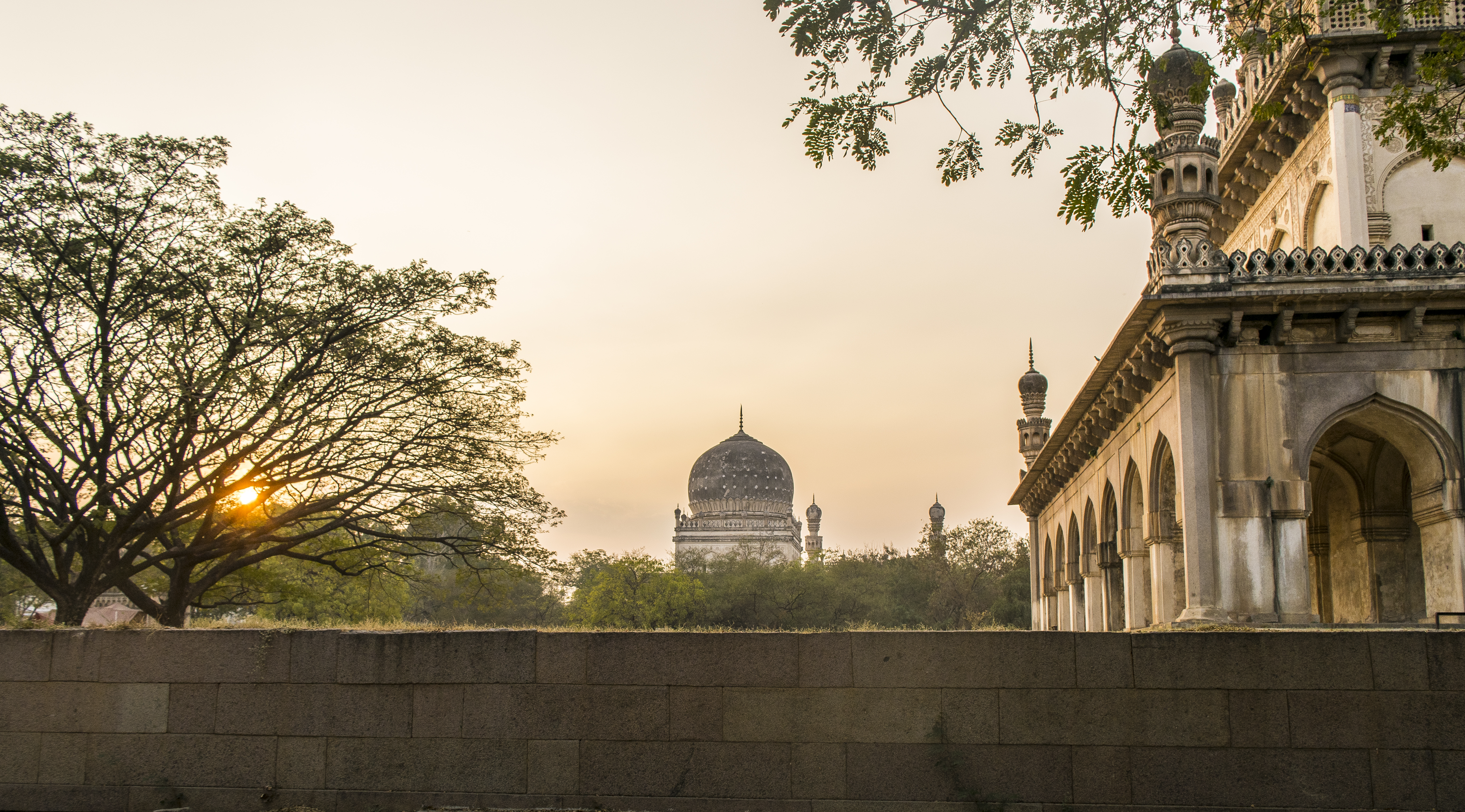
Qutb Shahi Tombs
Golden spires once distinguished the tombs of sultans from those of lesser royals. Carpets covered the floors, chandeliers hung from the ceilings, and velvet canopies draped on silver poles framed each sarcophagus while Quran readers recited verses at regular intervals. That was the Qutb Shahi tombs in their prime -- a necropolis so revered that even after a sultan's death, his tomb received the daily attention of a living court. Then, in 1687, the Mughal army arrived to besiege Golconda Fort, and the tombs became barracks. Guns were mounted on the mausoleums to bombard the very fortress the sultans had built. The transformation from sacred ground to artillery platform captures, in a single image, the violent end of a dynasty that had ruled from Golconda for over 170 years.
A Garden of the Dead
The tomb complex sits just north of the outer perimeter wall of Golconda Fort, past the Banjara Darwaza -- the Gate of the Gypsies -- amid the grounds of the Ibrahim Bagh, a garden precinct. Seven of the eight Qutb Shahi sultans are buried here, along with queens, princes, and other members of the royal household. The tombs form a dense cluster on a raised platform: domed structures rising from square bases, surrounded by pointed arches that blend Persian and Indian architectural forms. The smaller tombs have single-story galleries; the larger ones rise to two stories. At the center of each tomb, a sarcophagus sits above the actual burial vault in a crypt below. The domes were originally overlaid with glazed blue and green tiles, of which only scattered fragments now remain -- hints of a brilliance that once made these structures visible across the landscape.
The Tallest Structures in Hyderabad
When they were completed, the tombs of Sultan Quli, Jamsheed Quli, and Ibrahim Quli were the tallest structures in Hyderabad. Consider what that meant: in a city being built to rival the great capitals of the Islamic world, the monuments to the dead stood taller than any palace or mosque the living had constructed. The Qutb Shahi rulers invested in their afterlife architecture with the same ambition they brought to their fortifications and gardens. The carved stonework is intricate and assured, each tomb displaying the evolving style of its period -- from the relatively restrained early tombs to the more elaborate later ones. The complex also includes mosques, a hammam, and step-wells, creating a self-contained precinct that served both the spiritual needs of the dead and the ritual needs of the living who came to honor them.
Siege, Neglect, and Rediscovery
The Mughal siege of 1687 marked the beginning of centuries of decline. After Aurangzeb's forces captured Golconda, the tombs lost their royal caretakers and the ritual observances that had maintained them. The grounds became overgrown, stonework crumbled, and the once-brilliant tile domes faded to bare masonry. It was not until Sir Salar Jung III ordered a restoration in the nineteenth century that the complex received attention again. A garden was laid out, a compound wall built, and something of the original serenity returned. In 2014, UNESCO placed the tombs on its tentative World Heritage list under the name Monuments and Forts of the Deccan Sultanate, recognizing the site's architectural significance alongside Golconda Fort and the Charminar.
A Decade of Renewal
Beginning in 2013, the Telangana State Archaeology and Museums Department partnered with the Aga Khan Trust for Culture to undertake a comprehensive restoration of the tomb complex. The US Ambassadors Fund for Cultural Preservation funded the restoration of the historic step-wells within the grounds. Work paused during the COVID-19 pandemic but resumed afterward, and the results have been transformative. Structures that had deteriorated for centuries were stabilized, gardens were replanted, and the complex was reimagined as a heritage park. The restoration has revealed details long hidden under grime and vegetation -- carved calligraphy, ornamental plasterwork, the traces of painted interiors. Walking through the complex today, past the restored gardens and the cleaned stonework, the tombs communicate something of the reverence the Qutb Shahi dynasty invested in honoring its dead. All except the last sultan lie here, in a garden their dynasty planted and an empire their successors destroyed.
From the Air
Located at 17.395N, 78.396E in Hyderabad, Telangana, India, just north of Golconda Fort. The tomb complex is visible from the air as a cluster of domed structures surrounded by gardens, adjacent to the larger fortification of Golconda. Best viewed at 2,000-4,000 feet AGL. The distinctive domes on raised platforms are identifiable against the surrounding urban landscape. Nearest airport: Rajiv Gandhi International Airport (VOHS), approximately 25 km to the south. The complex sits in western Hyderabad, with Golconda Fort's massive walls and bastions providing a prominent visual reference point.