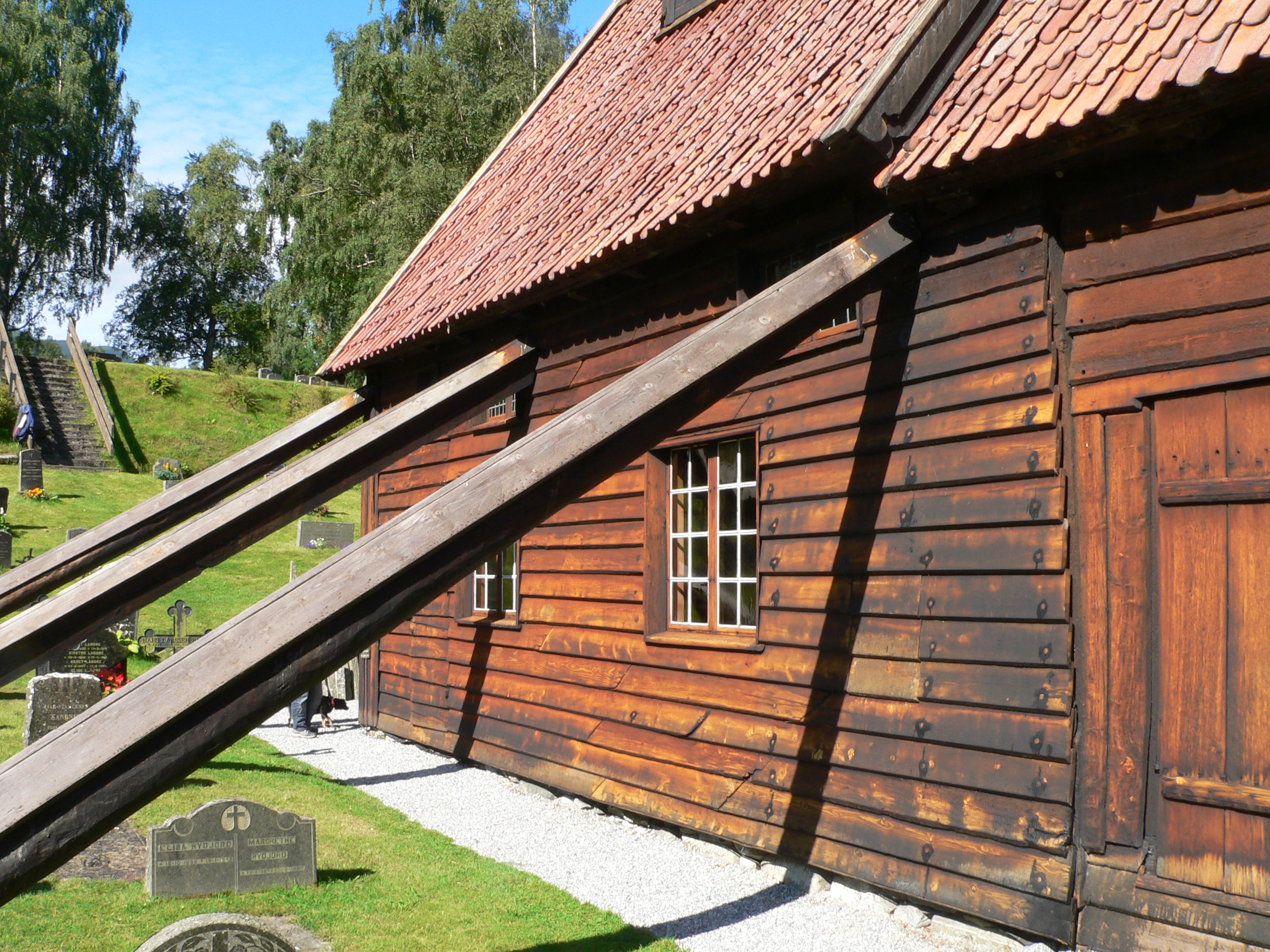
Rodven Stave Church
Once a year, on Olsok -- the eve of St. Olav's Day -- a worship service is held inside a brown wooden church in the village of Rodven. The congregation fits comfortably: the building seats about a hundred. What makes the occasion remarkable is not the size of the gathering but the age of the walls around it. Rodven Stave Church was built in the twelfth century, and the ground beneath it held an even older church before that. For more than eight hundred years, this small structure on the Romsdal coast has refused to fall down, though the elements have tried their best.
Timber Upon Timber
The church that stands today is not the first on this site. Archaeological excavations led by Hakon Christie in 1962-1963 uncovered postholes from an earlier structure, confirming that a previous church occupied the same ground -- likely built during the 1100s as an annex subordinate to the Old Veoy Church parish. That first building stood for nearly two hundred years before being dismantled and replaced. The replacement was also a stave church, built using the distinctive vertical post-and-plank construction that gives the type its name. Some materials were likely reused from the predecessor, including the north portal with its ornately carved crucifix, which scholars believe dates to the original twelfth-century building. The new church featured a rectangular nave and a narrower rectangular choir on the east end, with a small tower crowning the roof.
Storms and Stubborn Repairs
Around 1600, the old choir was torn down and rebuilt three meters wider, bringing it to the same width as the nave. The exterior corridors that once encircled the building were removed during this renovation. A sacristy was added to the north side of the choir in 1651. Then, in 1689, a violent storm ripped the tower from the roof. A quick fix followed -- but it was only meant to be temporary. The church languished for more than twenty years before significant repairs arrived. In 1712, master builder Hans Knutsen from Molde led a major renovation: structural repairs to walls and roof, a new church porch on the west end, a completely new roof and tower, and a fresh altar and pulpit inside. He also installed exterior support beams -- four at the corners and two along each long wall -- to brace the aging structure. These external supports define the church's silhouette today and classify it as a More-type stave church.
Retired but Not Forgotten
By 1900, the parish was reorganizing. Holm parish was established in 1901, and three new churches in the dragestil style replaced the region's medieval buildings. Architect Jens Zetlitz Monrad Kielland designed a new chapel just forty meters north of the stave church, across the road. When this new Rodven Chapel opened in 1907, the old stave church closed its doors to regular worship. The following year, the Society for the Preservation of Norwegian Ancient Monuments purchased the medieval building and turned it into a museum. The new chapel was eventually upgraded to a parish church and renamed Rodven Church. The two buildings now face each other across a narrow road -- eight centuries of Norwegian church architecture separated by a few dozen steps.
What Lies Beneath the Floor
Christie's 1962-1963 excavation did more than confirm the existence of an earlier church. Beneath the floor, archaeologists discovered an abundance of artifacts -- fragments of daily life and devotion accumulated over centuries of continuous use. The earliest historical records mentioning the church date to 1547, but the building was already old by then. Each layer of renovation -- the widened choir, the added sacristy, the replaced tower, the support beams -- tells of a community that repeatedly chose preservation over abandonment. That choice continues. Though the church is officially a museum, the annual Olsok service keeps the building connected to its original purpose, a thread of worship that stretches back to the time when Norway's first stave churches rose from the forests that provided their timber.
From the Air
Rodven Stave Church sits at 62.62N, 7.49E in the village of Rodven on the shore of the Langfjorden, an arm of the Romsdalsfjord. The small brown wooden church with its distinctive external support beams is visible at low altitude. Look for it next to the newer Rodven Church just across the road. Nearest airport is Molde Airport Aro (ENML), approximately 15 km northwest. Best viewed at 2,000-4,000 ft AGL.