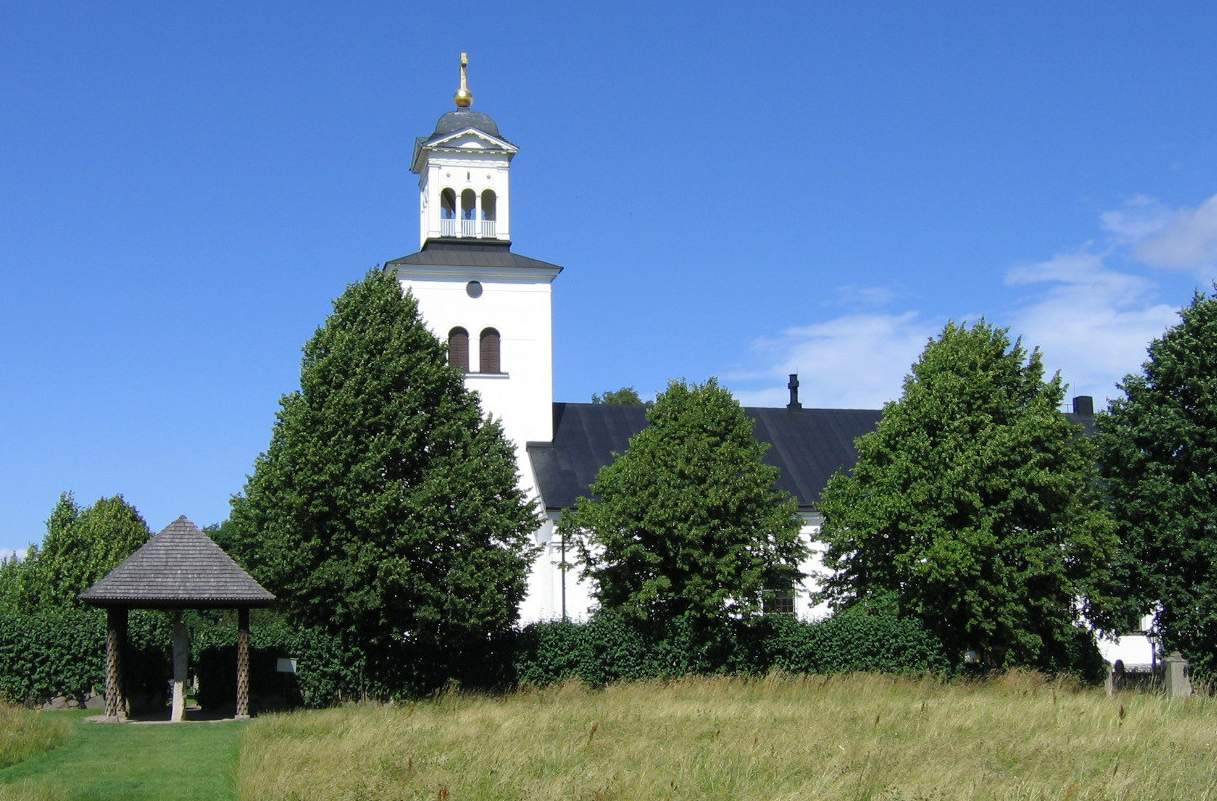
Rok Runestone
In memory of Vamodr stand these runes. And Varinn coloured them, the father, in memory of his dead son. So begins the longest runic inscription ever carved into stone, 760 characters covering five sides of a granite slab that has stood beside a church in Ostergotland, Sweden, since the 9th century. What follows the opening dedication is something no one fully understands: references to Theodoric the Great, Valkyries, Thor, twenty kings who shared only four names, and a 90-year-old man who fathered a child. The Rok runestone is considered the first piece of written Swedish literature. It is also one of the most mysterious.
A Stone Named for Itself
The name contains a small puzzle of its own. The stone sits in the village of Rok, but the village was probably named after the stone. In Old Norse, 'rauk' or 'rok' means a skittle-shaped stack or standing stone. So the Rok Stone is, in a sense, the Stone Stone, a tautology that hints at how central this monument was to the place's identity. It stands beside Rok's church now, but it predates Christianity in Sweden. The runes cover every surface except the base that was buried underground, and while a few sections have suffered damage over the centuries, most remain legible to those who can read 9th-century runic alphabets.
The Gothic Emperor
Among the stone's more startling claims is a passage about Theodoric the Great, the Ostrogothic king who ruled Italy and effectively controlled the Western Roman Empire until his death in 526 AD. The inscription describes him sitting armed on his Gothic horse, shield strapped, prince of the Maerings, ruling over the shores of some eastern sea. Scholars believe this refers to a famous equestrian statue of Theodoric that stood in Ravenna until Charlemagne moved it to Aachen in 801 AD. Nine generations separated Theodoric's death from the carving of the Rok stone, yet Varinn thought this foreign emperor's legend worth preserving in granite.
Valkyries and Wolves
The text speaks of Gunnr, whose horse sees fodder on the battlefield where twenty kings lie. Gunnr is a Valkyrie from Norse mythology, and her horse is no horse at all. This is kenning, the riddling poetic device beloved of Norse skalds: the Valkyrie's horse that feeds on battlefields is a wolf, scavenger of the slain. The twenty kings mentioned appear in another passage as four groups of five brothers each, where all five brothers in each group shared the same name, and their four fathers were themselves brothers. This arithmetic mythology, 4 times 5 equals 20, was apparently common knowledge in the 9th century. It has been completely lost.
Codes Within Codes
Varinn did not make his inscription easy to read. The first sections use the sixteen-character short-twig runes of the Younger Futhark. But after invoking someone named Ingold, he switches to the older twenty-four character Elder Futhark and to cipher runes, deliberately obscuring his meaning. Scholars assume this shift was intentional, that these encoded passages concern legends specific to Varinn's own tribe rather than widely known tales. The text invokes Thor directly and tells of a man named Sibbi who fathered a son at ninety. Since Thor is mentioned just before Sibbi's virility, it may be a recommendation that devotion to the old gods brings rewards.
Climate, Sacrifice, or Grief
Theories about the stone's purpose multiply across the centuries. Perhaps Varinn simply wanted to honor his son Vamodr with an impressive memorial. Perhaps he was a tribal leader using ancestral legends to justify his authority. Researchers at three Swedish universities have proposed that the inscription alludes to the climate catastrophe of 535-536 AD, when volcanic winter caused crop failures across the Northern Hemisphere. Others suggest Varinn was forced to sacrifice his own son because the boy's wife had been baptized by Christian missionaries. The stone's symmetrical structure, with three sections each containing questions and poetic answers, resembles riddle games described in medieval Icelandic texts. Whatever Varinn intended, he created something that would outlast his grief, his tribe, his language, and his gods.
From the Air
Located at 58.29N, 14.78E in Rok village, Odeshog Municipality, Ostergotland, Sweden. The stone stands beside Rok Church in a small rural community between Lake Vattern to the west and the forested interior of Ostergotland to the east. Nearest airports are Linkoping (ESSL) approximately 50km northeast and Jonkoping (ESGJ) approximately 60km southwest. From cruising altitude, Lake Vattern forms a distinctive elongated shape, and the agricultural landscape of Ostergotland spreads in a patchwork pattern across the region.