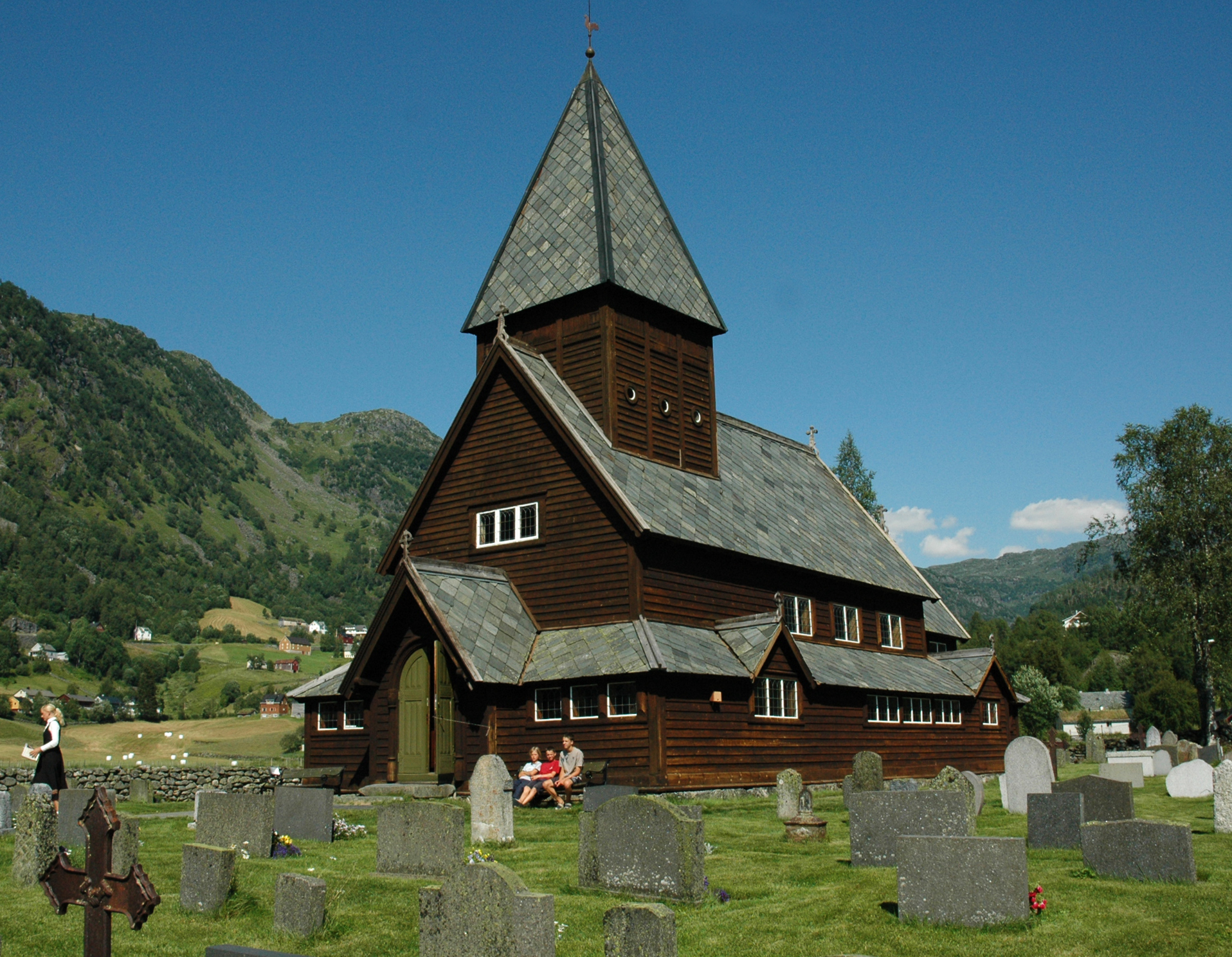
Røldal Stave Church
Somewhere around 1250, builders raised a wooden church in the mountain village of Røldal, at the head of a valley in what is now Ullensvang Municipality. Within decades, pilgrims began arriving. They came for the crucifix -- a carved wooden Christ, dated to roughly the same period as the church itself, which was said to produce drops of moisture on its surface. The phenomenon drew believers from across medieval Scandinavia, and their donations made tiny Røldal one of the most prosperous villages in the region. Nearly eight centuries later, the church still stands, still holds worship services twice a month, and still carries the weight of all those footsteps in its worn timber floors.
Built Between Two Traditions
Røldal Stave Church occupies an unusual position in the history of Norwegian wooden architecture. When restoration work began in 1844, investigators discovered that the church's construction method differed from other stave churches in ways that sparked a debate still not fully resolved. The question is whether Røldal is a true stave church -- built with vertical posts (staves) bearing the structural load -- or an example of the older post church tradition, where the posts are set directly into the ground. The distinction matters because post churches are believed to be the predecessors of stave churches, and if Røldal represents a transitional form, it offers a window into how Norwegian builders evolved their techniques during the Middle Ages. The church seats about 130 people in a long church design with a rectangular nave and chancel, and its brown wooden exterior has the weathered gravity that comes from standing exposed to mountain weather for three-quarters of a millennium.
The Treasure That Drew the Pilgrims
The medieval treasures of Røldal tell the story of a church that punched far above the weight of its tiny village. The crucifix that drew the pilgrims dates from about 1250. Wooden sculptures of St. Olaf, the Virgin Mary with child, and the Archangel Michael -- all carved around the same period -- once filled the interior. Most of these pieces now reside in the Bergen Museum, but their craftsmanship speaks to the wealth that pilgrimage brought. The donations were substantial enough to sustain both the church and the village, turning a remote mountain settlement into a minor religious destination. A soapstone baptismal font from the same era survives in the church, its weight and durability a contrast to the timber that surrounds it.
Layers of Paint and Time
Walk into Røldal Stave Church today and you are looking at the accumulated work of centuries. In the 1600s, painters covered the interior walls with murals -- rich, colorful scenes that transformed the dark wooden space into something vivid and surprising. The altarpiece, installed in 1629, was designed by Gottfried Hendtzschel, a German-born painter from Breslau in Silesia who brought Continental artistic traditions into this remote Norwegian valley. In the 1840s, the nave was enlarged by extending the building westward, and for decades afterward, layers of newer decoration obscured the older work. It was not until restoration efforts in the twentieth century that the 17th-century murals were uncovered again, their colors still surprisingly alive beneath the later additions.
A Museum That Still Prays
What makes Røldal unusual among Norway's surviving medieval churches is its dual identity. It is officially a preserved historic museum, maintained as a cultural artifact of national significance. But it is also still a working parish church in the Diocese of Bjorgvin, holding regularly scheduled worship services twice a month. Parishioners sit in pews that occupy the same space where medieval pilgrims once knelt before the sweating crucifix. The building serves two different kinds of visitors -- tourists who come to see a 13th-century stave church, and locals who come to worship in one. Both groups share the same creaking floorboards, the same filtered light through small windows, the same sense of enclosure that comes from being inside a structure that has outlasted every person who ever entered it.
From the Air
Located at 59.83N, 6.82E in the village of Røldal, Ullensvang Municipality, Vestland county. The church sits in a mountain valley at the head of Røldalsvatnet lake. Nearest airports include Haugesund Airport Karmøy (ENHD), approximately 75 km west, and Bergen Airport Flesland (ENBR), approximately 120 km north. Recommended viewing altitude 3,000-6,000 feet. The village of Røldal is small but the church and its graveyard are identifiable near the lake shore.