RAAF Base Tindal
Air Marshal Sir Frederick Scherger had been in Darwin when the Japanese bombed it in 1942. That experience shaped his thinking for the rest of his career, and in 1959 — now Chief of the Air Staff — he proposed building a second major airfield in the Darwin area. The reasoning was clear: Australia's northern defences were too concentrated, too exposed, too close to a coastline that an adversary could reach. A site near Katherine was surveyed and selected in May 1963. It was close enough to RAAF Base Darwin to afford mutual support, but far enough inland to be defensible, outside the worst cyclone tracks, and — in the calculations of Cold War planners — outside the projected nuclear fallout zone should Darwin ever be targeted. Tindal opened, finally, in 1988.
Designed for Silence, Built for War
Tindal was originally conceived as an "Un-Manned Operational Base" — a bare base with almost no permanent staff and very few buildings. A runway, taxiways, hardstanding, a water supply: the minimum required to activate the facility when needed. It was a strategic reserve, a place that could come to life in crisis. The base was ready to support RAAF units by early 1968, though expansion continued for another two years. The formal opening, planned for July 1988, was delayed by the difficulty of finding a date acceptable to Prime Minister Hawke and Defence Minister Kim Beazley simultaneously. Once open, Tindal became the RAAF's principal operational base in the Northern Territory — a position it has held ever since, growing steadily more capable and more important.
Crisis and Deployment
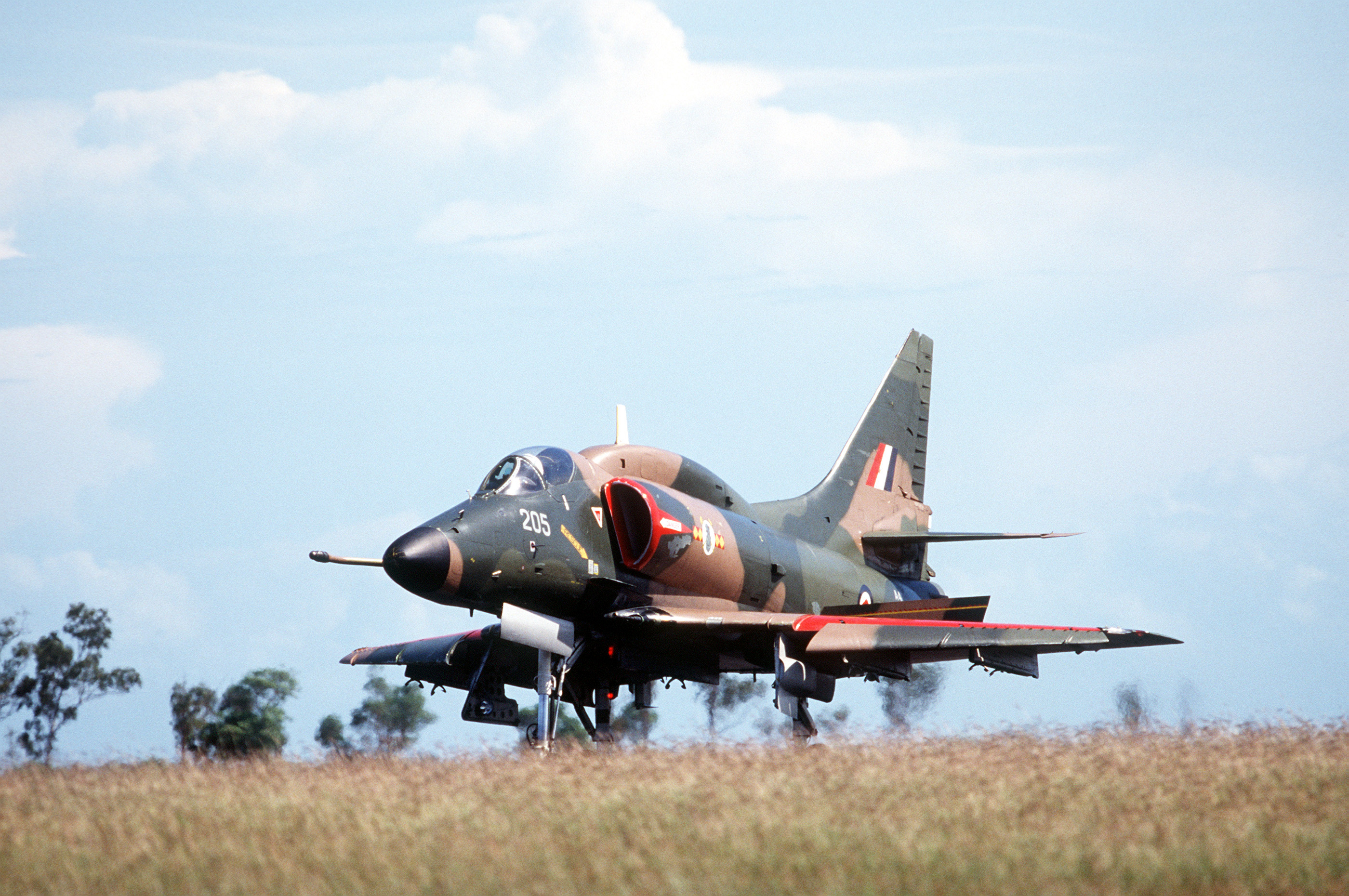
Tindal has been used in every major Australian military commitment since its opening. During the 1999 East Timor crisis, Australian F-111s and RNZAF A-4K Skyhawks were armed and on standby at the base, ready to strike Indonesian forces and command systems if the deteriorating situation demanded it. No. 75 Squadron deployed from Tindal for Australia's contribution to the 2003 invasion of Iraq. The base supported the Australian-led International Force for East Timor. In 2004, Tindal was awarded the RAAF's Hawker Siddeley Trophy for most proficient base of the year. More recently, on 17 October 2024, the base served as a staging ground for US Air Force B-2A stealth bombers conducting strikes on Houthi weapons storage facilities in Yemen.
The B-52s Are Coming
Tindal's current expansion represents the most significant investment in northern Australia's defence infrastructure in decades. Over $500 million has been committed for works to enable the base to operate F-35A Lightning II fighters — No. 75 Squadron now flies them here. On 31 October 2022, US and Australian officials confirmed the scope of further US-funded upgrades: an expanded apron with space for six B-52 Stratofortresses, new squadron operations facilities, maintenance infrastructure, and enhanced fuel and ammunition storage. The B-52s are nuclear-capable, and their planned stationing has generated debate about the risks of increased tension with China. The RAAF has noted that American bombers have been exercising in Australia since 2005. The changes were expected to be completed by the end of 2026. Whether Tindal becomes a permanent B-52 forward base or merely a regular exercise stopover, it is reshaping the strategic geometry of the Indo-Pacific.
An Exclusively Uniformed Base
One distinctive feature of Tindal is its manning policy: in keeping with its position in northern area operations, the base is staffed exclusively by uniformed RAAF personnel. No. 75 Squadron is the primary combat unit, flying F-35As in the multirole fighter role. They are joined by No. 452 Squadron's Tindal Flight handling air traffic control, a Control and Reporting Unit detachment running the Wakulda aerial surveillance system, and combat support elements. The base also hosts regular allied training exercises — Operation Pitch Black brings international air forces here periodically — and visits by US F-22 Raptors, B-2 Spirit stealth bombers, and now, eventually, B-52s. Katherine Airport, which shares Tindal's runways for civil aviation served by Air North, is the practical coincidence of military necessity and regional transport.
From the Air
RAAF Base Tindal (YPTN) is at -14.5211°S, 132.3778°E, 8nm east-southeast of Katherine. The base is clearly visible from altitude — long parallel runways, extensive apron, characteristic military hardstandings. This is active military airspace; coordinate with Tindal Approach before transiting. F-35As operate from here; expect fast-moving traffic. Civil flights use the shared runway for Katherine Airport services. Darwin (YPDN) is approximately 200nm north; the base sits in flat savanna country with Katherine Gorge escarpments visible to the northeast as a visual reference.