Radboud University Nijmegen
On 11 April 1943, the rector of the Catholic University of Nijmegen closed the doors of his own university rather than help the Nazi occupiers conscript his students. Bernard Hermesdorf was the only Dutch rector to refuse outright to distribute pre-printed loyalty statements to the Wehrmacht, the documents that would mark which students were available for forced labor in Germany. The Germans gave him 24 hours to deliver the non-signers to a transit camp at Ommen. Most of the students vanished into hiding instead. Only 83 reported. The university, eighty years later, still tells this story before it tells you about its Nobel laureate, because the institutional self-image that survived the war is the institutional self-image it still operates by.
A University for the Outsiders
Until the early 20th century, Dutch Roman Catholics occupied almost no senior posts in government, industry, or science. The country's older universities were Protestant institutions, and the social barriers were as effective as any formal ban. The Saint Radboud Foundation, a network of bishops, decided in the early 1920s that the answer was to build a Catholic university from scratch. The Catholic University of Nijmegen opened in 1923 with one purpose: to give Dutch Catholics a path into the educated professional class. It succeeded. Over the following century the school produced five Dutch prime ministers, including former prime minister Dick Schoof, and its alumni now hold senior posts across European politics, banking, and the sciences. The motto over the original door reads In Dei Nomine Feliciter, happily in the name of God.
From Carolus Magnus to the Hippies
For its first forty years, every Nijmegen student automatically belonged to N.S.V. Carolus Magnus, the student corporation named after Charlemagne, who held court here in the early Middle Ages. Carolus Magnus modeled itself on the corporations at Leiden, Delft, and Groningen and, to the silent horror of the university's Catholic management, copied their liberal-elitist style. Men joined the Gentleman's Roland Society (founded 1928); women joined the Ladies Society Lumen Ducet (1929); smaller groups called disputen formed within these. Then the 1960s arrived. The hippie movement reached Nijmegen, student numbers swelled from 3,000 in 1960 to 15,000 in 1980, the student body became more diverse and more left-wing, and Carolus Magnus turned into an unloved bureaucracy. In 1966 mandatory membership ended. Students chose their own associations from then on, and the new ones, including the evangelical Navigators and the egalitarian Ovum Novum, looked nothing like the corporations they replaced.
The Castle, the Forest, and the Black Hole
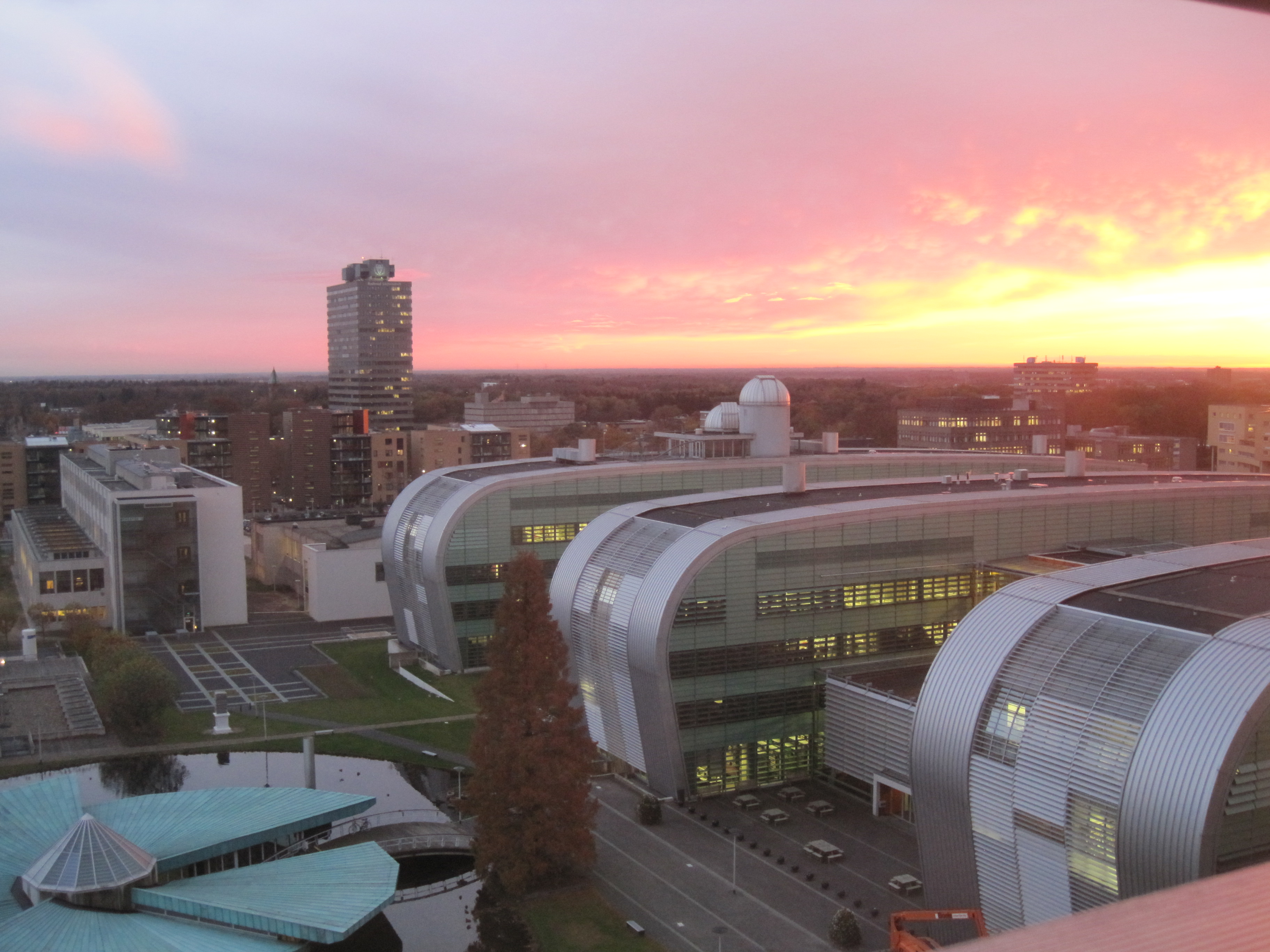
After the war, classes resumed in 1946 amid bombed-out buildings. The university bought the Heyendaal estate south of the city center, a green landscape with its own castle (now the Faculty Club), and moved its faculties out one by one until by 1988 the whole institution sat under a forest canopy fifteen minutes by bike from Nijmegen Centraal Station. Visitors still notice this first. The campus repeatedly tops Dutch rankings for greenest university grounds. The Huygens Building houses Natural Sciences. The Erasmus Tower carries Arts and Theology. The Maria Montessori building holds Social Sciences. The Berchmanianum, a former Jesuit monastery, anchors the southern edge. And inside the science buildings, Radboud researchers helped image the first photograph of a black hole. Professor Heino Falcke, a radio astronomer here, was one of the architects of the Event Horizon Telescope collaboration that produced the famous 2019 image of M87's shadow. Falcke won the Spinoza Prize, the Netherlands' top research award, in 2011. Fourteen Radboud faculty members have won the Spinoza since 1999.
Donders and the Mind
Radboud's quietly outsized influence on world neuroscience runs through the Donders Institute for Brain, Cognition and Behaviour, located on the southern campus. Donders sits alongside the Max Planck Institute for Psycholinguistics, which makes Nijmegen one of the densest concentrations of language and cognition research in Europe. Sir Konstantin Novoselov did his PhD here under Andre Geim, and the two went on to win the 2010 Nobel Prize in Physics for the isolation of graphene, the single-atom-thick sheet of carbon that has become a defining material of 21st-century electronics. The biologist Frans de Waal, Radboud class of 1970, did the foundational primatology that reshaped how the public understands empathy in animals. The cryptographer Joan Daemen helped design AES, the encryption standard that protects most of the internet, and SHA-3, the modern hashing algorithm. None of this is what you expect from a university whose origin story is about pulling Dutch Catholic kids into the professional class.
Losing the C-Word
The relationship between the university and the Dutch Catholic bishops has been strained for decades, mostly because the university kept appointing non-Catholic or non-practicing Catholic leaders and the bishops kept refusing to approve them. The break came in November 2020. The Bishops' Conference of the Netherlands revoked the designation 'Catholic' from the university primarily because the governing foundation (SKU) moved to reduce bishop-appointed board seats from all five to just one — a governance dispute the bishops viewed as stripping the Church of meaningful influence. Differing views on medical ethics, including the university medical center's plan to open a Transgender Care Center, deepened the rupture. Radboud appealed to Rome. In November 2022 the Vatican's Dicastery for Culture and Education ruled that the bishops could strip the Catholic label from the executive council but not from the university as a whole. The institution that was founded to give Dutch Catholics a foothold in academic life remains, ambiguously, a Catholic university, and the relationship continues, ambiguously, to function. The students walk to class under the same trees regardless.
From the Air
Radboud University's Heyendaal campus sits at approximately 51.82 degrees north, 5.87 degrees east, in southern Nijmegen near the German border. From altitude the campus reads as a green wedge south of the city center, with the Erasmus Tower and the Huygens science complex as the most visible buildings; the Radboud University Medical Center is one of the larger urban structures in this part of the city. Nearest airports are Weeze (EDLV) about 25 km east across the German border, Eindhoven (EHEH) 50 km southwest, and Dusseldorf (EDDL) 80 km southeast. The Waal river runs north of the city and is a useful visual reference, with the historic Nijmegen bridge visible from cruise altitude.