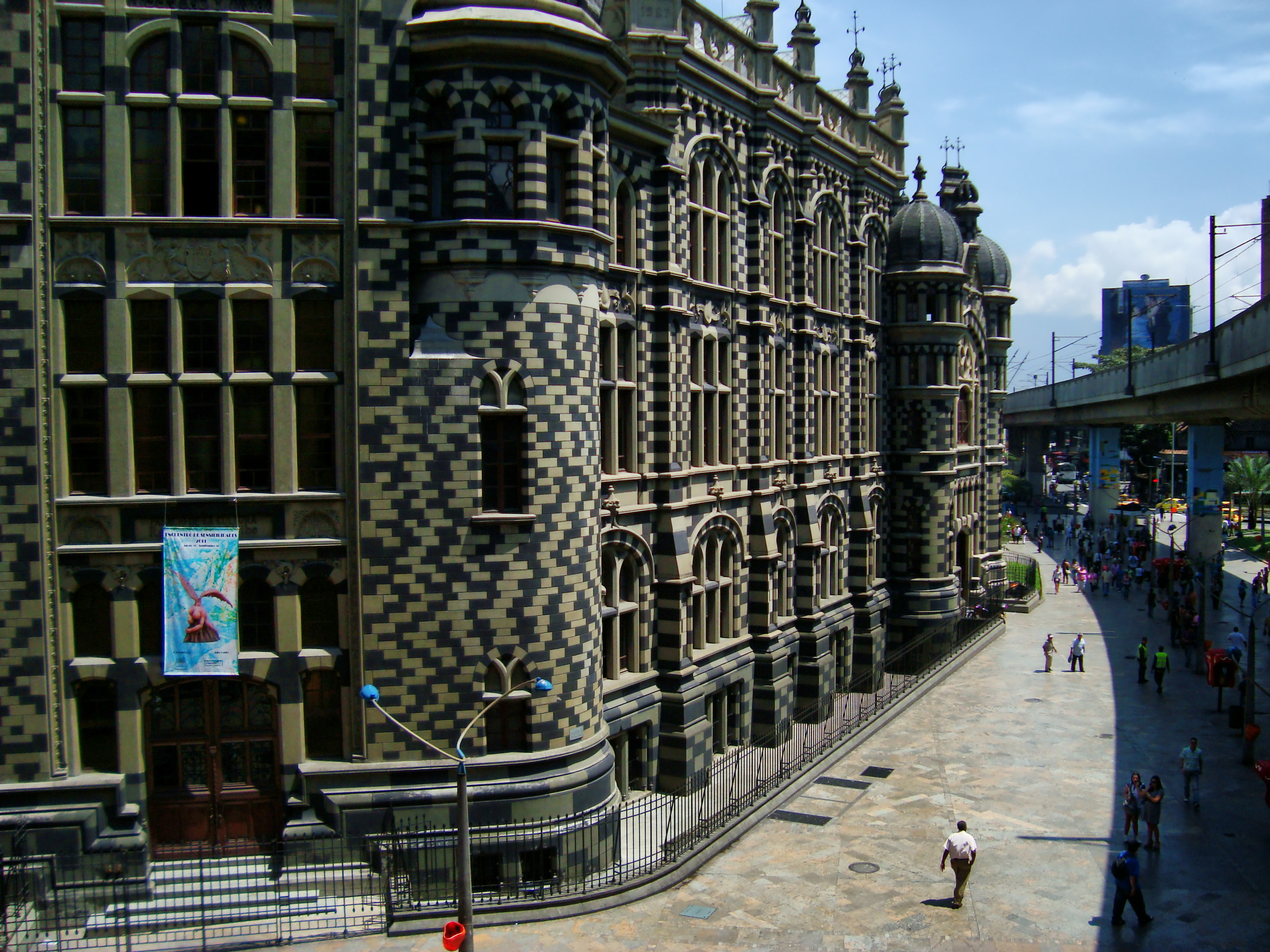
Rafael Uribe Uribe Palace of Culture
Depending on the sunlight, the black and white stone facade shifts into a faint greenish hue, as if the building were breathing with the Colombian weather. The Rafael Uribe Uribe Palace of Culture stands on Medellin's Plaza Botero like something transplanted from medieval Flanders -- because, in a sense, it was. Belgian architect Agustin Goovaerts designed this Gothic Revival palace in the early 1920s, importing not just a European aesthetic but the actual metalwork from Belgium, assembled using the same riveting techniques then rising over Manhattan. The result is a building that belongs simultaneously to Antioquia and to the wider world, a paradox the palace has been living out for a century.
A Belgian Vision in the Andes
Pedro Nel Ospina, then governor of Antioquia and later president of Colombia, wanted Medellin to have public buildings worthy of its ambitions. In 1920, he brought Goovaerts from Schaerbeek, Belgium, to serve as the department's official architect. Goovaerts arrived with grand plans -- the original design called for five floors, over 300 offices, a library, and a museum. What actually got built was more modest, trimmed by political disputes and budget realities. Construction began in 1925 at the intersection of Calibio and Bolivar streets, initially to house the Departmental Assembly and archive. But the building the city envisioned and the building it could afford were two different structures, and that tension would define the palace's first half-century.
Crises, Pauses, and Incandescent Bolts
The 1929 financial crisis hit Antioquia hard. Governor Camilo C. Restrepo ordered construction suspended, and the palace sat unfinished for four years. Work resumed in 1932 with the octagonal unit and east wing, but the interior tells the story of the artisans who persevered through the delays. Ignacio Gomez Jaramillo painted a mural fresco called "The Liberation of Slaves." The Horace and Arturo Longas brothers crafted stained glass windows using the ancient leaded technique, joining colored panes with strands of lead. Bronze reliefs were cast by Bernardo Vieco. The dome's metal supports, imported from Belgium in 1928, were assembled by heating each nut and bolt until incandescent, then tightening them as they cooled -- the same method used to build New York's skyscrapers, a technique that gave the structure its strength without a single weld.
Abandoned, Then Rescued
In 1937, the government abandoned the still-unfinished palace. Makeshift fences closed off its empty halls. For decades, the building sat in limbo while officials planned a new government seat elsewhere. Some Medellin residents proposed converting it into a shopping mall, as had happened with the nearby Major Seminary and National Palace. Others suggested demolishing it entirely. Neither fate came to pass. Architects Gerardo Mejia, Gustavo Restrepo, and Gustavo Aristizabal were eventually contracted to complete the north facade, recovering elements of Goovaerts' original decorative vision. In 1982, Resolution 000002 of the National Council of National Monuments elevated the palace to a national monument, a legal shield against the wrecking ball.
From Calibio Palace to Cultural Heart
When the governor's offices finally moved to the new La Alpujarra Administrative Center, the building shed its old name -- Calibio Palace -- and was rechristened in 1987 for Rafael Uribe Uribe, the Liberal general and journalist who fought in Colombia's Thousand Days War. Uribe Uribe was born in the Antioquia town of Valparaiso in 1859 and was assassinated on the steps of the Colombian Capitol in Bogota in 1914, hacked to death in broad daylight. Naming the palace for him was an act of regional memory, linking the building's survival to the persistence of the man it honors. Today the palace houses the Institute for Culture and Heritage of Antioquia, hosting concerts, art exhibitions, and conferences. Its four floors surround a central courtyard, and a rooftop terrace offers panoramic views across Medellin's valley.
Above the Valley of Aburra
From the air, the palace's dark Gothic profile stands out against the surrounding modern towers of downtown Medellin, its dome and spires unmistakable on the edge of Plaza Botero. The building sits in the Aburra Valley at roughly 1,500 meters above sea level, ringed by the green ridges of the Andes. During Medellin's famous Christmas lights season, the palace is illuminated in cascading color, visible from the hillsides that frame the city. It is a building that nearly became a parking structure, that might have been a mall, that could have been rubble -- and instead became the place where Antioquia keeps its memory.
From the Air
Located at 6.2518N, 75.5677W in the Aburra Valley at approximately 1,500 meters elevation. The Gothic Revival palace is identifiable by its distinctive dark dome and spires adjacent to Plaza Botero in downtown Medellin. Nearest airports: Olaya Herrera Airport (SKMD, 3 km south) for a close overhead pass, or Jose Maria Cordova International Airport (SKRG, 20 km southeast in Rionegro). Best viewed at 3,000-5,000 feet AGL on a clear day. The narrow valley orientation (north-south) makes approaches along the river corridor most natural.