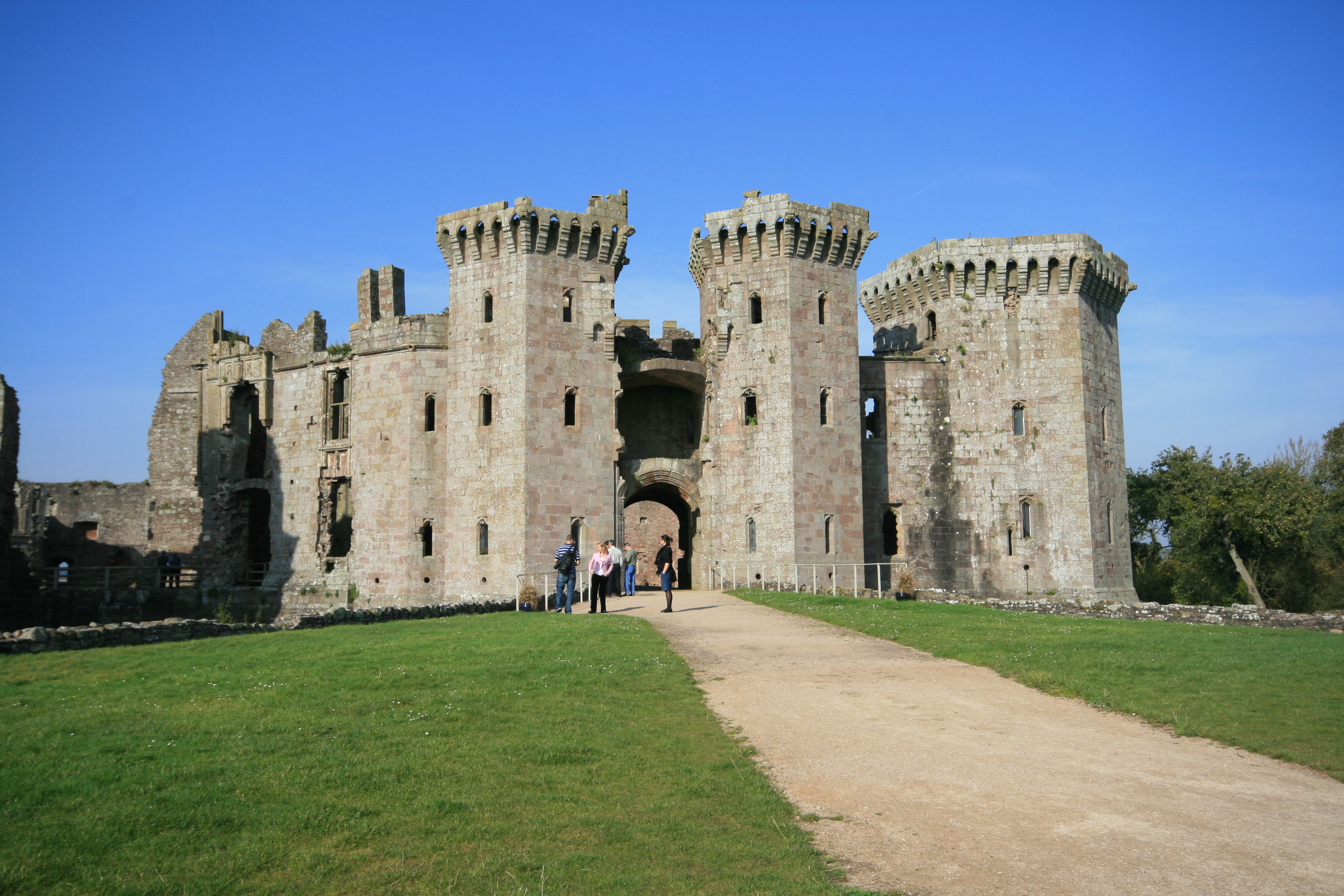
Raglan Castle
The 1639 inventory reads like a museum catalog: silver and gilt plate in the Great Tower, tapestries from Arras hanging on the walls, an ostrich egg cup, a silver basket for oranges and lemons. Raglan Castle was no bare-stone fortress. By the time the English Civil War arrived at its gates, it had spent two centuries evolving from a Welsh nobleman's stronghold into one of the most luxurious residences in the kingdom -- a castle whose gardens, contemporaries claimed, were the equal of any in England or Wales.
The Yellow Tower of Gwent
Raglan's most distinctive feature is its great hexagonal keep, known as the Great Tower or the Yellow Tower of Gwent. Sir William ap Thomas, the lesser son of a minor Welsh family who climbed the ranks of 15th-century politics, purchased the manor of Raglan in 1432 for 1,000 marks and began building in earnest. His son dropped the Welsh surname, calling himself William Herbert, and remodeled the castle on a grander scale in the 1460s. Herbert was the first Welshman to be made an earl, and contemporary poets called him the "national deliverer" who might achieve Welsh independence. The castle's polygonal towers may have been designed to echo those of Caernarfon Castle, with its allusions to the return of a Roman emperor to Wales. Historian Anthony Emery called the result one of the "last formidable displays of medieval defensive architecture."
Somersets and Silver Plate
By 1492, through marriage, Raglan passed to the Somerset family, who would shape it for the next two centuries. The Somersets were politically astute -- Sir Charles Somerset served both Henry VII and Henry VIII and was made Earl of Worcester. Under their stewardship, Raglan gained its water gardens, terraces, and the moat walk encircling the Great Tower. Henry Somerset, the 5th Earl, maintained the castle in the 1630s with a staff that included a steward, a Master of Horse, a Master of Fishponds, a falconer, and many footmen. Mead was the drink of choice, though visitors noted the household was unusually sober and respectful. Surrounding the castle were extensive orchards, fish ponds, and the great deer parks of Home Park and Red Deer Park.
The Last Royalist Stand
When civil war engulfed England and Wales, Raglan became a Royalist garrison. Modern earthwork bastions were built, a powder mill established, and a force of 300 men raised at a cost of 40,000 pounds. Charles I himself visited twice -- once in June 1645 after his defeat at Naseby, and again in 1646, when he passed the time playing bowls on the castle green while his cause collapsed around him. As the end approached, the Marquess sent valuables to nearby Troy House for safekeeping: oak panelling, plaster ceilings, paintings. The Parliamentary army arrived in June 1646 under Colonel Morgan, and a grinding summer siege began. Fairfax's men dug trenches forward and moved their mortars into range -- probably including the famous "Roaring Meg" -- bringing the castle's interior under bombardment.
The Grand Dilapidator
Fairfax ordered Raglan totally destroyed, but the fortifications proved too strong. Only a few walls were successfully slighted. The castle's library, containing an important collection of Welsh documents and books, was either stolen or destroyed -- a cultural loss that resonated beyond the military defeat. The 3rd Marquess chose to rebuild at Troy and Badminton rather than Raglan, and an estate surveyor named Hopkins earned the nickname "the Grand Dilapidator" for the chimneys, window frames, and staircases he stripped from the ruin. It was not until 1756 that the 5th Duke finally ended the plundering. Raglan then found a second life as a stop on the popular Wye Tour, admired by Romantics who saw beauty in its broken walls. In 1938, the 10th Duke entrusted the castle to the state, and it became a permanent monument to the ambition, luxury, and violent end of late medieval Wales.
From the Air
Located at 51.77N, 2.85W, just north of Raglan village in Monmouthshire, southeast Wales. The hexagonal Great Tower is the most prominent feature from the air. Nearest airports: Bristol (EGGD) 35nm southeast, Cardiff (EGFF) 30nm south. Best viewed at 1,500-2,500ft AGL in clear conditions. The castle sits on a slight rise, visible above the surrounding farmland.