Raid on Manila
Captain Edward Cooke raised a glass and proposed a toast: to the downfall of England. The Spanish officers around the table in the cabin of HMS Fox drank heartily, unaware that their gracious French host was, in fact, a captain in the Royal Navy, that the frigate beneath their feet was HMS Sybille's consort flying a false tricolor, and that their own boat crews were being disarmed on deck at that very moment. It was the afternoon of January 14, 1798, and the most theatrical naval deception in the history of Manila Bay was unfolding over wine and pleasantries.
Silver, Tea, and the Shifting of Alliances
The raid grew from a tangle of European politics and Asian commerce. When Spain signed the Treaty of San Ildefonso in 1796 and turned from Britain's ally into its enemy, the strategic calculus of the entire East Indies shifted overnight. Britain controlled the major Indian Ocean trade routes from Bombay, Madras, and Calcutta, and had already seized Dutch Ceylon and the Cape Colony. But the Spanish Philippines, with a powerful naval squadron based at Cavite, now threatened the annual China Fleet -- a convoy of East Indiaman merchant ships that sailed from Macau to Europe laden with tea and silk worth millions of pounds. A single convoy in 1804 was valued at over eight million pounds sterling. Rear Admiral Peter Rainier initially planned a full-scale invasion of Manila, echoing the British capture of the city in 1762, but the Treaty of Campo Formio and the rising threat from the Kingdom of Mysore in India forced him to cancel the operation. Instead, he sent Captain Cooke east with two frigates to escort the merchant ships -- and to see what mischief he could manage along the way.
French Colors in the Bay
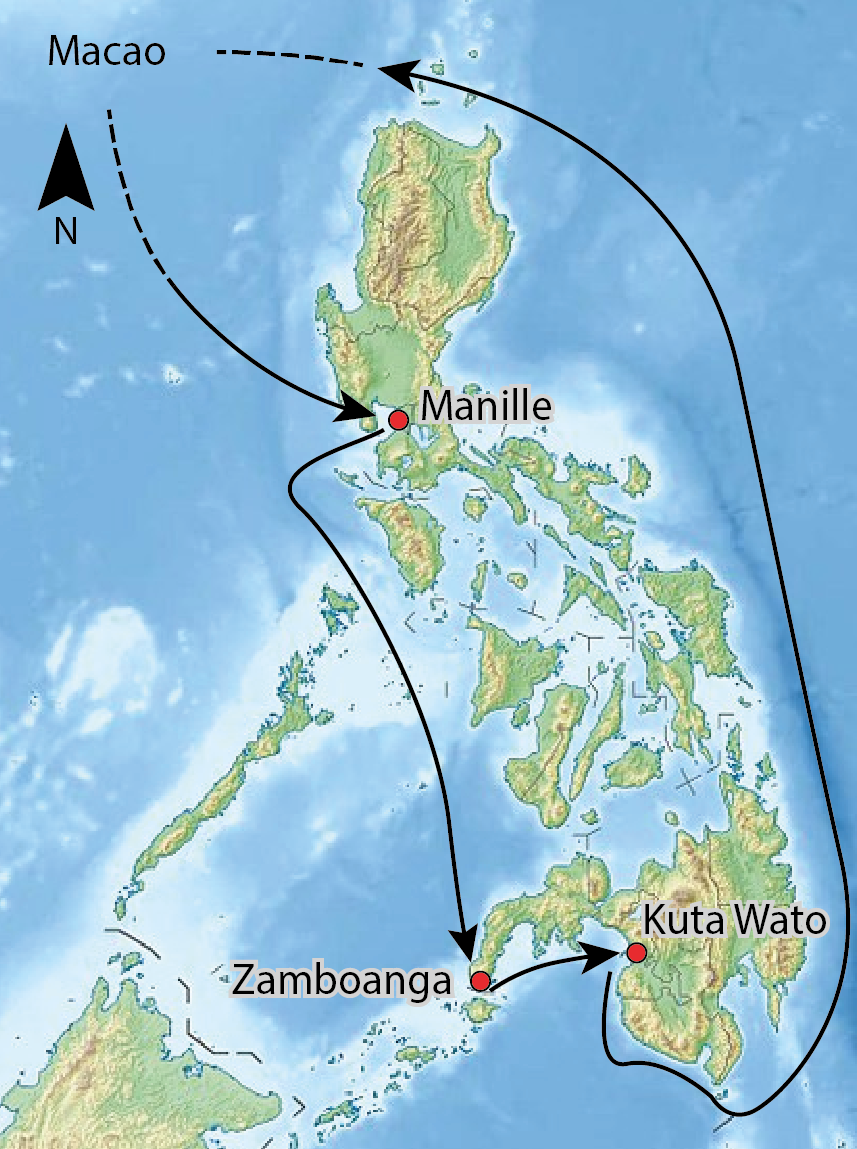
Cooke sailed from Macau on January 5, 1798, aboard the 40-gun Sybille with Captain Pulteney Malcolm commanding the 32-gun Fox. Both ships flew French tricolors, Sybille disguised as the powerful French frigate Forte and Fox masquerading as the Prudente. Off Luzon, they intercepted a small Spanish merchantman whose captain, believing he was speaking to Frenchmen, revealed that the Spanish squadron at Cavite was dismasted and under repair after a typhoon the previous April. Cooke rewarded the captain's candor by releasing his vessel -- though he did relieve him of 3,900 silver dollars first. On the afternoon of January 13, the two frigates slipped past the fortress of Corregidor unchallenged and anchored between Manila and Cavite the next morning. From this vantage, Cooke could see the sorry state of Spain's Pacific fleet: the ships of the line San Pedro Apostol, Europa, and Montanes, along with two frigates, sat in dock unfit for action. The Manila galleon Marquesetta was being unloaded at the Cavite docks -- its treasure already ashore, beyond British reach.
Toasts and Treachery
What followed was espionage disguised as hospitality. Fox, first into the anchorage, was approached by a Spanish guard boat. Malcolm, fluent in French, welcomed the officers aboard and introduced himself as commander of a pair of French frigates seeking supplies and allies for commerce raiding. Cooke then appeared, claiming to be the French Commodore Latour -- a real officer who, unknown to the Spanish, had been killed in action off Sumatra in 1796. The Spanish were completely deceived, augmented by fake French uniforms. Each successive boatload of officials that pulled alongside was escorted below to join what had become a rolling dinner party, while their crews were quietly seized at gunpoint on deck. By mid-afternoon, the cabin held the personal barge crew of the Spanish commander at Cavite, Rear Admiral Don Ignacio Maria de Alava, along with multiple officers who had freely shared detailed intelligence about Manila's defenses. Meanwhile, Fox's sailors stripped the captured Spanish seamen of their clothing, donned the uniforms, and rowed for the mouth of the Pasig River. There they surprised three heavy gunboats -- armed with 32-pounder and 24-pounder long guns -- and captured all of them without firing a shot.
The Dinner Party Ends
The harbor captain arrived furious, demanding the gunboats be returned. Malcolm received him with a tirade of incomprehensible French and brought him below to join the growing collection of captives. At four in the afternoon, Cooke and Malcolm hosted a grand dinner for all their officer prisoners, sending food and grog to the approximately 200 Spanish sailors now held aboard Fox. Once the meal was finished, Cooke released every captive without conditions of parole, allowing them to row back to shore. He kept the gunboats. The frigates departed past Corregidor the following day, turning south. A storm claimed one gunboat and its twelve crew. At Zamboanga, Cooke tried the French disguise again, but Sybille grounded on a sandbank, arousing suspicion. An attempted bombardment and amphibious assault on the harbor fort failed -- two British sailors killed, twelve wounded -- and 250 local villagers armed with lances drove the landing party from the beach. Cooke scuttled the remaining gunboats and sailed north for China, losing two more men and nine captured by Lumad tribesmen during a water stop at a village in the Sultanate of Maguindanao.
An Audacious Footnote
Rainier expressed satisfaction with the intelligence Cooke had gathered: the Spanish squadron posed no immediate threat. Historian C. Northcote Parkinson speculated that more might have been achieved had Cooke joined forces with HMS Resistance, which was also in Philippine waters, but noted that Resistance's captain had considerably less imagination and guile. Richard Woodman was less generous, calling the mission one with no glorious outcome and citing the failure to capture the treasure ships. The broader story, though, has an ironic coda. The real French frigates Forte and Prudente -- the very ships Cooke had impersonated in Manila Bay -- were sent to raid British trade in the Indian Ocean the following year. Prudente was captured off southern Africa. Forte was intercepted near Balasore in Bengal by none other than HMS Sybille under Cooke himself. In the ensuing battle, the genuine Forte was taken, but Cooke was mortally wounded. The man who had toasted England's downfall in a Spanish captain's ear died five months later, having made the joke real.
From the Air
Centered at approximately 14.52N, 120.93E, within Manila Bay. The bay entrance between Bataan Peninsula and Cavite Province is 19 km wide, with Corregidor Island visible in the narrows. Cavite, where the Spanish squadron was docked, lies on the southern shore. The mouth of the Pasig River, where the gunboats were seized, enters near Intramuros in Manila. Ninoy Aquino International Airport (RPLL) is on the eastern bay shore. Best viewed at 5,000-10,000 ft to appreciate the anchorage positions. Zamboanga, the raid's second target, is approximately 850 km to the south on Mindanao.