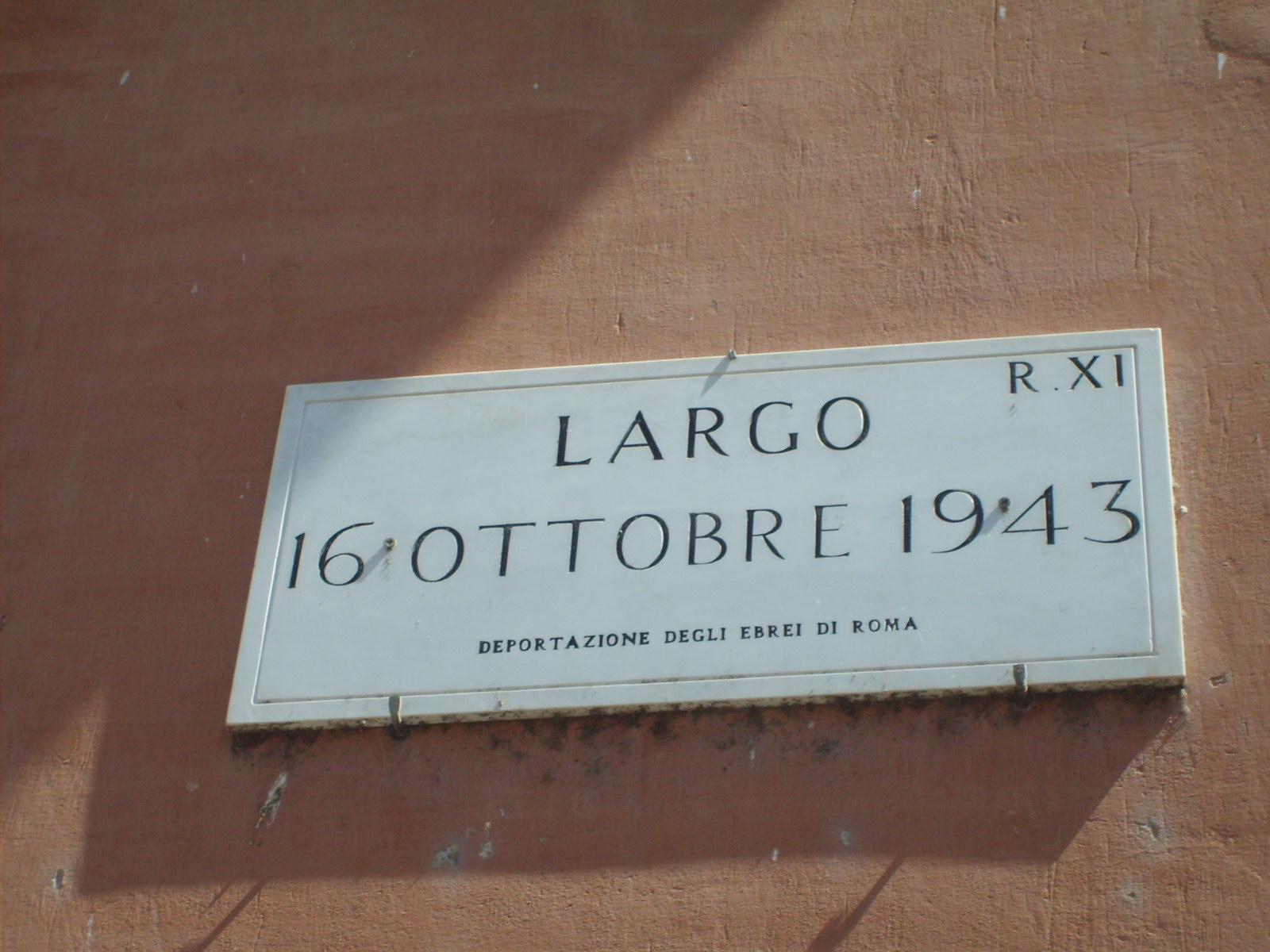
Raid on the Roman Ghetto
Sixteen survived. Out of 1,023 Jewish men, women, and children loaded onto trains at Rome's Tiburtina station on October 18, 1943, fifteen men and one woman returned from Auschwitz. The other 1,007 -- including 207 children -- did not. They had been seized two days earlier from Rome's Jewish Ghetto, a neighborhood whose community had lived continuously along the banks of the Tiber for over two thousand years, longer than the papacy itself had existed. The German ambassador to the Vatican, Ernst von Weizsacker, described the roundup in his report to Berlin with a phrase that would haunt historical debate for generations: it had taken place, he wrote, "under the Pope's windows."
Four Hundred Years Behind Walls
Rome's Jewish community is among the oldest in Europe, predating Christianity by centuries. In 1555, Pope Paul IV issued the papal bull Cum nimis absurdum and confined the city's Jews to four cramped blocks around the Portico d'Ottavia, wedged between the Theatre of Marcellus, the Fontana delle Tartarughe, the Palazzo Cenci, and the Tiber. For nearly four centuries, this ghetto defined Jewish life in Rome -- a place of severe overcrowding and restricted rights, but also of deep communal bonds, religious scholarship, and cultural persistence. By the time German forces occupied Rome in September 1943, the walls had long since come down, but the neighborhood remained the heart of Jewish Rome. Approximately 8,000 Jews lived in the city, one-fifth of all Jews in Italy. Many had recently moved south, hoping that proximity to the Allied advance would offer safety.
A Ransom That Bought Nothing
Shortly after the German occupation began on September 10, 1943, SS commander Herbert Kappler summoned the leaders of Rome's Jewish community and demanded fifty kilograms of gold within thirty-six hours. If they failed, he said, two hundred Jews would be deported. The community scrambled to gather the ransom, and ordinary Romans -- including some Catholic churches -- contributed gold to help reach the quota. The gold was delivered on time. It bought the community nothing. The deportation order had already been decided at higher levels. Theodor Dannecker, Adolf Eichmann's deputy for Italy and a man recently tasked with implementing the Final Solution on Italian soil, had his orders. The gold went to Berlin. The roundup proceeded.
Dawn on October Sixteenth
At dawn on Saturday, October 16, 1943, 365 German security police sealed off the Ghetto. Italian police were excluded from the operation -- the Germans considered them too unreliable to carry out the arrests. Soldiers went door to door with lists of names and addresses drawn from census records. Families were given twenty minutes to gather their belongings. The sick, the elderly, infants in cribs -- none were spared. A total of 1,259 people were detained that morning, including 363 men, 689 women, and 207 children. Some managed to escape over rooftops. Neighbors hid a few families. The Italian public, to the extent they understood what was happening, objected -- but there was nothing civilians could do against armed soldiers operating under direct orders. The prisoners were held for two days at the Military College on Via della Lungara before being loaded onto Holocaust trains at Tiburtina station. Six days later, the trains arrived at Auschwitz.
Under the Pope's Windows
The Ghetto lies barely a kilometer from the Vatican. Pope Pius XII knew about the roundup. Whether he could have stopped it -- or whether a public protest would have worsened the situation -- remains one of the most bitterly debated questions in Holocaust history. The German military commander in Rome, General Reiner Stahel, had initially expected papal condemnation and hesitated to act. That condemnation never came. Historian Ian Kershaw wrote that "a strong and unequivocal protest from the Pontiff might well have deterred the German occupiers." But historian Peter Longerich, a leading authority on Nazi decision-making, countered that "there is no evidence that a public protest by the Pope would have led to a change in German policy toward the Jews. On the contrary, experience suggests that such protests often led to harsher measures." The Dutch bishops' protest of July 1942, Martin Gilbert noted, had resulted not in saved lives but in the immediate arrest of Jewish converts who had previously been spared. The debate resists resolution because it asks a question history cannot answer: what would have happened if a different choice had been made.
Stones of Memory
Today, stone plaques mark the Ghetto and Tiburtina station. Small brass stumbling stones -- stolpersteine -- are embedded in the sidewalks outside homes from which families were taken, each engraved with a name, a date of birth, and the words "deported" and "murdered at Auschwitz." The community itself survived. Roman Jews returned to the Ghetto after the war and rebuilt. The Great Synagogue of Rome, which stands at the edge of the old quarter overlooking the Tiber, hosts one of the most active Jewish congregations in Europe. Every October 16, the community gathers to read the names of the deported. The neighborhood around the Portico d'Ottavia is now filled with restaurants and shops, many of them Jewish-owned, serving the Roman-Jewish cuisine -- carciofi alla giudia, fried artichokes -- that emerged from centuries of life within those walls. It is a neighborhood that insists on being alive, even as it refuses to forget what was taken from it.
From the Air
Located at 41.893N, 12.478E in central Rome, the Roman Ghetto sits along the left bank of the Tiber River, immediately south of the Isola Tiberina (Tiber Island). The Great Synagogue's distinctive square dome is visible from the air. The Theatre of Marcellus, a partially intact Roman amphitheatre, provides a landmark at the northern edge of the neighborhood. Best viewed at 1,500-2,500 feet AGL. Nearby airport: LIRF (Leonardo da Vinci-Fiumicino, 18nm SW).