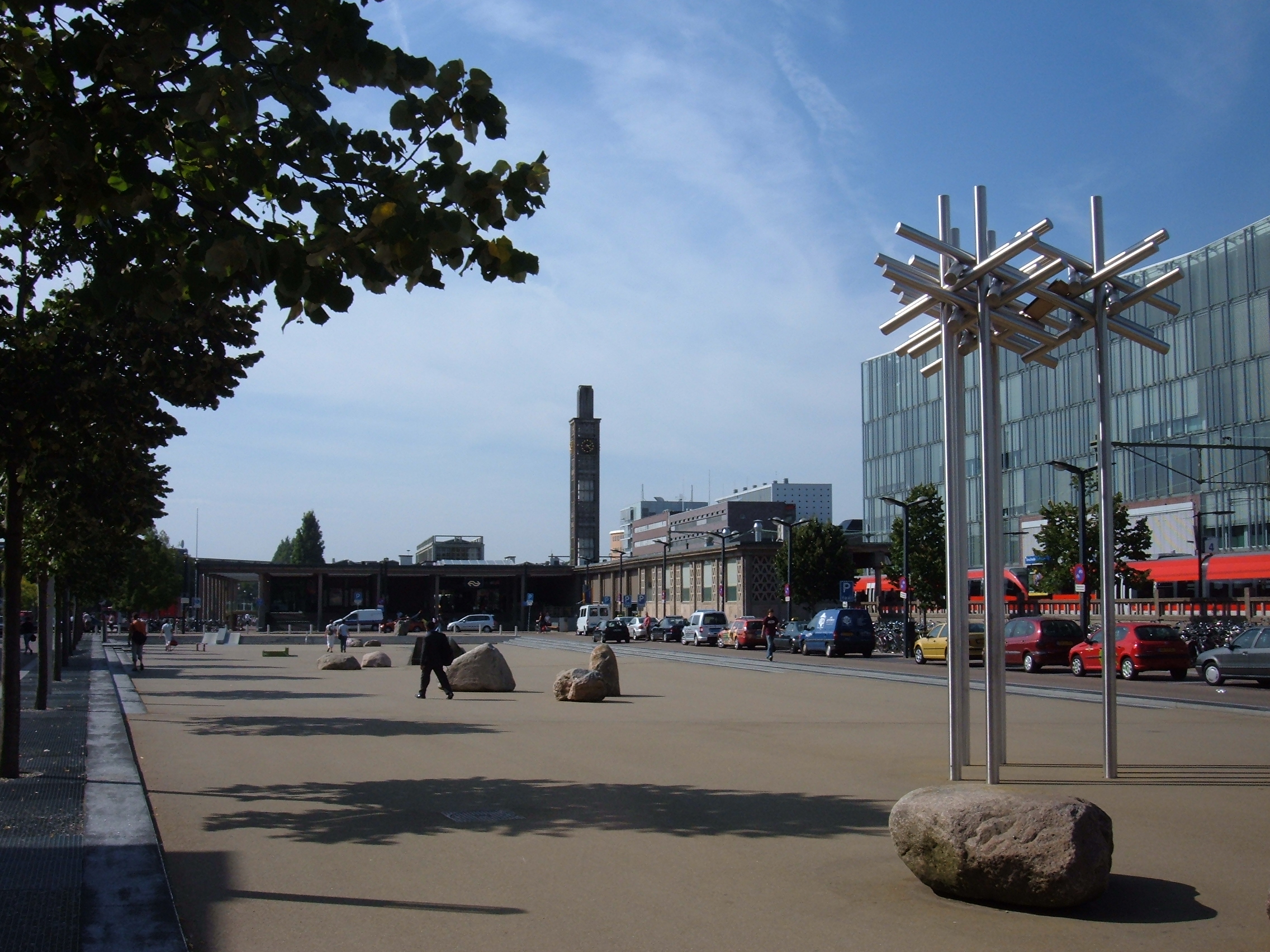
Rail travel in the Netherlands
The Netherlands has 3,434 kilometres of railway in a country you can drive across in three hours. That ratio - more rail per square kilometre than almost anywhere on Earth - is not an accident. The Dutch built a network that prefers the passenger to the car, and the country still mostly runs on it. A train pulls out of Amsterdam Centraal every couple of minutes for somewhere worth going. Half of the country's commuters meet at a platform, not a parking lot. Stand on any provincial station after 7 am and you will see school kids with backpacks, suits with laptops, farmers' wives with shopping bags, and the occasional cyclist wheeling a bike into a designated carriage, because of course the trains take bicycles too.
How the Network Feels
Dutch rail is not glamorous in the way that French TGVs are glamorous. The trains are mostly double-deck commuter stock in NS blue and yellow, the seats are firm rather than plush, the announcements switch between Dutch and English with mild reluctance. What it has is reach. Practically every village of any size is a short walk or bus ride from a station. Trains arrive on patterns - sprinters that stop at everything, intercity trains that skip ahead between regional hubs, fast services for the bigger pairs of cities - and they arrive often enough that you do not really need a timetable. You walk to the platform, and a train shows up. From Amsterdam to Rotterdam takes about forty minutes on the regular intercity, and the high-speed service does it in twenty-six. The Hague to Utrecht is three quarters of an hour. Groningen to Maastricht, the entire diagonal of the country, is just over four hours.
The OV-chipkaart, and Now the Tap
For years the country ran its public transport on a contactless smart card called the OV-chipkaart, introduced in stages from 2005 to replace the paper strippenkaart that anyone who travelled the country in the 1990s will remember fondly. You tap in when you board, tap out when you leave, and the system charges you for the distance travelled. The card works on every train, tram, bus, and metro in the country - one of the rare cases where a national transport-ticketing project actually delivered on its promises. The system has been gradually extended to ordinary bank cards and phone wallets, so an out-of-country visitor can now simply tap their contactless card on the gate reader and walk through. The fares remain among the more expensive in Europe, but the service is the kind that keeps a country bound together.
The High-Speed Connections
Long-distance international travel from the Netherlands runs on a small set of high-speed routes built up over the past two decades. The Thalys - now branded Eurostar - takes you from Amsterdam Centraal to Brussels in just under two hours and on to Paris Nord in about three and a quarter. The same trains, on a different route, reach London via the Channel Tunnel in around four hours. Eastward, ICE International trains run from Amsterdam to Cologne and Frankfurt, threading down the Rhine. The Nightjet sleeper trains have been revived from Amsterdam south to Innsbruck and Zurich, leaving in the early evening and arriving for breakfast - a kind of overnight European travel that nearly died in the 2000s and has since stubbornly returned, partly on the strength of climate-conscious passengers who refuse the short-haul flight.
Bicycle and Train, Together
The Dutch invented the verb stallen for parking a bike, and they applied it to railway stations with characteristic seriousness. Utrecht Centraal has the largest bicycle parking facility in the world: more than 12,500 spaces stacked over three underground levels, where commuters drop their bikes in the morning and pick them up in the evening without thinking about it. Most stations have at least a few hundred spaces. You can also bring your own bike on the train, in the marked bike carriage, for a flat surcharge - except during the morning and afternoon rush, when conductors will firmly point you back to the platform. There are also OV-fiets stations at almost every railway stop, a bike-share system specifically designed for the last few kilometres of a train journey. Pay a small annual fee, swipe in, take a sturdy blue and yellow bike, drop it back the next day.
What Goes Wrong, and What Happens Next
The Dutch rail network is dense enough that when something fails - a downed overhead line, a signal fault, autumn leaves making the rails greasy - the effect propagates fast. Trains stack up. Stations fill. In a normal year, the disruption is announced calmly on the platform screens and resolved within an hour or two. In a bad year, NS publishes apologies and the newspapers tally up the punctuality stats with national interest, because the trains are one of the things the country measures itself by. When a strike or storm shuts down the network, replacement bus services appear, sometimes within minutes. The trains carry roughly 1.1 million passengers a day. That is a lot of people whose plans depend on the country running on time, and most days, it does.
From the Air
Coordinates 52.375 N, 5.219 E - the geographic centre of the Dutch rail network. From the air, the Netherlands is one of the easiest countries in Europe to read: the rail lines stand out as straight, treeless corridors crossing the polder grid, with stations marked by clusters of red-roofed buildings and dense bike parking. Major junctions to spot include Amsterdam Centraal (about 30 km west), Utrecht Centraal (15 km south), and Hilversum (10 km south). Best viewed at 3,000 to 6,000 ft AGL. Closest airport: Amsterdam Schiphol (EHAM), the country's main international hub and itself directly connected to the rail network via the underground station beneath the terminal. Lelystad (EHLE) lies 25 km north-east.