Hollywood's Favorite Railroad
Gary Cooper stood on the platform, sweat on his brow, waiting for the train that would deliver his enemies. The locomotive that pulled into frame was Sierra No. 3, a Baldwin-built 4-6-0 that had been hauling freight and lumber through the Mother Lode country since 1891. By the time High Noon wrapped in 1951, the engine had already spent two decades moonlighting for Hollywood. It would spend five more. Today, Sierra No. 3 still runs the same rails through Jamestown, California, carrying not lumber but tourists who come to ride the most filmed railroad in American history.
Lumber, Gold, and the Sierra Railway
The Sierra Railway began operations in 1897, built to connect the logging and mining operations of Tuolumne County to the main Southern Pacific line at Oakdale. It served the West Side Lumber Company's mill at Tuolumne and the Standard Lumber Company farther up in the mountains, where an extensive narrow-gauge logging network threaded through the Sierra Nevada range. The West Side's system was the last narrow-gauge logging railroad operating in the American West, running into the 1960s. The Pickering Lumber Company's tracks reached all the way north to what is now the South Grove of Calaveras Big Trees State Park. At Jamestown, the Sierra Railway built its maintenance shops - a roundhouse, machine shop, and turntable - that remain remarkably intact and continue to function much as they have for over a century. The complex is listed on the National Register of Historic Places as the Sierra Railway Shops Historic District.
The Hooterville Cannonball and Other Stars
In 1929, filmmakers discovered the Sierra Railway. The Virginian was the first production to use Sierra No. 3, and within a decade the Gold Country tracks had become Hollywood's go-to backlot for westerns, comedies, and dramas. The Marx Brothers chased across its cars in Go West. The locomotive carried Gary Cooper toward his showdown in High Noon and Glenn Ford to prison in the original 3:10 to Yuma. Sierra No. 3 and coach number 5 became the Hooterville Cannonball on Petticoat Junction. The same engine pulled through episodes of Little House on the Prairie, Wild Wild West, Iron Horse, and Tales of Wells Fargo. When Robert Zemeckis needed a 19th-century train for Back to the Future Part III, he came to Jamestown. Over 200 movies, television shows, and commercials have featured the railroad - a filmography that makes Railtown the most extensively used location railroad in motion picture history.
Saved Twice
The California State Railroad Museum assumed responsibility for Railtown in 1992, transforming a working rail yard into a state historic park without losing its essential character. Visitors could tour the 1910 roundhouse, watch machinists operate belt-driven lathes that predate the automobile, and ride behind steam or diesel power on seasonal excursions through the oak-studded foothills. But California's budget crises repeatedly threatened the park's existence. Governor Schwarzenegger proposed closing it in 2008 as part of a deficit reduction plan. In 2011, the state announced the closure of 70 parks, Railtown among them. The anticipated shutdown in July 2012 galvanized locals and rail enthusiasts, who organized fundraising campaigns and volunteer labor to keep the gates open. Their efforts succeeded, and the park has since received funding to restore Sierra No. 28, an original Sierra Railway steam locomotive that serves as the mainstay of passenger operations.
Grease and Steam
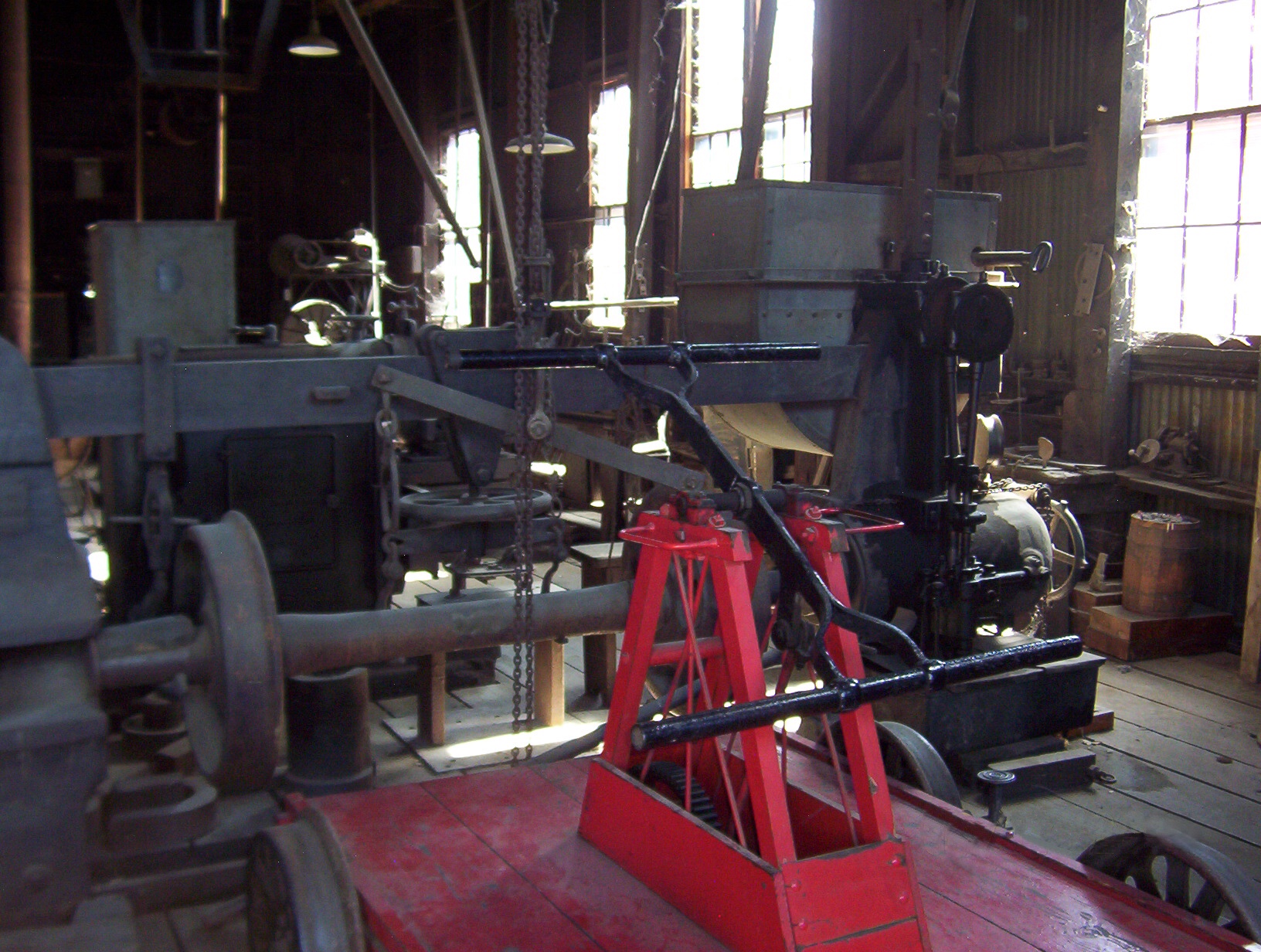
What sets Railtown apart from other railroad museums is that its shops never stopped working. The machine shop still smells of cutting oil and warm metal. Overhead, a flat-belt line shaft connects to shapers and engine lathes from the early 1900s - the same power transmission system that drove American industry before electric motors became standard. A hand car and wheel press sit in the foreground, tools from an era when mechanical advantage was measured in muscle and leverage. Volunteers help maintain the equipment and guide visitors through the roundhouse, explaining not just how trains worked but how the people who kept them running spent their days. The park is less a museum of objects than a museum of labor, preserving the rhythms and routines of a craft that most of the country forgot decades ago.
From the Air
Railtown 1897 State Historic Park is located at 37.951N, 120.418W in Jamestown, California, in the Sierra Nevada foothills. The roundhouse and rail yard are visible from the air, with tracks running through golden oak-covered hills. Best viewed at 2,000-4,000 feet AGL. Columbia Airport (O22) is approximately 5 nm east. Oakdale Airport (O27) lies about 20 nm west. The park sits along State Route 49 in the heart of Gold Country.