Railway Museum (Netherlands)
Maliebaan station closed to passengers in 1939, the way small terminus stations did everywhere in Europe - bypassed by faster lines, abandoned to weeds. For fifteen years it sat empty on the leafy eastern edge of Utrecht, an ornate brick building with platforms going nowhere. Then in 1954 the Dutch national railway moved its collection of historic trains into the place. Locomotives that had spent their working lives pulling away from stations now pulled into one, and stayed. The Spoorwegmuseum - the Railway Museum of the Netherlands - became one of the only major museums in the world that lives inside the very thing it celebrates.
From Filing Cabinet to Roundhouse
The museum was founded in 1927 inside the headquarters of the Nederlandse Spoorwegen, the Dutch national railway, and at first it was barely a museum at all - mostly photographs, documents, and timetables in glass cases. In the 1930s curators started preserving the locomotives themselves, but the timing was poor: the Second World War destroyed part of the collection. After the war, the surviving rolling stock briefly migrated to Amsterdam's Rijksmuseum before NS realized what it had on its hands - a collection that needed sheds, not galleries, and platforms, not pedestals. The closed Maliebaan station offered both. The transition from filing cabinet to roundhouse was complete by 1954.
Track One
For nearly half a century, the most distinctive sight inside the museum was simply this: a long row of steam locomotives lined up along Track One, the original platform of the working station, all coupled together like a single impossible train. There was De Arend, a replica of the 1839 locomotive that had pulled the first Dutch passenger service. There was NS 3737, one of the last steam engines in regular Dutch service. There was the CC50 number 22, an enormous machine built in 1928 for Indonesian Railways and nicknamed De Monster - the largest locomotive in the collection, with the workshop scars of a colonial career stamped into its boiler plates. They stood in their black livery, smelling faintly of cold iron and old oil, and you could walk between them.
The 2003 Reinvention
In September 2003 the museum closed for the most ambitious renovation of its history. The Victorian station building was gutted and restored to its 19th-century appearance - station hall, freight hall, dining room, third-class waiting room, first and second-class waiting room, and a Royal Waiting Room transplanted from a Hague station demolished in 1973. Behind the building, the entire back lot was cleared and replaced by a new exhibition hall divided into four 'worlds': The Great Discovery, set in the 19th century; Dream Travels, evoking the era of luxury international expresses around 1900; Steel Monsters, devoted to the 1930s and 1940s; and The Workshop, a vast train hall where visitors can climb onto the locomotives themselves. The museum reopened in 2005.
A Station That Works Again
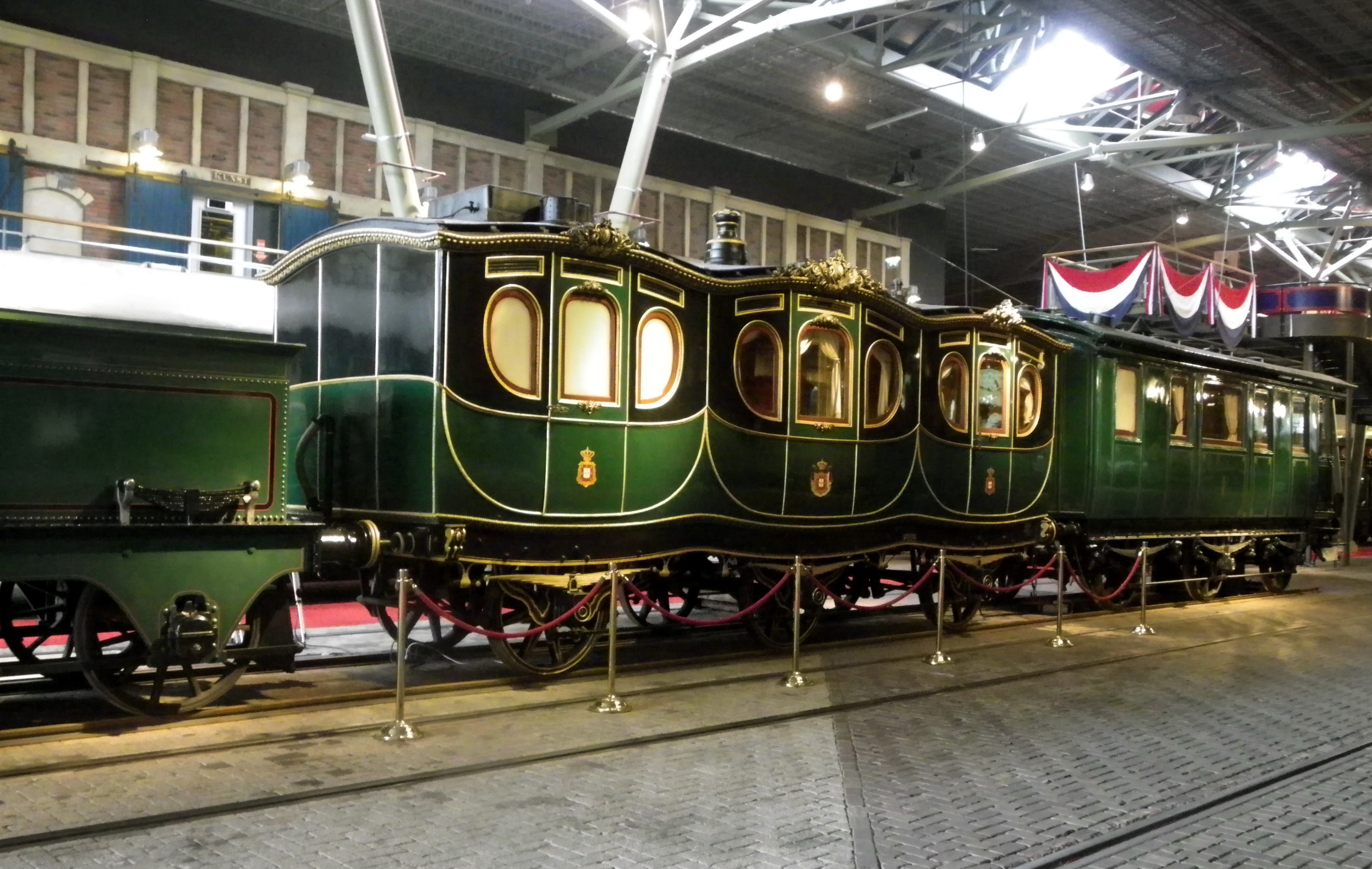
Maliebaan station did not just become a museum in 2005. It became, once again, a station. After 66 years of silence, regular train service was restored on the line between Utrecht Centraal and the museum, stopping at Utrecht Overvecht in between. On days the museum is open, an hourly service runs - real timetabled trains, not heritage rides - bringing visitors directly to the museum platform. You step off a modern Sprinter train and walk straight into the 19th-century station hall. In 2010, Queen Beatrix opened a special exhibition called Royal Class, Royal Railways, marking five years since the reopening with a display of the royal trains that had once carried her ancestors across the country.
The Collection
The rolling stock list reads like a national autobiography written in steel. Steam: NS 700 from 1864; NS 1000 number 89, called Nestor, from 1880; NS 3700 number 3737 from 1911; the WD Austerity from 1945, built for wartime urgency. Diesel: a chronology of post-war Dutch reconstruction, from the Class 200 of 1940 through the Class 600 of 1955. Electric: the Class 1500 Diana from 1954, the workhorses that strung the Dutch network together. Passenger cars: an Orient Express dining carriage from 1911, a CIWL sleeper from 1964, the early Arend wagons of 1839 that started the whole thing. Most of it has been restored; some of it still runs. Trams, freight cars, and a horse-drawn carriage from 1891 fill in the corners. It is the Dutch railway, parked permanently in the place it once departed from.
From the Air
Located in eastern Utrecht at 52.088 N, 5.132 E, on the historic Maliebaan rail corridor. The site is recognizable from altitude as a green pocket of museum grounds and rail yard amid the surrounding residential streets. Amsterdam Schiphol (EHAM) is roughly 35 km northwest; Rotterdam The Hague (EHRD) about 50 km southwest. The flat polder landscape east of the Randstad makes Utrecht's Dom Tower a useful visual reference - the railway museum lies just over a kilometer east-northeast of it.