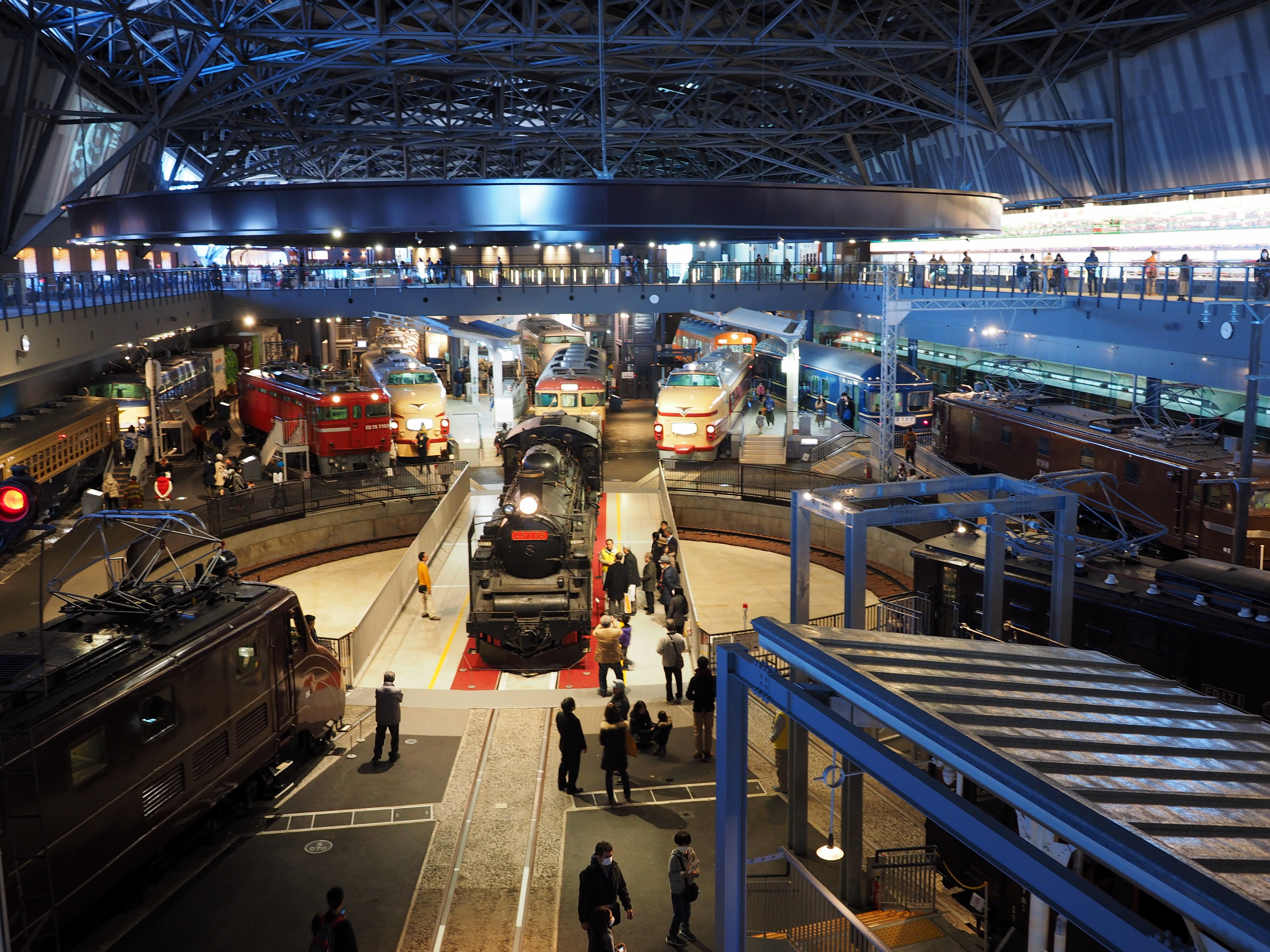
Railway Museum (Saitama)
A small green tank locomotive sits under careful lighting near the entrance, looking almost toy-like compared to the bullet trains parked nearby. This is Locomotive No. 1, a British-built 2-4-0T engine shipped to Japan in 1871, and in 1872 it hauled the country's first railway passengers between Tokyo and Yokohama. That one machine set in motion an obsession. Japan went from having zero rail infrastructure to operating the fastest trains on the planet within a single century, and the Railway Museum in Saitama tells that story with thirty-six full-size vehicles, driving simulators, and the kind of meticulous devotion to detail that only a nation of rail enthusiasts could produce.
From Locomotive No. 1 to the Shinkansen
The museum's collection reads like a timeline of Japanese ambition. Locomotive No. 1, designated a national Important Cultural Property in 1997, anchors the history zone, where it stands alongside Class 7100 No. 7101 Benkei, an American-style locomotive that once ran on Hokkaido's earliest railways. Nearby, Class C57 No. 135 holds a poignant distinction: it hauled the last scheduled steam service in Japan in 1975, marking the end of an era. But the collection does not dwell on nostalgia. The 0 Series Shinkansen car on display represents the 1964 revolution that gave the world the bullet train. The progression continues through the 200, 400, and E1 Series up to the E5 Series, the sleek green-and-white train that runs the Tohoku Shinkansen at speeds exceeding 320 kilometers per hour.
A Century Behind the Throttle
The Railway Museum is not content to let visitors merely look. Driving simulators put you in the cab of a D51 steam locomotive, an E5 Series Shinkansen, and trains on the Tokaido, Keihin Tohoku, and Yamanote lines -- the arteries of Tokyo's commuter network. The D51 simulator reproduces the physical experience of operating a steam engine, with actual valve controls and the thrum of simulated boiler pressure, and is reserved for junior high school students and older. The other simulators welcome younger visitors, and the 500-yen reservation fee does nothing to deter the long queues. Beyond the simulators, the learning zone uses actual train components -- bogies, couplings, pantographs -- to teach the physics of rail travel. The museum takes roughly two hours to walk through, though enthusiasts routinely double that.
A Long Journey to Omiya
The museum itself has a history worth telling. Its predecessor opened on October 14, 1921, beneath an elevated rail line near Tokyo Station, celebrating the fiftieth anniversary of Japanese railways. In 1936 it relocated into the former Manseibashi Station building, a handsome brick structure that had ceased passenger operations. Renamed the Transportation Museum in 1948, it expanded to cover automobiles, ships, and aircraft, but trains always dominated. By the early 2000s, the cramped Tokyo location could no longer house the growing collection. On May 14, 2006, the old museum closed its doors, and on October 14, 2007, the new Railway Museum opened in Saitama's Omiya ward, in a purpose-built 19,800-square-meter facility on a 42,500-square-meter site. In 2012, the museum formed a sister alliance with the National Railway Museum in York, England, linking two nations whose rail histories helped shape the modern world.
Imperial Carriages and Hidden Treasures
Among the museum's quieter exhibits are six imperial carriages, rarely discussed but deeply significant. Imperial Carriage No. 1 dates to the earliest years of Japanese rail, built for the Meiji Emperor's use, its lacquered wood and silk interiors reflecting a period when train travel was still a novelty reserved for the highest ranks of society. The museum also houses a Kotoku 5010 Kaitakushi passenger carriage from the Hokkaido colonization era and a Maite 39 luxury observation car that once served VIP routes. A Teppaku Reading Room, opened in 2012 in the remodeled north wing, offers access to railway literature and historical documents. A four-story south extension, added in 2018, expanded exhibit space further. One stop from Omiya Station on the New Shuttle people mover, the museum is accessible from anywhere in the Tokyo metropolitan rail network -- appropriately enough, by train.
From the Air
Located at 35.92N, 139.62E in Omiya ward, Saitama city, on the northern edge of the Tokyo metropolitan area. The museum sits adjacent to the rail yards and tracks radiating from Omiya Station, one of the largest rail junctions in the Kanto region -- the converging rail lines are clearly visible from altitude. Nearest major airports: Tokyo Haneda (RJTT, ~45 km south), Narita International (RJAA, ~65 km east). Honda Airport (RJT1), a small private airfield, lies about 20 km to the west. Recommended altitude 3,000-5,000 ft for views of the extensive rail infrastructure around Omiya.