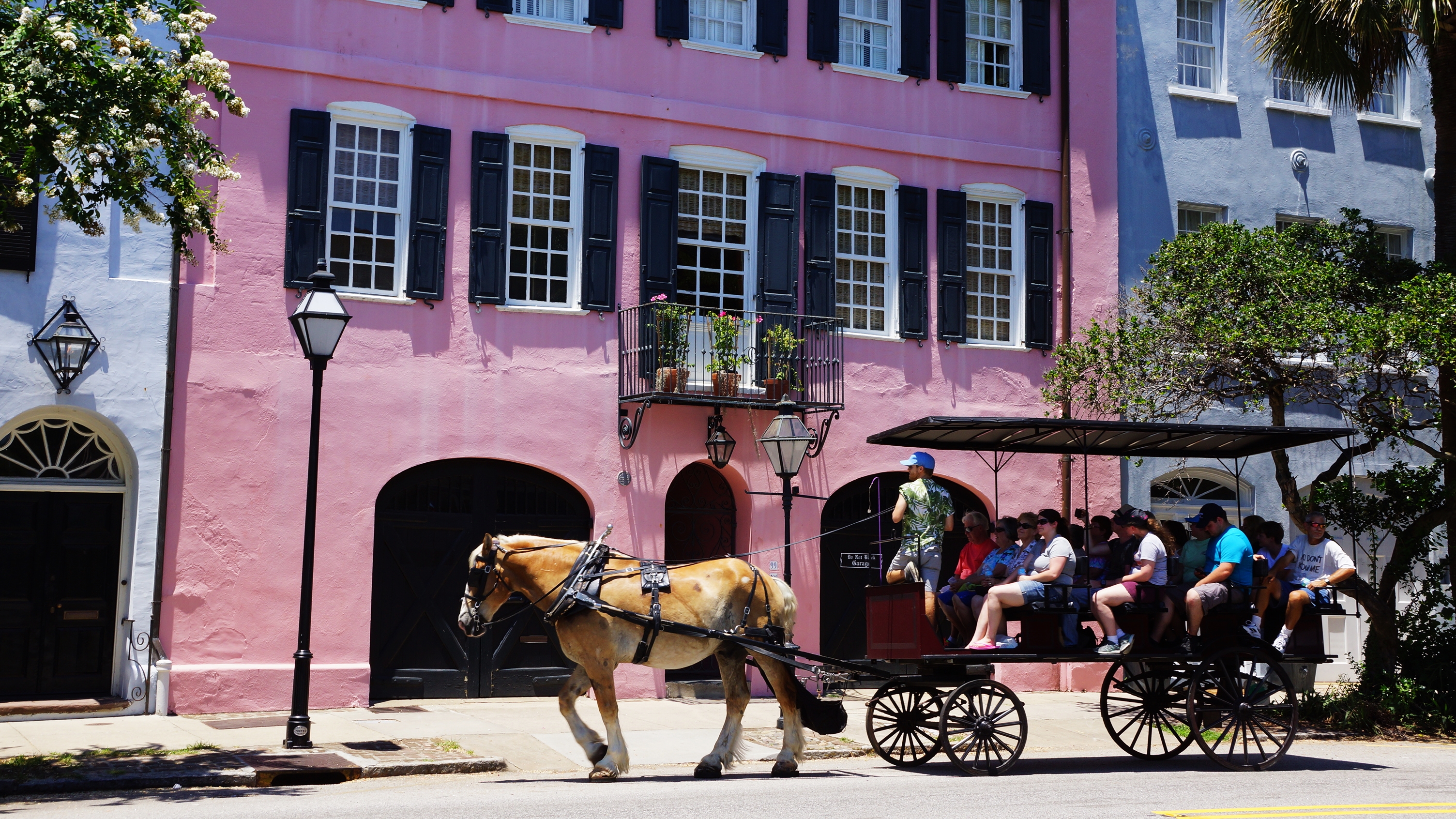
Rainbow Row
Dorothy Legge chose pink. It was 1931, the country was deep in the Depression, and the row of crumbling merchant houses along East Bay Street had been sliding toward ruin for decades. But Legge, who had purchased numbers 99 through 101, looked past the decay and saw colonial Caribbean charm. She painted her restored houses in bright pink, inspired by the tropical color traditions of the islands. Her neighbors noticed. One by one, through the 1930s and 1940s, other owners followed her lead, choosing their own pastel shades - butter yellow, mint green, powder blue, coral. By 1945, thirteen houses stretching from 79 to 107 East Bay Street had been transformed from a neglected stretch of waterfront into a candy-colored architectural gem. Someone started calling it Rainbow Row, and the name stuck.
Merchants on the Waterfront
These buildings were never designed to be pretty. When they were constructed in the mid-to-late 1700s, they stood directly on the Cooper River waterfront - the land between them and today's waterline was filled in later. They were working commercial buildings: stores on the ground floor, living quarters above. Most had no interior staircase connecting the two levels; owners climbed exterior stairs in their rear yards to reach their homes. The oldest surviving structure, 97 East Bay Street, dates to around 1741, built by merchant Othniel Beale as a brick store. Others followed through the colonial period - ship chandleries, trading houses, merchants' quarters. Then on a devastating night in 1778, fire swept through the neighborhood and destroyed most of the block. Only 95 to 101 East Bay Street survived. The rest were rebuilt in the years after, giving the row its current mix of pre- and post-fire Georgian architecture.
A Long Descent
After the Civil War, this stretch of Charleston's waterfront fell hard. The merchant class that had built and occupied Rainbow Row was gone, and the neighborhood devolved into near-slum conditions. The buildings deteriorated for decades. Then in the 1920s, Susan Pringle Frost entered the picture. Frost was Charleston's first female real estate agent, a suffragist, and - most importantly for these buildings - the founder of the Society for the Preservation of Old Dwellings, now the Preservation Society of Charleston. She bought six of the Rainbow Row buildings, though she lacked the money to restore them immediately. Her purchases held the line against demolition. Then came Dorothy Legge with her pink paint in 1931, and the restoration cascade began. The last holdout, 85 East Bay Street, a former ship chandlery with Chinese Chippendale interior details, was finally purchased and restored by Louise Graves in 1944.
Thirteen Shades of History
Each house carries its own story. Number 83, the William Stone House, was built around 1784 by a Tory merchant who had fled to England during the Revolution. Number 95 was once owned by Charles Cotesworth Pinckney, a signer of the U.S. Constitution and twice a presidential candidate. Number 103, the Joseph Dulles House, was built by an ancestor of John Foster Dulles, the future Secretary of State. Number 91 had Greek Revival details stripped away in the 1940s by its owner, New York playwright John McGowan, who preferred the original colonial look. And at the north end, number 107 contains a quirky origin story: when John Blake bought the lot in 1791, the neighboring house at 105 had been built eight inches over the property line onto his land. Blake accepted a deed for the errant wall and agreed to build a gutter between the two buildings.
Myths and the Actual Rainbow
Charleston loves its legends, and Rainbow Row has collected a few. One popular tale claims the houses were painted in different colors so drunken sailors stumbling in from the harbor could remember which building to bunk in. Another version says the colors date from the buildings' commercial days, when owners used distinct hues to direct illiterate enslaved people to the correct shop. Neither story holds up. The pastel rainbow is a twentieth-century creation, born from Dorothy Legge's Caribbean-inspired choice and the domino effect of restoration that followed. The practical truth is that the light colors also helped keep interiors cool in Charleston's sweltering summers. Today Rainbow Row is one of the most photographed streetscapes in America, drawing visitors who line up along East Bay Street to capture its cheerful facade. The houses remain private residences, their colors maintained by owners who understand they are stewards of Charleston's most recognizable landmark.
From the Air
Located at 32.78°N, 79.93°W on East Bay Street along the Cooper River waterfront in Charleston's historic district. From the air, Rainbow Row appears as a tight block of colorful rooftops between Tradd Street and Elliott Street on the eastern edge of the peninsula. The waterfront park and Cooper River are immediately to the east. Charleston Executive Airport (KJZI) is approximately 8 miles to the west, and Charleston International Airport (KCHS) is about 12 miles to the northwest. Fort Sumter is visible across the harbor to the south-southeast.