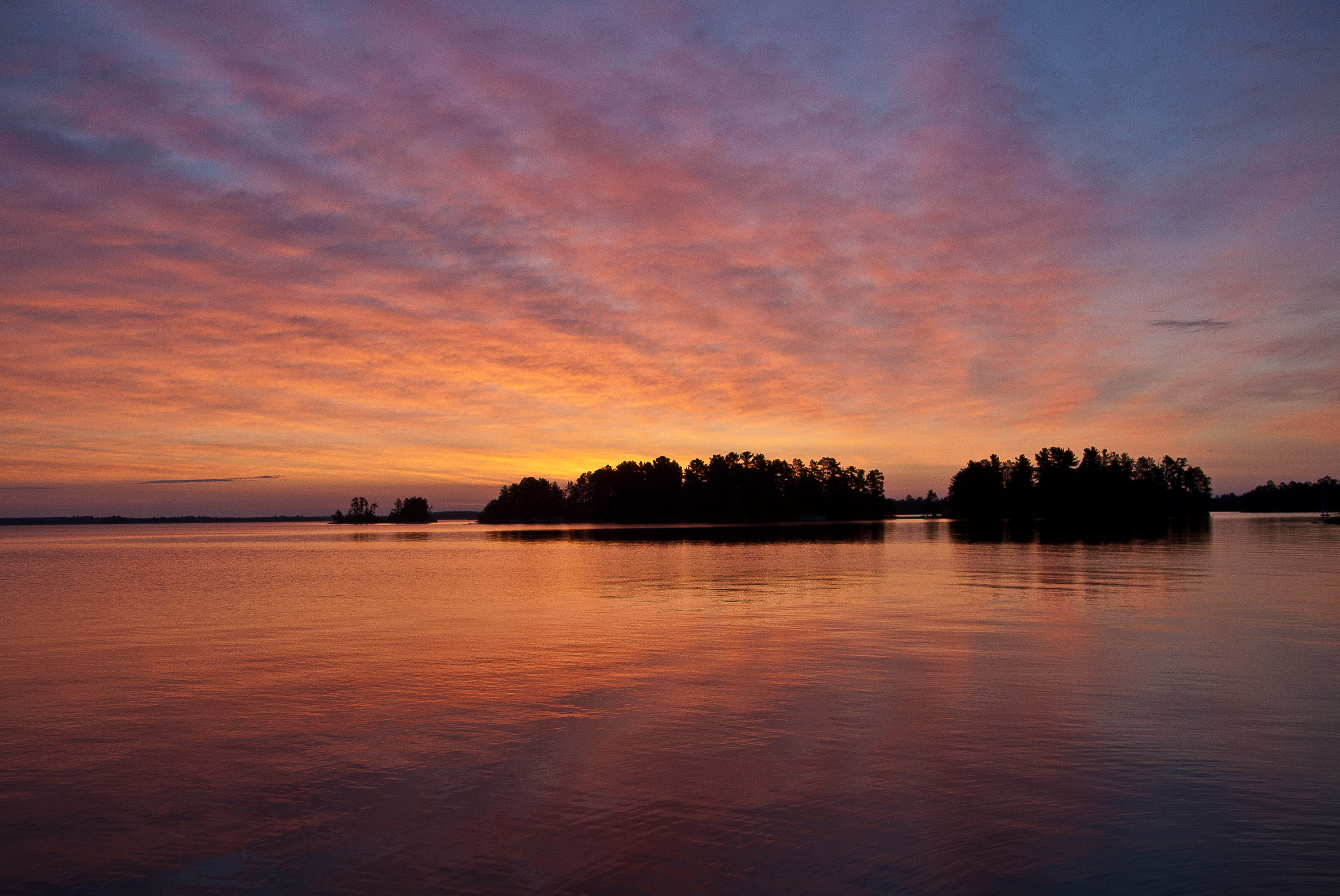
Rainy Lake
The Cree called it tahki-mana-kimiwan -- 'it always is raining' -- though the name actually described the mist rising from the river that drains its western end, not the lake itself. The earliest European cartographers spelled it half a dozen ways: Tekamamiwen on the Ochagach map around 1728, Lac Tacamamiouer on the 1739 de l'Isle map, Lake Tecamaniouen on the 1757 Mitchell Map. Each attempt captured a different ear's interpretation of indigenous syllables that had been in use for centuries before any French voyageur dipped a paddle into these waters. Rainy Lake sprawls across 360 square miles of the Minnesota-Ontario border, its 929 miles of shoreline fractured into hundreds of islands, bays, and inlets carved from some of the oldest exposed rock on Earth.
Bedrock Older Than Complex Life
The rock beneath Rainy Lake belongs to the Superior Craton of the Canadian Shield -- Precambrian stone so ancient it predates the evolution of multicellular organisms. Satellite images reveal the scars: a large caldera and fault lines slicing through the lake's irregular shape. The Rainy Lake-Seine River Fault zone runs from Tilson Bay in the southwest to Seine Bay in the northeast, a strike-slip fault that shifted whole blocks of crust sideways. The Quetico Fault cuts east to west through McDonald Inlet. Together, these fault systems create a triangular wrench zone separating granite-greenstone terrain to the north from metasedimentary terrain to the south. The glaciers came later, grinding and gouging this already fractured landscape into the labyrinth of waterways visible today. Islands emerge from the lake as bare knobs of polished stone, their surfaces recording billions of years of geological violence.
The Voyageurs' Highway
French trader Jacques de Noyon wintered at Rainy Lake in 1688, the first documented European presence here. By the 1730s, regular fur trade routes ran west from Lake Superior through these interconnected waterways. Pierre Gaultier de Varennes, sieur de La Verendrye, explored the region and recorded the indigenous names. The voyageurs -- French-Canadian paddlers who moved beaver pelts and trade goods in birchbark canoes -- established routes so thoroughly that when the American Revolution ended, diplomats used the voyageurs' customary waterway as the basis for the international boundary between the United States and Canada. The border still follows these water routes today. Voyageurs National Park, established on the lake's southeastern corner where it connects with Kabetogama and Namakan lakes at Kettle Falls, protects a 56-mile stretch of this historic corridor. The park maintains 46 boat-in camping sites on Rainy Lake alone.
Two Nations, One Lake
The international border does not simply cross Rainy Lake -- it winds through it, threading between islands and following channels that were ancient travel routes long before they became jurisdictional lines. This creates a distinctive governance situation. Canadian law applies to the Ontario side; American law governs the Minnesota side. Two coast guards maintain separate navigational aids. Boaters who wish to go ashore on the opposite side must clear customs, though special permits like the CANPASS Remote Area Border Crossing allow citizens to simplify the process. The water level itself is managed jointly, controlled by hydroelectric dams spanning the Rainy River between International Falls and Fort Frances, by water-control dams at Kettle Falls, and by the Sturgeon Falls Generating Station on the Seine River. The International Joint Commission, a binational body created by the Boundary Waters Treaty of 1909, oversees this shared stewardship through the International Rainy-Lake of the Woods Watershed Board.
Walleye Water and Winter Roads
Rainy Lake's fishery draws anglers from across North America. Walleye, northern pike, muskellunge, crappie, and both largemouth and smallmouth bass populate its waters. The annual Canadian Bass Championship has been held on the lake every summer since 1996. Hundreds of small islands on both the Canadian and American sides host fishing cabins, small resorts, and vacation homes, and guided fishing services form a significant sector of the local economy. In winter, the National Park Service maintains an ice road providing car access to areas otherwise reachable only by boat. The frozen lake becomes a different landscape entirely -- vast, white, and open to ice fishing, cross-country skiing, snowshoeing, and snowmobiling. Tim O'Brien set pivotal scenes of his novel The Things They Carried along the Rainy River, the lake's western outlet, where his narrator contemplates crossing into Canada to escape the Vietnam War draft.
From the Air
Located at 48.6536°N, 93.1064°W, Rainy Lake stretches approximately 60 miles along the Minnesota-Ontario border. The lake's 929 miles of shoreline and hundreds of islands make it unmistakable from altitude. Voyageurs National Park occupies the southeastern corner where Rainy Lake connects to Kabetogama and Namakan lakes at Kettle Falls. Falls International Airport (KINL) at International Falls is the nearest commercial airport, located at the lake's western outlet along the Rainy River. The international dam and bridge between International Falls and Fort Frances, Ontario are visible landmarks. The lake's complex shoreline and island-studded surface are best appreciated from 4,000-8,000 feet AGL. The Superior National Forest and Boundary Waters Canoe Area Wilderness extend to the east and southeast.