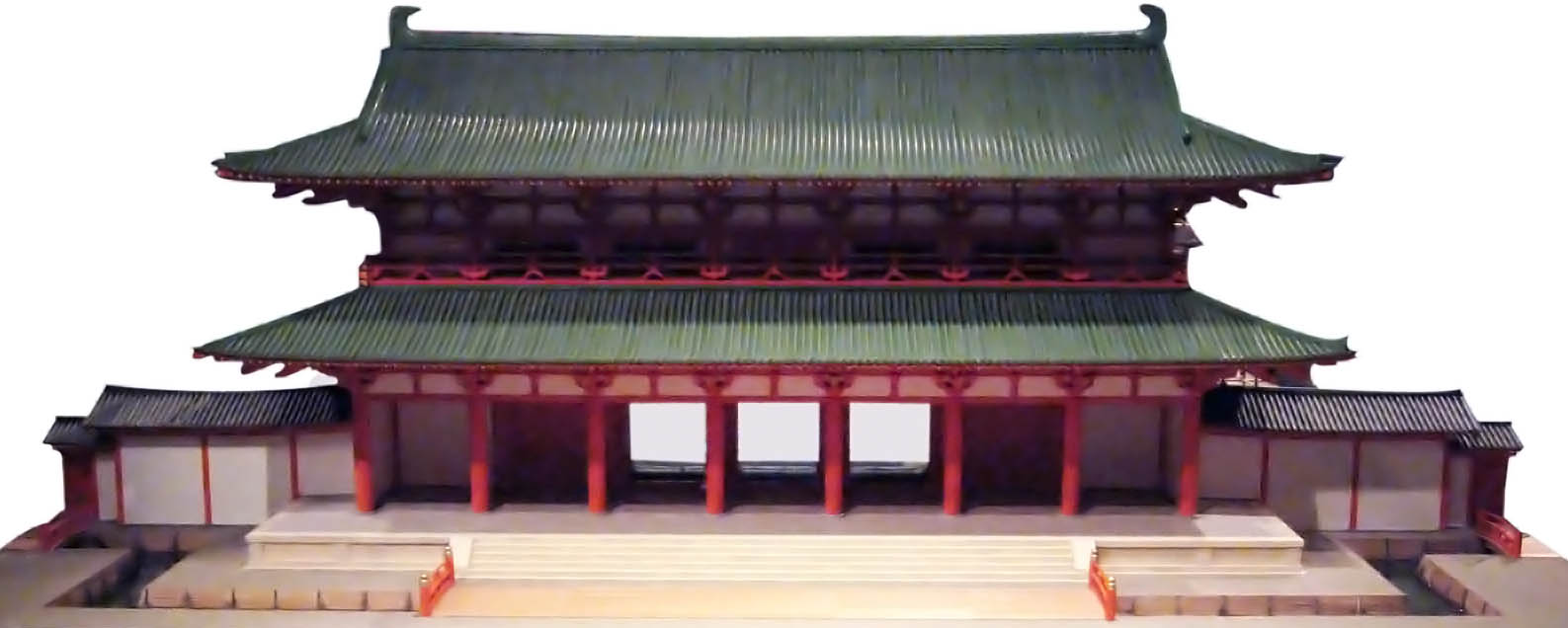
Rajomon
There is a small stone pillar behind a shop on Kujo street in southern Kyoto, next to a children's playground. Nothing about it commands attention. Yet this unassuming marker stands where one of Japan's most famous structures once towered -- the Rajomon, the great southern gate of the imperial capital. Built in 789, the gate was once roughly 32 meters wide, anchoring the far end of Suzaku Avenue, the monumental boulevard that ran straight north to the emperor's palace. Today not a single foundation stone remains, but the gate's afterlife in literature and film has made it one of the most recognized place names in Japanese culture.
The Gate Between Worlds
When Kyoto was laid out as Heian-kyo in 794, it followed the Chinese grid-pattern model of an ideal capital. Suzaku Avenue ran like a spine down the center of the city, stretching roughly four kilometers from the Suzakumon -- the main entrance to the imperial palace compound -- south to the Rajomon, the gate that marked the boundary between civilization and the world beyond. The gate was topped by a ridge-pole and flanked by stone walls, a structure designed to project imperial authority and define the edge of the ordered realm. At the northern end, the emperor. At the southern end, the gate through which travelers, merchants, and diplomats passed. Between them, the capital of Japan.
Ruin and Reputation
By the twelfth century, the gate had collapsed into ruin. What replaced grandeur was something darker. The crumbling structure became a shelter for thieves and outcasts. People abandoned corpses and unwanted infants at its base. The Rajomon became shorthand for lawlessness and moral decay -- a place where civilization's promises broke down. According to legend, the demon Ibaraki Doji haunted the ruins, a supernatural echo of the very real dangers lurking there. The gate's transformation from imperial symbol to den of thieves gave it a narrative power that pure architectural splendor never could have.
A Name That Traveled the World
In 1915, the young writer Ryunosuke Akutagawa set his short story at the ruined gate, using its decay as a deliberate metaphor for the collapse of moral certainty. A servant, newly dismissed and desperate, encounters an old woman stripping hair from corpses to sell as wigs. The story's bleak meditation on survival and ethics made the gate a literary landmark. Then in 1950, Akira Kurosawa used the gate as the framing device for his film Rashomon, which combined Akutagawa's gate setting with another of his stories. The film -- depicting the same crime told from contradictory perspectives -- won the Golden Lion at the Venice Film Festival in 1951 and introduced Japanese cinema to global audiences. It also gave the world the term 'the Rashomon effect,' now used across disciplines to describe situations where subjective accounts of the same event irreconcilably diverge.
What the Kanji Remember
Even the gate's name carries layers of history. The original characters are rajomon, where rajo means 'city wall' and mon means 'gate.' But the noh playwright Kanze Nobumitsu (1435–1516) used different kanji that could be read as Rashomon, and that alternate spelling stuck in the popular imagination. Akutagawa and Kurosawa both used this literary variant. The modern scholarly name reverts to Rajomon, using the original characters, but most of the world knows the gate by its theatrical alias. It is a fitting irony for a place whose greatest legacy is a story about how the same truth can be told in different ways.
The Sister Gate in Nara
Kyoto was not the only ancient capital with a Rajomon. The earlier capital of Heijo-kyo, present-day Nara, had its own version standing roughly four kilometers south of the imperial palace. Excavations between 1969 and 1972 uncovered foundation stones suggesting a gate approximately 41.5 meters wide. Some of those stones were repurposed in the sixteenth century by Toyotomi Hidenaga to expand his castle at Koriyama. The Nara gate is even more thoroughly vanished than Kyoto's -- no marker, no pillar, just archaeological records. But together, the two gates testify to a city-planning tradition imported from China that shaped Japanese urban life for centuries.
From the Air
Located at 34.979N, 135.743E in the Minami-ku ward of southern Kyoto, Japan. The site is near the intersection of Kujo street and Route 171, a short distance west of the distinctive five-story pagoda of To-ji temple, which serves as an excellent aerial landmark. Nearby airports include Kansai International Airport (RJBB, approximately 85 km south) and Osaka Itami Airport (RJOO, approximately 30 km southwest). Best viewed at low altitude (2,000-3,000 feet AGL) to appreciate the grid layout of central Kyoto and trace the line of the ancient Suzaku Avenue northward toward the former palace grounds.