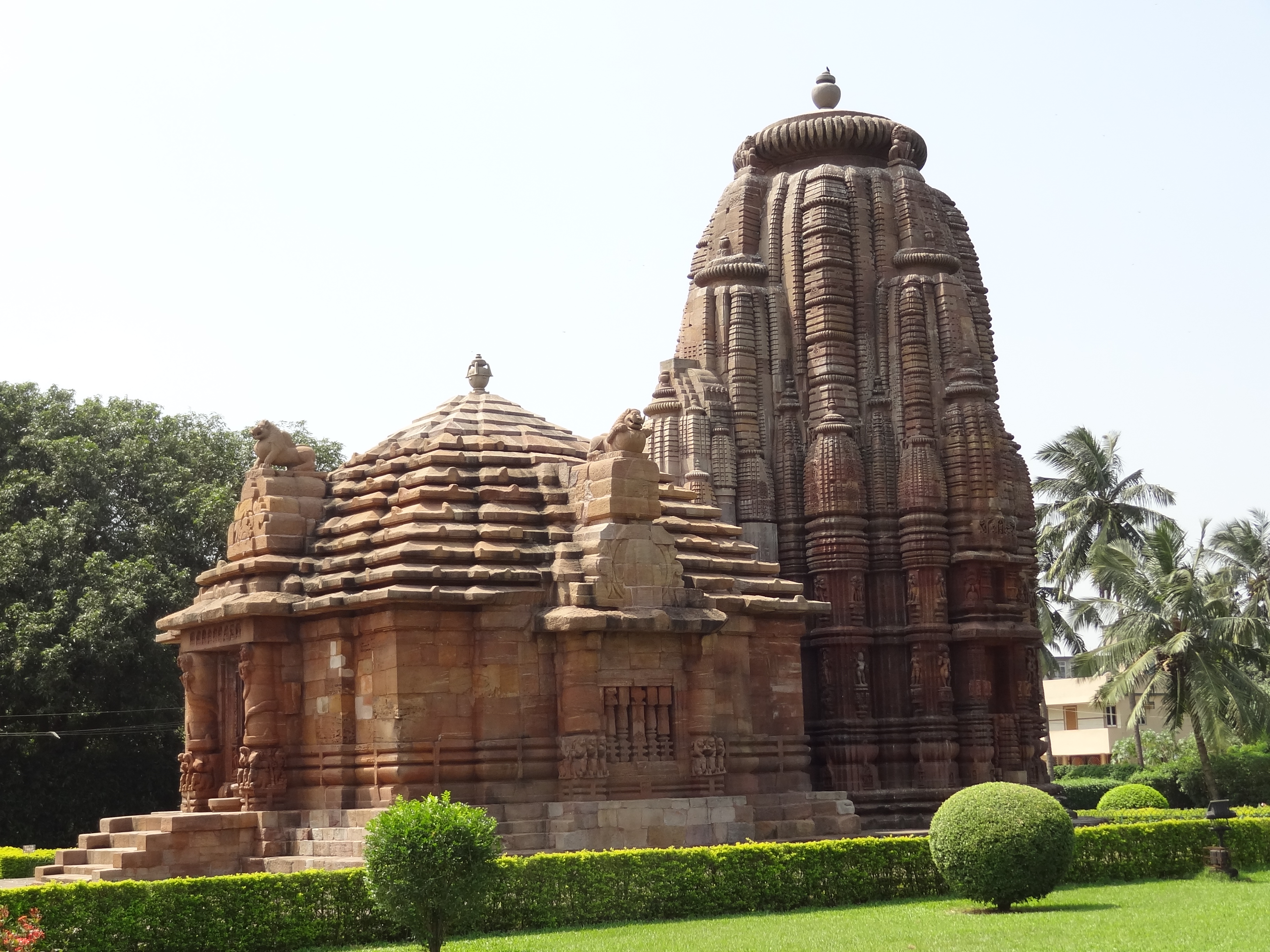
Rajarani Temple
The sandstone gives it away. Walk through the gardens surrounding Rajarani Temple in Bhubaneswar, and the structure announces itself in warm tones that shift with the light - dull red blending into honeyed yellow, the two colors so distinct that locals named them raja and rani, king and queen. The name stuck, though historians insist it has nothing to do with royalty. It has everything to do with the stone itself, quarried from deposits whose mineral makeup produces this peculiar two-toned warmth. Built in the mid-11th century CE, likely by rulers of the Somavamshi dynasty who migrated from central India to Odisha, Rajarani Temple stands in a city of a thousand temples and still manages to surprise. Its tower is unlike any other in Bhubaneswar. Its sculptures rank among the finest in eastern India. And its empty sanctum - no deity inside, no active worship - gives it the strange stillness of a masterpiece that has outlived its original purpose.
A Tower That Looks West
Bhubaneswar's temple skyline follows rules. Towers rise in the rekha deul style, their curved profiles built from stacked horizontal layers with clear vertical divisions. Rajarani Temple breaks the pattern. Its vimana soars 18 meters above a raised platform, surrounded by clusters of miniature towers with double crowning elements that give the whole structure a rounded, almost organic silhouette. The effect looks less like the other temples of Bhubaneswar and more like the famous towers of Khajuraho, 800 kilometers to the west in Madhya Pradesh. Scholars believe this resemblance is not coincidence. The Somavamshi rulers who likely commissioned Rajarani Temple had roots in central India, and they brought their architectural vocabulary with them. The tower's bada is divided into five sections rather than the usual three, adding visual complexity. An amalaka - a ribbed stone disk - crowns the summit. From the ground, the tower reads as a single ascending gesture, but up close it dissolves into dozens of smaller forms, each echoing the larger shape, a fractal logic carved in sandstone.
The Women on the Walls
Rajarani Temple is locally known as the "love temple," and the reason is carved across every surface of its exterior walls. Tall, slender nayikas - idealized female figures - grace the sanctum in poses that range from devotional to frankly sensual. One turns her head away from an emaciated ascetic, a gesture of disdain or perhaps compassion. Another fondles her child. A third holds a tree branch, a fourth gazes into a mirror, a fifth removes her anklet, a sixth caresses a pet bird, a seventh plays a musical instrument. Each figure wears diaphanous drapery that conceals nothing, and the sculptors rendered every detail of jewelry, coiffure, and expression with extraordinary precision. Between these figures, mithuna couples embrace in high relief on the projecting portions of the temple walls. The erotic carvings are explicit but never crude, integrated into a broader decorative program that includes vyala figures, elephants, and scrollwork of lush foliage and creeping vines. The best-preserved sculptures are the eight dikpalas - guardians of the cardinal and intermediate directions - standing on the central facades, their bodies and ornaments rendered with a refinement that places Rajarani among the finest achievements of Odishan sculpture.
A Temple Without a God
Step inside the jagamohana, the viewing hall with its pyramidal roof, and you pass through doorjambs flanked by Shaiva doorkeepers and a lintel bearing Lakulisa figures, above which runs an architrave of the nine planets. The Naga and Nagini figures at the entrance once gave rise to the folk belief that the temple was named for a literal king and queen, though historians dismiss this. Continue into the sanctum and you find - nothing. No Shiva lingam, no deity image, no sign of active worship. The absence is striking in a city where temples buzz with daily ritual. Scholars classify Rajarani as broadly Shaivite based on its iconographic program, but the empty interior leaves the question open. Was the deity removed? Was the temple never consecrated? The silence inside contrasts powerfully with the exuberance outside, as though the builders poured all their devotion into the walls and left the center for something beyond representation.
Where Music Fills the Courtyard
Since 2003, Rajarani Temple has hosted an annual music festival organized with the help of the Bhubaneswar Music Circle. For three days, musicians from across India perform in the temple grounds, and the programming reflects an unusual ambition: all three traditions of Indian classical music - Hindustani from the north, Carnatic from the south, and Odissi, the classical music tradition indigenous to Odisha - receive equal prominence. The setting is deliberate. Rajarani Temple stands apart from Bhubaneswar's living religious sites, its empty sanctum and garden enclosure making it a natural concert venue. Evening performances unfold against the floodlit tower, the carved nayikas watching from above as ragas float through air that still carries the warmth of the day's sun on sandstone. The festival is a modest affair by national standards, but it honors a real connection: many of the temple's carved figures depict musicians and dancers, their stone instruments frozen mid-note for a thousand years, finally answered by the living sound below.
From the Air
Located at 20.238°N, 85.834°E in Bhubaneswar, the capital of Odisha. The temple sits in a garden compound east of the city center, distinct from the main temple cluster around Lingaraja Temple. Biju Patnaik International Airport (VEBS) is approximately 5 km to the southwest. From altitude, Bhubaneswar's old town is identifiable by its dense cluster of temple towers - Rajarani Temple stands slightly apart to the northeast. Best viewed at lower altitudes where the warm sandstone tones contrast with surrounding greenery. The Mahanadi River delta is visible to the north, and the coastline near Puri lies about 60 km to the south-southeast.