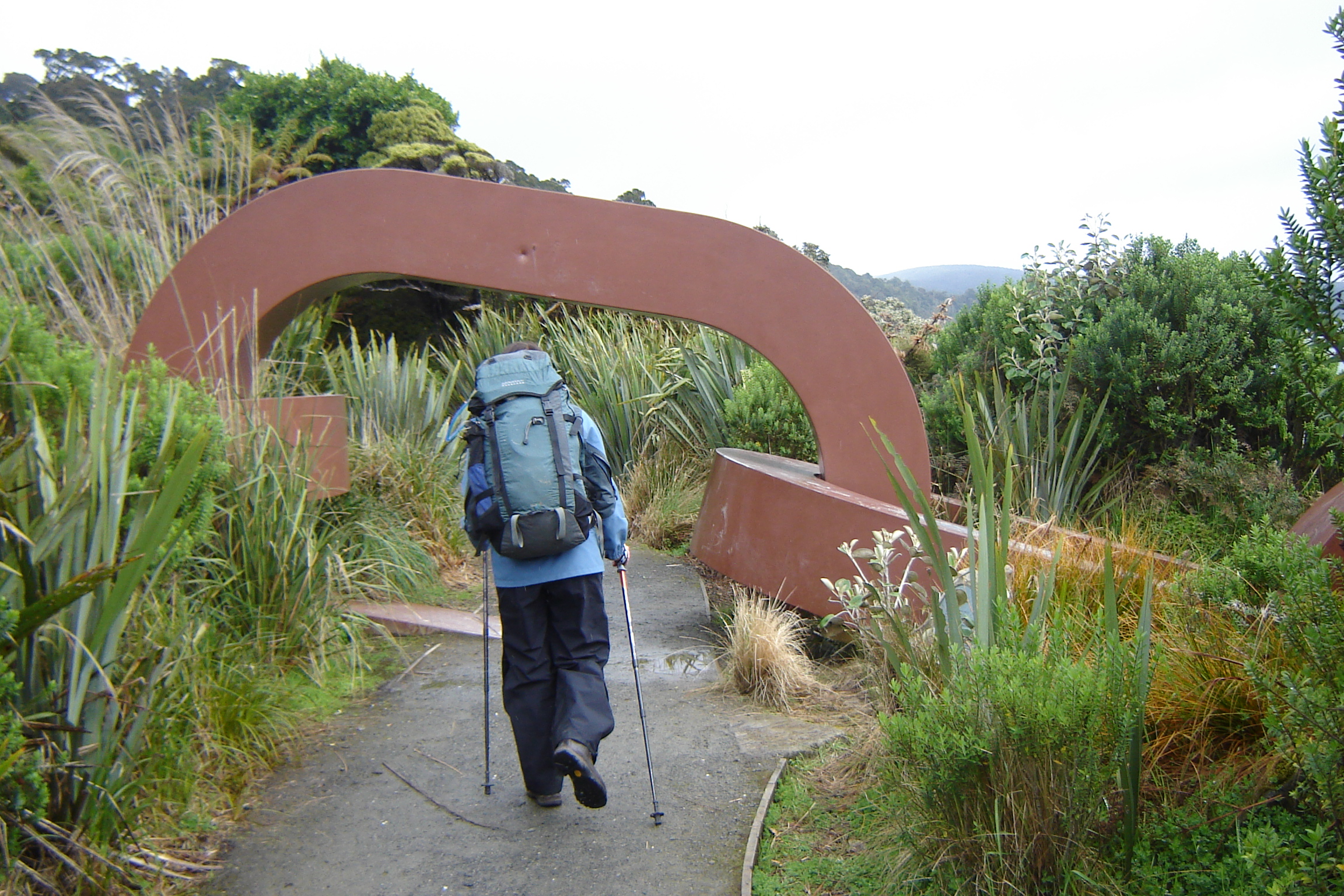
Rakiura National Park
On 9 March 2002, three people gathered at the edge of the New Zealand bush to open a national park: Prime Minister Helen Clark, Conservation Minister Sandra Lee, and Sir Edmund Hillary, the man who had climbed Everest half a century earlier. The park they inaugurated was the country's fourteenth, its newest, and its most remote - Rakiura, covering 85% of Stewart Island, 1,400 square kilometers of granite, rainforest, and coastline where the nearest traffic light is an hour's ferry ride and a three-hour drive away.
The Anchor's Reach
A chain sculpture stands at the park entrance, designed by Southland sculptor Russell Beck. It represents the Maori mythology of this place: the South Island was the canoe of the demigod Maui, and Rakiura was its anchor - Te Punga o Te Waka a Maui. The sculpture was unveiled at the park's opening, a physical marker where legend meets conservation law.
The park itself stitches together a patchwork of former nature reserves, scenic reserves, and state forest areas into a single protected entity. It excludes the small township of Oban and its roads, along with private and Maori-owned land, but everything else belongs to the park. From dense lowland forest to windswept coastline, from deep fiord-like inlets to the wild western beaches, the landscape shifts constantly across a terrain built on some of the oldest granite in New Zealand.
Ghosts in the Tin Range
In the 1970s, when the kakapo was believed nearly extinct, a population was discovered in the Tin Range on the island's southwest coast. The discovery electrified conservation biology. Kakapo are the world's heaviest parrots - flightless, nocturnal, and so endangered that every individual has a name and a tracking device. The Tin Range birds were eventually transferred to nearby Codfish Island, a predator-free refuge outside the park boundary, where intensive management has slowly pulled the species back from the edge.
The kakapo were not the only surprise hiding in Rakiura's forests. An estimated 15,000 southern brown kiwi - the tokoeka, the largest kiwi species - roam the park, thriving in the absence of stoats and ferrets. Yellow-eyed penguins breed along certain coastal stretches. South Island kaka patrol the forest edges near Oban. Weka, those curious flightless birds with a reputation for stealing anything shiny, inhabit the offshore islands within the park boundary.
Three Tracks, Three Worlds
The Rakiura Track offers the gentlest introduction: 32 kilometers through lowland kamahi, totara, and rimu forest, past Port William and along the north arm of Paterson Inlet. Most walkers complete it in three days. Kiwi are regularly heard - and sometimes seen - near the huts after dark.
The Northwest Circuit is another matter entirely. At 125 kilometers, it takes eight to ten days and follows the coastline through a series of isolated sandy beaches before crossing the Freshwater Depression to reach Paterson Inlet. Ten huts punctuate the route, spaced five to seven hours apart. Then there is the Southern Circuit, a challenging nine-day, 70-kilometer route that after rain involves long stretches through mud and standing water. Its Doughboy Bay Hut holds a distinction: it is the southernmost hut in the Department of Conservation's entire network.
The Weight of Remoteness
Rakiura's remoteness is both its protection and its challenge. Eighty-five percent of an island that is itself a ferry ride and a strait crossing from the nearest city - that is a formidable buffer against the pressures that have degraded ecosystems elsewhere in New Zealand. No stoats or ferrets have established here. The rat eradication on nearby Ulva Island has allowed forest health to recover so dramatically that orchid species once difficult to find are now abundant.
But remoteness also means that few people experience the park at all. The Northwest Circuit sees only a handful of trampers each week in peak season. The Southern Circuit sees fewer still. Plastic debris washes onto the western beaches from the Southern Ocean, a reminder that isolation does not mean insulation. The park endures because of its distance from people, but it needs people to know it exists, to value what the distance protects.
From the Air
Located at 46.98S, 167.81E, Rakiura National Park covers most of Stewart Island, visible as a large forested landmass south of the South Island across Foveaux Strait. The park boundary excludes the small cleared area around Oban/Halfmoon Bay on the east coast. Ryan's Creek Aerodrome (NZRC) serves the island. From altitude, the dominant features are the dense native bush cover, the deeply indented coastline, Paterson Inlet bisecting the island, and Mason Bay's long western beach. Codfish Island lies to the northwest. Approach from the north offers views across Foveaux Strait; the western approaches show the exposed, uninhabited coastline. Maritime weather dominates - expect low cloud, rain, and strong westerly winds.