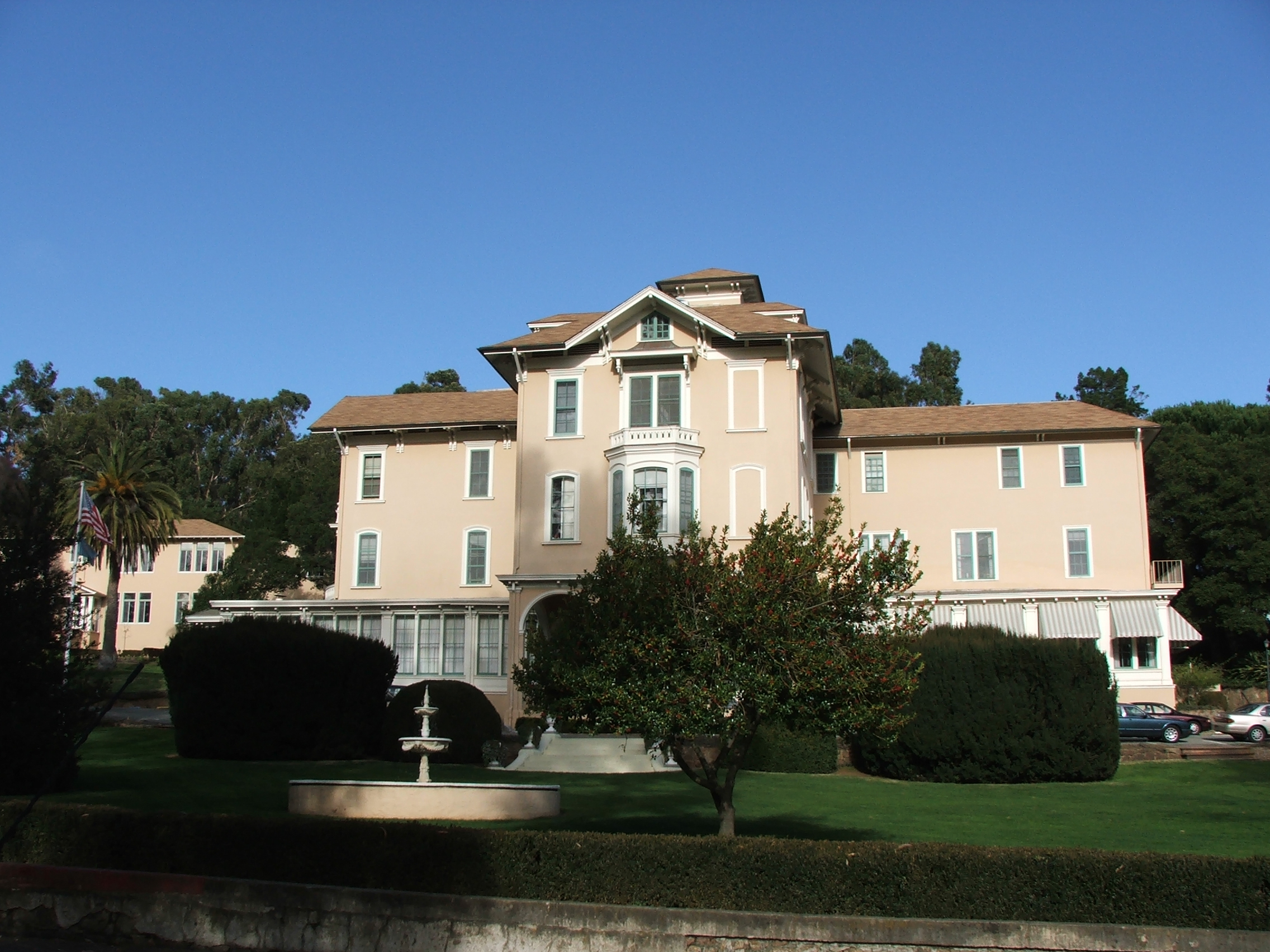
Ralston Hall
William Chapman Ralston made his fortune financing the Comstock Lode, the massive silver deposit beneath Virginia City, Nevada, that briefly made San Francisco the financial capital of the American West. With that money, he co-founded the Bank of California and built himself a country house in Belmont that was as extravagant as the era demanded. Ralston Hall still stands, an opulent Italianate villa with touches of Steamboat Gothic and Victorian ornamentation, a monument to the unbridled ambition of California's silver age.
Silver and Steamboats
The mansion's architecture tells you everything about Ralston's aspirations. The main structure follows the lines of an Italian villa, but the decorative flourishes draw from Steamboat Gothic, a style associated with the ornate paddle-wheelers that once moved people and goods along America's rivers. Victorian details layer over both influences. The result is a house that refuses to be categorized, much like the man who built it. Ralston was a San Francisco businessman who operated on a scale that made him one of the most powerful men in the state, financing not only mining operations but also hotels, theaters, and civic improvements. His country house in Belmont was where he entertained the powerful and displayed the wealth that the Comstock Lode had made possible.
From Mansion to Sanitarium
After Ralston's death, the mansion's story took a darker turn. The building was converted into a sanitarium, one of several grand homes on the San Francisco Peninsula that found second lives as medical facilities in the early twentieth century. The sanitarium operated under the direction of a Dr. Gardner until his death in 1913, after which the institution declined in popularity. It finally closed after World War I in 1922. The building's conversion from private luxury to institutional care was a common trajectory for California's gilded-age estates, as the families that built them moved on and the houses proved too large and expensive for any single household to maintain.
The Sisters and the Students
In 1922, the Sisters of Notre Dame de Namur purchased the former sanitarium as a home for their college. The mansion has since served as the centerpiece of what became Notre Dame de Namur University. In 1966, Ralston Hall was designated a National Historic Landmark, and in 1972, it received additional recognition as a California registered Historic Landmark. The building stands today as one of the finest surviving examples of nineteenth-century domestic architecture on the Peninsula, its ornate facades maintained by an institution that found in Ralston's excess a suitable setting for education. That a mansion built on speculative silver wealth should end up as a Catholic university campus is one of those narrative arcs that fiction would reject as too neat.
From the Air
Located at 37.52°N, 122.29°W in Belmont, on the campus of Notre Dame de Namur University. San Carlos Airport (KSQL) is approximately 2 miles east. The mansion's Italianate roofline and grounds may be visible from low altitude amid the surrounding campus buildings and residential areas. Crystal Springs Reservoir is a prominent landmark to the west.