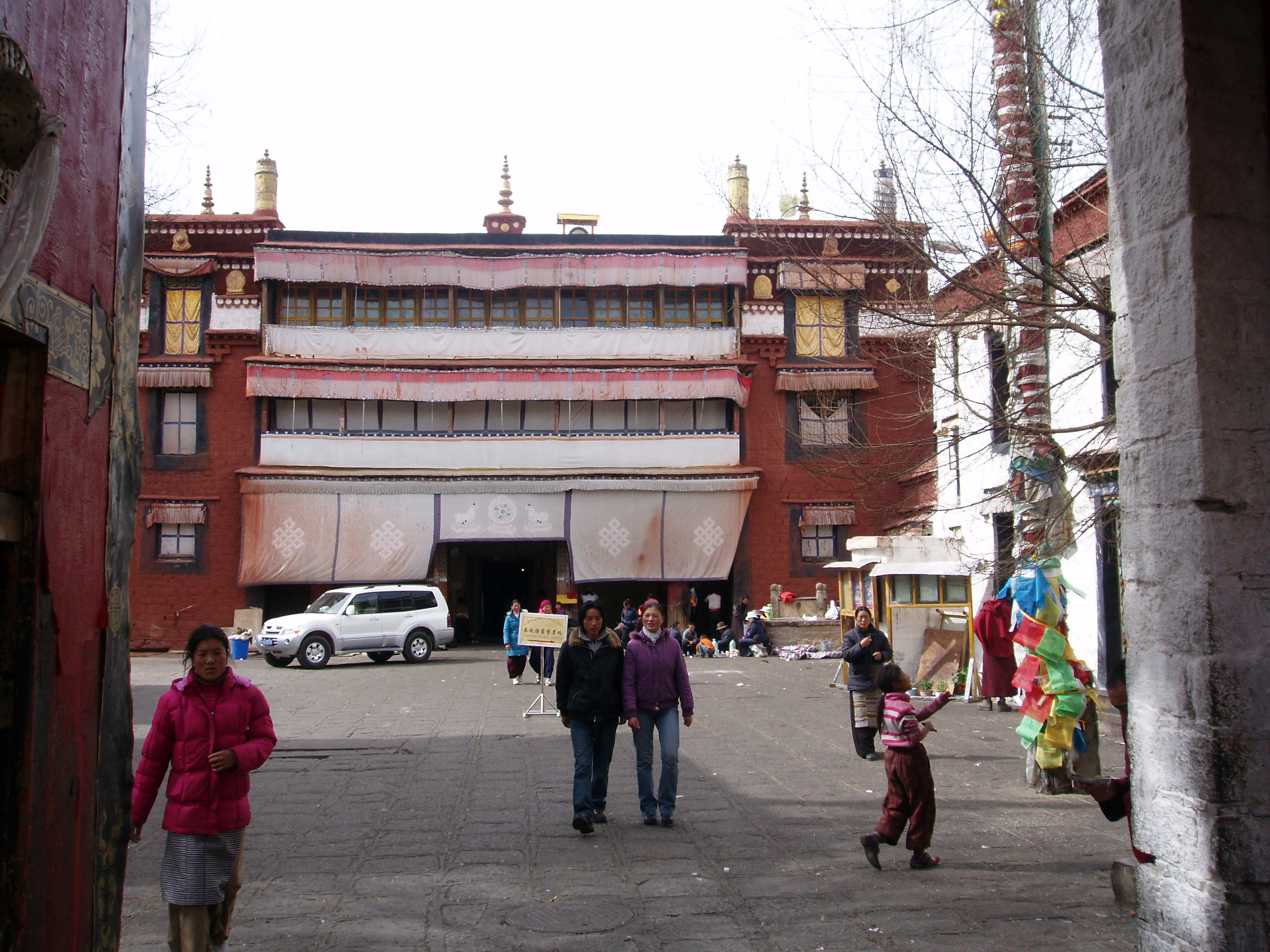
Ramoche Temple
In 1983, someone found the lower half of a bronze Buddha in a Lhasa rubbish tip. The upper half turned up in Beijing. When the two pieces were joined and returned to Ramoche Temple, they completed a journey that had begun thirteen centuries earlier - a journey involving two princesses, a hidden chamber, Mongol invaders, Red Guards, and a fire that gutted one of Tibet's oldest sacred buildings. Ramoche is Lhasa's second most important temple, after the Jokhang. It has always lived in the Jokhang's shadow, and the story of the statue explains why.
Two Princesses, Two Statues
Ramoche was built in the 7th century as a sister temple to the Jokhang, completed around the same time. Tradition holds that it was constructed to house the Jowo Rinpoche, a revered statue brought to Lhasa by Princess Wencheng of the Tang dynasty, carried from China in a wooden cart via Lhagang. Unlike the Jokhang, Ramoche was originally built in Chinese style - a reflection of the princess who sponsored it. But the statue did not stay. During the reign of Mangsong Mangtsen (649-676), fear that Tang China might invade led Princess Wencheng to have the Jowo Rinpoche hidden in a secret chamber within the Jokhang. After 710 CE, Princess Jincheng moved it permanently to the Jokhang's central chapel. In its place at Ramoche, a different statue was installed: the Jowo Mikyo Dorje, a small bronze of the Buddha as an eight-year-old boy, said to have been crafted by the divine artisan Vishvakarman and brought to Lhasa by Bhrikuti, the Nepalese queen.
Fire, Mongols, and the Upper Tantric College
Ramoche's original structure did not survive. Mongol invasions badly damaged the temple, and whether the statue that remained by the modern era was the original Jowo Mikyo Dorje is a matter of scholarly uncertainty. The temple itself was destroyed by fire, and the present three-story building dates to 1474. Shortly after its reconstruction, Ramoche became the Assembly Hall of the Gyuto Tratsang, the Upper Tantric College of Lhasa, and housed approximately 500 monks. The college maintained close ties with Yerpa, a monastery outside the city that provided summer quarters for the monks. For centuries, Ramoche served this dual role: a temple of deep historical significance and a working institution of tantric Buddhist education. The site occupies roughly 4,000 square meters - almost one acre - in the northwestern part of Lhasa, east of the Potala and north of the Jokhang.
The Rubbish Tip and the Reunion
In 1959, the temple was gutted by fire during the Lhasa uprising against Chinese occupation. The bronze Jowo Mikyo Dorje statue disappeared. Red Guards during the Cultural Revolution inflicted further damage, part of a systematic campaign that dismantled religious institutions across Tibet. For nearly a quarter century, the statue was presumed lost. Then in 1983, the lower portion surfaced at a refuse site in Lhasa, and the upper half was located in Beijing. Through the efforts of Ri'bur Sprul Sku, the pieces were reunited and placed back in Ramoche, which was partially restored in 1986. The restoration was incomplete - much of the temple's original artistry is gone forever - but the return of the statue, even in two broken halves, gave Ramoche back its reason for being.
The Sister Who Endures
Ramoche has always been defined by its relationship to the Jokhang. It was built at the same time, for the same purpose, by the same royal household. Its original statue was transferred to the Jokhang and replaced by the Jokhang's. Even today, pilgrims who visit one typically visit the other. But Ramoche carries something the Jokhang does not: a story of loss so total that recovery seemed impossible, followed by recovery so improbable it feels like a parable. A statue broken in half, scattered across a continent, pulled from refuse, and returned to the altar it was made for. The temple sits quietly in Lhasa's northwestern quarter, smaller and less visited than its famous sister, holding a bronze Buddha whose journey may be the most remarkable of any sacred object in Tibet.
From the Air
Ramoche Temple is located at 29.659N, 91.131E in the northwestern part of central Lhasa at approximately 3,650m elevation. It sits east of the Potala Palace and north of the Jokhang Temple. The site covers about 4,000 square meters and is identifiable as a traditional temple structure within Lhasa's old city grid. Lhasa Gonggar Airport (ZULS) is approximately 60km to the southwest. Expect high-altitude conditions and variable mountain weather.